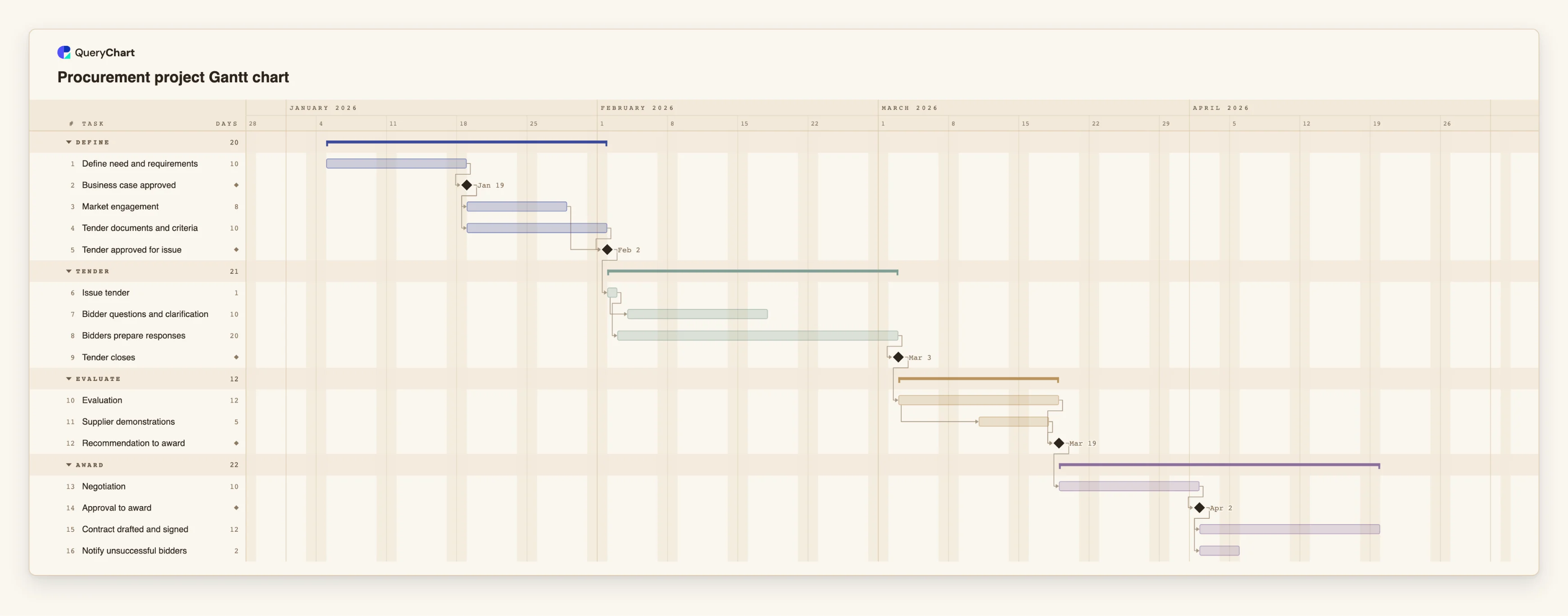
Procurement project Gantt chart template: need to contract
An editable procurement project Gantt chart: requirements, market engagement, tender, evaluation, negotiation, award and contract, with dependencies and milestones. Change a duration and the dates follow.
What the procurement project gantt chart template: need to contract process is
A competitive procurement is a project with long, fixed waits. Bidders need time to respond, and cutting it short is the quickest way to get fewer or worse bids. Evaluation needs the criteria agreed before the bids arrive. Negotiation and approval take as long as they take. A Gantt chart makes those constraints visible to the people asking when the new supplier will be in place.
This template has four phases: Define, Tender, Evaluate and Award. The business case is the first milestone, and both the market engagement and the tender documents follow it. The tender cannot be issued until the documents and criteria are done and the tender is approved for issue. After issue, clarification and response preparation run together, and clarification starts two days in. Demonstrations start partway through evaluation.
Several of these steps have a rule-bound timing in public or regulated procurement, for example minimum response periods. Those depend on your organisation's policy and on the applicable law, so set the durations from them and do not rely on the examples here. The plan is for a single tender and does not track spend.
For the decisions in each stage, see the procurement tender process at /templates/procurement-tender-process and the procurement process at /templates/procurement-process.
What this flowchart covers
In this template
- Four phases, Define, Tender, Evaluate and Award, with 16 tasks and six milestones: "Business case approved", "Tender approved for issue", "Tender closes", "Recommendation to award", "Approval to award" and the award notices that follow.
- Preparation in parallel: "Market engagement" and "Tender documents and criteria" both follow "Business case approved" and meet at "Tender approved for issue".
- A bidding period with overlapping activity: "Bidder questions and clarification" starts two days into "Issue tender" and "Bidders prepare responses" runs for twenty days.
- Evaluation with demonstrations: "Supplier demonstrations" start six days into "Evaluation".
- A clear route to contract: "Negotiation", "Approval to award", "Contract drafted and signed" and "Notify unsuccessful bidders".
When to use this template
- A business unit asks when a new supplier can be in place.
- You are planning a tender and need to agree the timetable with bidders and stakeholders.
- Approval or evaluation took longer than planned and you need to see the effect on the contract date.
- You want a standard tender timetable to adapt.
The plan, task by task
Every task in the chart with its length in working days and what it waits for. A dependency is a step number; SS is start-to-start, FF is finish-to-finish, and +n is a lag in working days.
| # | Task | Group | Working days | Depends on |
|---|---|---|---|---|
| 1 | Define need and requirements | Define | 10 | |
| 2 | Business case approved | Define | Milestone | 1 |
| 3 | Market engagement | Define | 8 | 2 |
| 4 | Tender documents and criteria | Define | 10 | 2 |
| 5 | Tender approved for issue | Define | Milestone | 3, 4 |
| 6 | Issue tender | Tender | 1 | 5 |
| 7 | Bidder questions and clarification | Tender | 10 | 6SS+2 |
| 8 | Bidders prepare responses | Tender | 20 | 6 |
| 9 | Tender closes | Tender | Milestone | 8 |
| 10 | Evaluation | Evaluate | 12 | 9 |
| 11 | Supplier demonstrations | Evaluate | 5 | 10SS+6 |
| 12 | Recommendation to award | Evaluate | Milestone | 10, 11 |
| 13 | Negotiation | Award | 10 | 12 |
| 14 | Approval to award | Award | Milestone | 13 |
| 15 | Contract drafted and signed | Award | 12 | 14 |
| 16 | Notify unsuccessful bidders | Award | 2 | 14 |
How it works
Set the durations from policy and law
Use your procurement policy and any applicable rules for minimum periods. Do not shorten the bidders' time.
Write the criteria before issue
Keep them in the tender documents task so they are fixed before bids arrive.
Gate the issue
Keep "Tender approved for issue" as a milestone with a named approver.
Overlap clarification with response time
Start clarification shortly after issue, and keep it open for most of the bidding period.
Plan evaluation as a task with a team
Give it a duration based on the number of bids and evaluators.
Include the notices and the contract
Notifying unsuccessful bidders and drafting the contract are part of the schedule.
Frequently asked questions
How do I plan a tender timetable?
List the stages from need to contract, give each task a length in working days and link it to what it depends on. This template does that for a competitive tender.
How long should bidders have to respond?
It depends on the size and complexity of the tender and, in public procurement, on the applicable rules. Set the duration from your policy and rules.
Does it track costs or savings?
No. It is a schedule. Cost and savings tracking belong in a separate process.
Can I use it for a small purchase?
Yes, with shorter durations. Many small purchases need only a subset of the tasks.