Procurement process flowchart
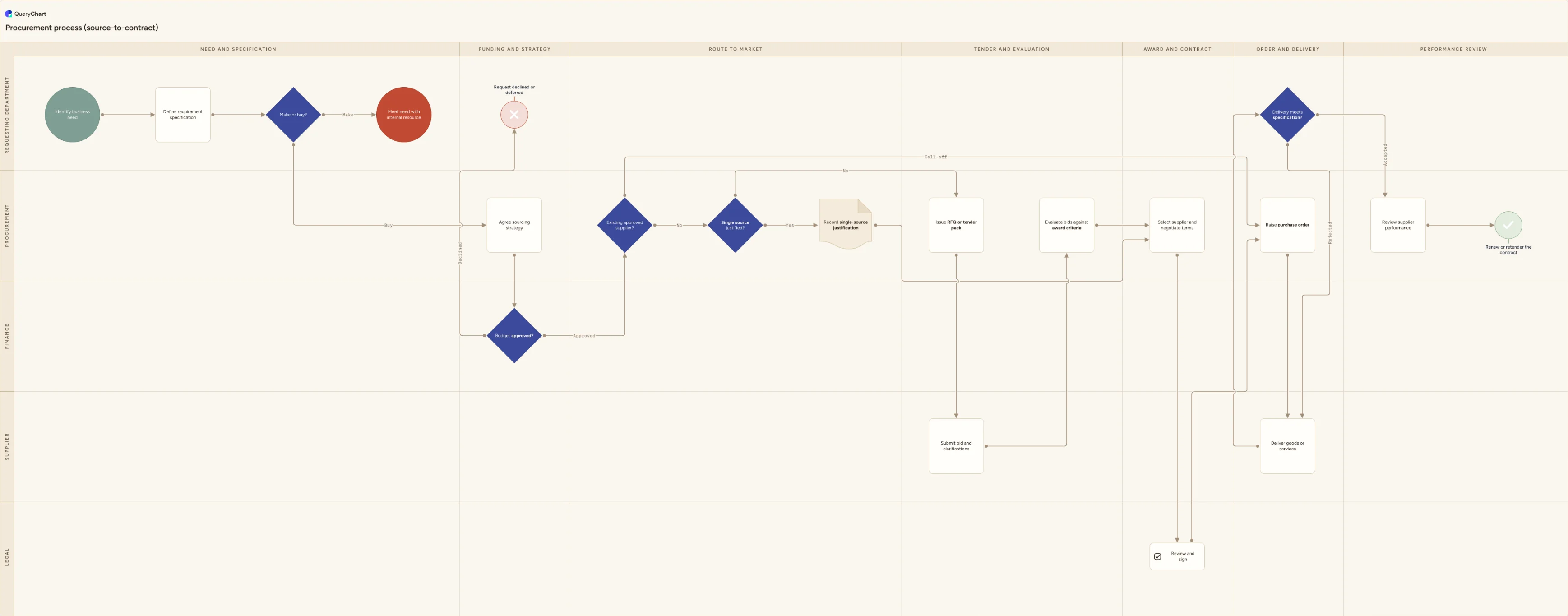
End-to-end procurement process flowchart: need and specification, make or buy, budget approval, tender or call-off, award, contract, delivery and review.
What the procurement process is
The procurement process covers everything between recognising that the organisation needs something it cannot produce itself and having a supplier under contract, delivering, and being measured. It is wider than raising a purchase order; the order is one step near the end. The decisions that determine what the organisation actually pays, and how much risk it carries, are made much earlier: in the specification, in the make-or-buy call, and in the choice between calling off an existing agreement and running a competitive tender.
Two places account for most procurement problems. The first is the specification. A requirement written around one supplier's product settles the award before the tender is issued, and usually produces a single compliant bid. The second is the route to market. Every organisation has a fast path for spend already covered by a framework or standing contract, and that path is legitimate until it quietly becomes the default and non-competitive awards stop being justified, priced or time-limited. Both are visible on a flowchart in a way they never are in a written policy.
This template maps the process across five lanes (Requesting department, Procurement, Finance, Supplier and Legal) and seven phases, from need and specification through to performance review. It draws the branches that need a documented answer rather than leaving them implicit: make or buy, budget approval, whether an approved supplier already covers the requirement, whether a single-source award can be justified, and whether the delivery meets the specification.
What this flowchart covers
In this template
- Five swimlanes (Requesting department, Procurement, Finance, Supplier and Legal) across seven phases: Need and specification, Funding and strategy, Route to market, Tender and evaluation, Award and contract, Order and delivery, and Performance review.
- A make-or-buy decision in the Requesting department lane, with the Make branch terminating explicitly at "Meet need with internal resource" rather than trailing off the diagram.
- Budget approval as a Finance-owned gate before anything reaches the market, with the declined branch ending at "Request declined or deferred" rather than looping silently back.
- The route-to-market fork at "Existing approved supplier?", where a call-off runs straight to "Raise purchase order" and skips tender and contract entirely, because the rates and terms already exist.
- The single-source branch at "Single source justified?", which either records a written justification as its own document step that rejoins at supplier selection, or sends the requirement into a full RFQ or tender pack, supplier bid and clarifications, and evaluation against award criteria.
- Award through to closure: select supplier and negotiate terms, Legal review and signature, purchase order, supplier delivery, an acceptance decision that returns rejected deliveries for re-supply, then supplier performance review and a renew-or-retender outcome.
When to use this template
- Writing or refreshing a procurement policy, where the steps and hand-offs should be agreed before anyone drafts the wording.
- Setting out when a competitive tender is required and when a call-off against an existing agreement is enough, so requesters stop deciding it case by case.
- Bringing new buyers, budget holders and requesting managers up to speed on where their step sits and what unblocks it.
- Preparing for an audit or customer assurance review that asks how suppliers are selected, how non-competitive awards are justified, and how performance is monitored.
- Configuring a sourcing module or ERP workflow, where the agreed process should exist on paper before it is encoded in a tool.
How it works
Rename the lanes to the roles you actually have
Replace Requesting department, Procurement, Finance, Supplier and Legal with your real functions. Smaller organisations have no separate procurement team, in which case merge that lane into Finance and keep the steps. Use one lane per decision-maker rather than per person, so the chart survives someone changing job.
Set the thresholds that drive the route to market
The "Existing approved supplier?" and "Single source justified?" decisions are where your rules live. Write down the value bands: below which figure a single quote is enough, where three quotes start, and where a full tender becomes mandatory. State the currency, and state whether the threshold applies per order or per supplier per year, otherwise orders get split to stay under it.
Define what a single-source justification must contain
Name the fields on the "Record single-source justification" step: why no other supplier can meet the requirement, what was done to test that, the value, the duration, and who authorised it. Give each justification an expiry date and re-test it at renewal, because non-competitive awards are the first thing an auditor will pull.
Fix the award criteria before the tender goes out
Add your evaluation criteria and weightings to the "Evaluate bids against award criteria" step and settle them before bids are opened. Record how clarifications are handled and how scores are captured. Criteria agreed after the bids are in cannot be defended, whether the challenge comes from a losing bidder or an internal auditor.
Decide where this process hands over to procure-to-pay
This chart closes the sourcing cycle at the performance review. Goods receipt, invoice matching and payment belong to the purchase order process, so either link the two charts at the "Raise purchase order" step or extend this one, but do not document the same steps in both and let them drift apart.
Close the loop and keep one current version
The "Review supplier performance" step is the one most often skipped. Give it a cadence and named criteria: ISO 9001 clause 8.4 expects an organisation to determine criteria for evaluating, selecting, monitoring and re-evaluating external providers, and to retain records of those activities. Circulate the finished chart to procurement, finance and legal, capture their approval, and link the approved version from your procurement policy so nobody is working from a screenshot in an old training deck.
Frequently asked questions
What are the main steps in a procurement process?
Identify the need and write a specification; decide whether to make or buy; confirm funding; agree a sourcing strategy; choose a route to market, either a call-off against an existing agreement or a competitive tender; issue the RFQ or tender pack and evaluate bids against published criteria; select the supplier and negotiate; review and sign the contract; raise the purchase order; take delivery and accept it against the specification; then review supplier performance and decide whether to renew or retender. Organisations differ mainly in how formal each step is and at what value it becomes mandatory.
What is the difference between procurement and purchasing?
Purchasing is the transactional end: raising the order, receiving the goods, paying the invoice. Procurement is the whole cycle around it, including specification, market analysis, the decision to compete or call off, evaluation, negotiation and contract management. In this chart everything from "Identify business need" through to "Review and sign contract" is procurement, and "Raise purchase order" onwards is where purchasing, or procure-to-pay, takes over.
When is a single-source award acceptable?
When only one supplier can genuinely meet the requirement, for example proprietary technology, a compatibility constraint or a real emergency, and the reason is documented before the award rather than reconstructed afterwards. The test is whether the constraint is real or created by your own specification, since a requirement written around one product manufactures its own single source. The template gives the justification its own record so the reason, value, duration and approver sit in one place, and it should carry an expiry date so it is re-tested rather than renewed out of habit.
Do I need a full tender, or can I call off an existing agreement?
If the requirement is already covered by a framework or standing contract with agreed rates and terms, a call-off is the faster route and just as defensible, which is why the template sends it straight to the purchase order and skips the tender and contract phases. Run a tender when no agreement is in place, when the value sits above your competition threshold, or when the existing agreement no longer reflects the market. If you are a public body, the thresholds, notice requirements and standstill periods come from the procurement regulations you work under; this template is a general commercial flow and does not encode them.