Training plan Gantt chart template: needs to evaluation
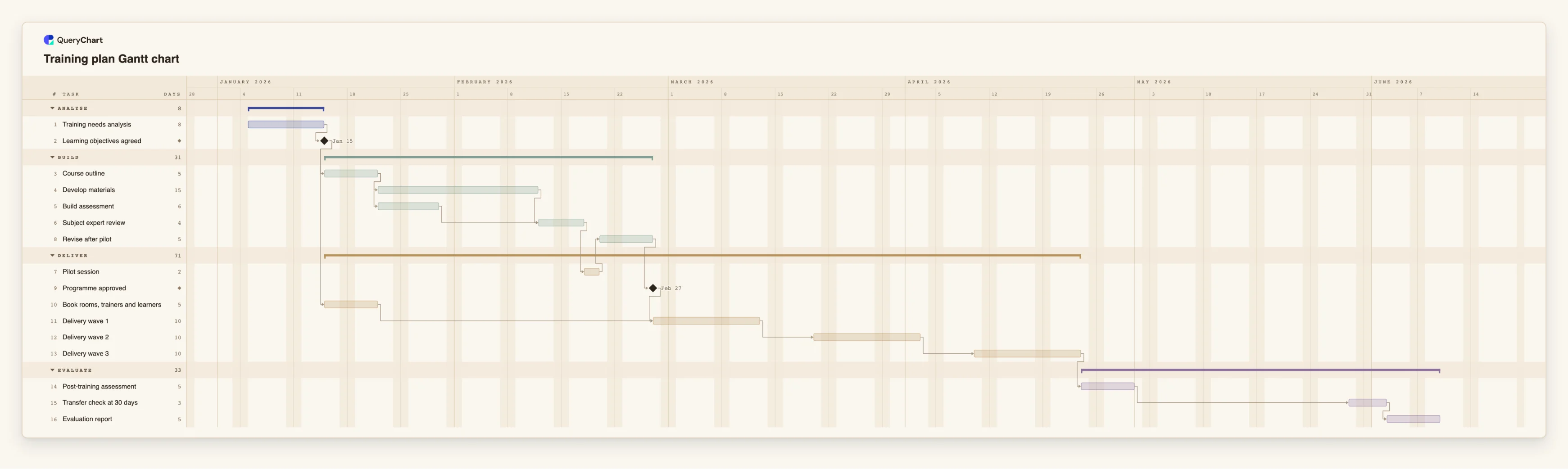
An editable employee training plan Gantt chart: needs analysis, content, pilot, delivery in waves, assessment and evaluation, with dependencies and milestones. Change a duration and the dates follow.
What the training plan gantt chart template: needs to evaluation process is
A training programme is easy to schedule as a list of sessions and hard to schedule as a project. Before anyone is in a room there is analysis, content, review and a pilot, and after the sessions there is the question of whether it worked. Organisations tend to plan the sessions and not the rest, which is why content is rushed and evaluation is skipped.
This template has four phases: Analyse, Build, Deliver and Evaluate. The learning objectives are the first milestone, because everything depends on them: the outline, the assessment, and the booking of trainers and learners, which can start as soon as the objectives are agreed. Materials and the assessment are built side by side and meet at the subject expert review. A pilot follows, then a revision, then the "Programme approved" milestone.
Delivery is in three waves with a five-day gap between them, so the trainer can adjust to what the previous group found. After the last wave comes an assessment, a transfer check twenty days later to see whether people apply what they learned, and the evaluation report. If the programme is a one-off session, delete the waves; if it is a rollout across many sites, add them.
For the request and approval route for individual training, see the training process at /templates/training-process.
What this flowchart covers
In this template
- Four phases, Analyse, Build, Deliver and Evaluate, with 16 tasks and two milestones: "Learning objectives agreed" and "Programme approved".
- Building in parallel: "Develop materials" and "Build assessment" both follow "Course outline" and meet at "Subject expert review".
- Logistics that start early: "Book rooms, trainers and learners" depends only on "Learning objectives agreed".
- Delivery in three waves with gaps: "Delivery wave 1", "Delivery wave 2" and "Delivery wave 3", each five days after the last.
- Evaluation planned in advance: "Post-training assessment", "Transfer check at 30 days" and "Evaluation report".
When to use this template
- You are rolling out a training programme and need the build and delivery schedule.
- Content is rushed because the delivery dates were set first.
- You need to show that evaluation is part of the plan, not an afterthought.
- You deliver the same training repeatedly and want a standard plan.
The plan, task by task
Every task in the chart with its length in working days and what it waits for. A dependency is a step number; SS is start-to-start, FF is finish-to-finish, and +n is a lag in working days.
| # | Task | Group | Working days | Depends on |
|---|---|---|---|---|
| 1 | Training needs analysis | Analyse | 8 | |
| 2 | Learning objectives agreed | Analyse | Milestone | 1 |
| 3 | Course outline | Build | 5 | 2 |
| 4 | Develop materials | Build | 15 | 3 |
| 5 | Build assessment | Build | 6 | 3 |
| 6 | Subject expert review | Build | 4 | 4, 5 |
| 7 | Pilot session | Deliver | 2 | 6 |
| 8 | Revise after pilot | Build | 5 | 7 |
| 9 | Programme approved | Deliver | Milestone | 8 |
| 10 | Book rooms, trainers and learners | Deliver | 5 | 2 |
| 11 | Delivery wave 1 | Deliver | 10 | 9, 10 |
| 12 | Delivery wave 2 | Deliver | 10 | 11+5 |
| 13 | Delivery wave 3 | Deliver | 10 | 12+5 |
| 14 | Post-training assessment | Evaluate | 5 | 13 |
| 15 | Transfer check at 30 days | Evaluate | 3 | 14+20 |
| 16 | Evaluation report | Evaluate | 5 | 15 |
How it works
Agree the objectives as a gate
Keep "Learning objectives agreed" as a milestone. Content, assessment and logistics all depend on it.
Build content and assessment together
Give them separate tasks and link both to the outline, so the assessment tests what is taught.
Pilot before you roll out
Keep the pilot and the revision in the plan. They are cheaper than redoing all the waves.
Plan the waves
Set the number of groups and the gap between them. A gap allows changes between waves.
Schedule the transfer check
Add a task a few weeks after training to see if behaviour changed. Use a lag to place it.
Report
Keep the evaluation report as a task with an owner.
Frequently asked questions
How do I make a training plan timeline?
List the stages from needs analysis to evaluation, give each a length in working days and link it to what it depends on. This template does so for a programme delivered in three waves.
How many delivery waves should I plan?
As many as your audience needs. Add or remove wave tasks and keep a gap between them to adjust to feedback.
What is a transfer check?
A check some weeks after training of whether people use what they learned at work. It is often what shows whether the training worked.
Does it cover individual training requests?
No. For the approval route for one person's training, see the training process template.