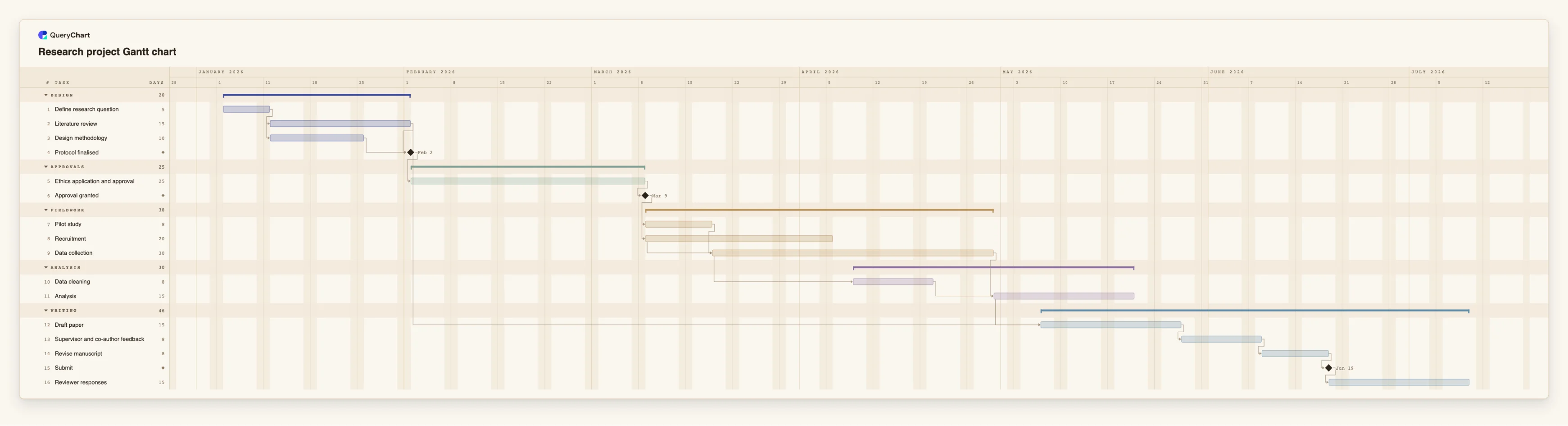
Research project Gantt chart template: question to publication
An editable research project Gantt chart: literature review, ethics approval, data collection, analysis, writing and submission, with dependencies and milestones. Change a duration and the dates follow.
What the research project gantt chart template: question to publication process is
Research timelines differ from business projects in one respect: many of the biggest waits are outside the researcher's control. Ethics approval, recruitment, access to data, and peer review each take as long as they take. A Gantt chart does not shorten them, but it shows what else can be done while you wait, and how a slip in one propagates to the submission date.
This template has five phases: Design, Approvals, Fieldwork, Analysis and Writing. The literature review and the methodology are done together and meet at "Protocol finalised". Ethics approval follows, and nothing in the fieldwork can start without it. The pilot and the recruitment run in parallel once approval is granted, and data collection begins when the pilot is done and recruitment has started. Analysis begins before collection ends, because cleaning can start on the first batch, and the draft begins as soon as analysis is under way.
Durations are working days and are examples. Ethics times and recruitment rates vary a great deal between institutions and fields. Use your own, and if you do not know them, put in a pessimistic value and see how the submission date moves.
For a doctoral thesis, which has a larger structure, see the thesis plan at /templates/thesis-gantt-chart.
What this flowchart covers
In this template
- Five phases, Design, Approvals, Fieldwork, Analysis and Writing, with 16 tasks and three milestones: "Protocol finalised", "Approval granted" and "Submit".
- Parallel preparation: "Literature review" and "Design methodology" both feed "Protocol finalised".
- An external wait: "Ethics application and approval" is a task of its own, and everything in fieldwork depends on "Approval granted".
- Overlap in the data: "Data cleaning" starts fifteen days into "Data collection", and "Draft paper" starts five days into "Analysis".
- The wait after submission: "Reviewer responses" follows "Submit" so the plan does not end on the day of submission.
When to use this template
- You are planning a study and need to show a supervisor or funder when each stage happens.
- Ethics approval or recruitment is slower than planned and you need to see the effect on the paper.
- You are writing a grant application and need a credible timeline.
- You want to see which parts of the work can run while you wait.
The plan, task by task
Every task in the chart with its length in working days and what it waits for. A dependency is a step number; SS is start-to-start, FF is finish-to-finish, and +n is a lag in working days.
| # | Task | Group | Working days | Depends on |
|---|---|---|---|---|
| 1 | Define research question | Design | 5 | |
| 2 | Literature review | Design | 15 | 1 |
| 3 | Design methodology | Design | 10 | 1 |
| 4 | Protocol finalised | Design | Milestone | 2, 3 |
| 5 | Ethics application and approval | Approvals | 25 | 4 |
| 6 | Approval granted | Approvals | Milestone | 5 |
| 7 | Pilot study | Fieldwork | 8 | 6 |
| 8 | Recruitment | Fieldwork | 20 | 6 |
| 9 | Data collection | Fieldwork | 30 | 7, 8SS+5 |
| 10 | Data cleaning | Analysis | 8 | 9SS+15 |
| 11 | Analysis | Analysis | 15 | 9, 10 |
| 12 | Draft paper | Writing | 15 | 2, 11SS+5 |
| 13 | Supervisor and co-author feedback | Writing | 8 | 12 |
| 14 | Revise manuscript | Writing | 8 | 13 |
| 15 | Submit | Writing | Milestone | 14 |
| 16 | Reviewer responses | Writing | 15 | 15 |
How it works
List the stages of your study
Rename the tasks. Add the waits that belong to your field, such as data access agreements or equipment booking.
Estimate the external waits pessimistically
Give ethics, recruitment and review a long duration, and keep them as tasks of their own.
Use overlaps where the work really overlaps
Link cleaning to the start of collection with a start-to-start link and a lag. Link drafting to the start of analysis the same way.
Mark the approvals as milestones
Keep "Approval granted" as a gate. Nothing in the fieldwork should start without it.
Plan the writing as a task, not a remainder
Give drafting, feedback and revision their own durations, including the time that co-authors take.
Include what happens after submission
Keep the reviewer response in the plan so a later deadline is not a surprise.
Frequently asked questions
How do I make a Gantt chart for a research project?
List the stages from question to submission, give each a length in working days and link each to what it depends on. This template does so for a generic empirical study; replace the tasks and lengths with yours.
Can I use this in a grant application?
Yes. Many funders ask for a timeline. Export the chart as a PDF or an image and attach it. Make the durations realistic, especially for approvals and recruitment.
How should I treat ethics approval?
As a task of its own with a pessimistic duration, followed by a milestone that all fieldwork depends on.
Does it work for qualitative research?
Yes. Rename the pilot, recruitment and data tasks as interviews, transcription and coding, and adjust the overlaps.