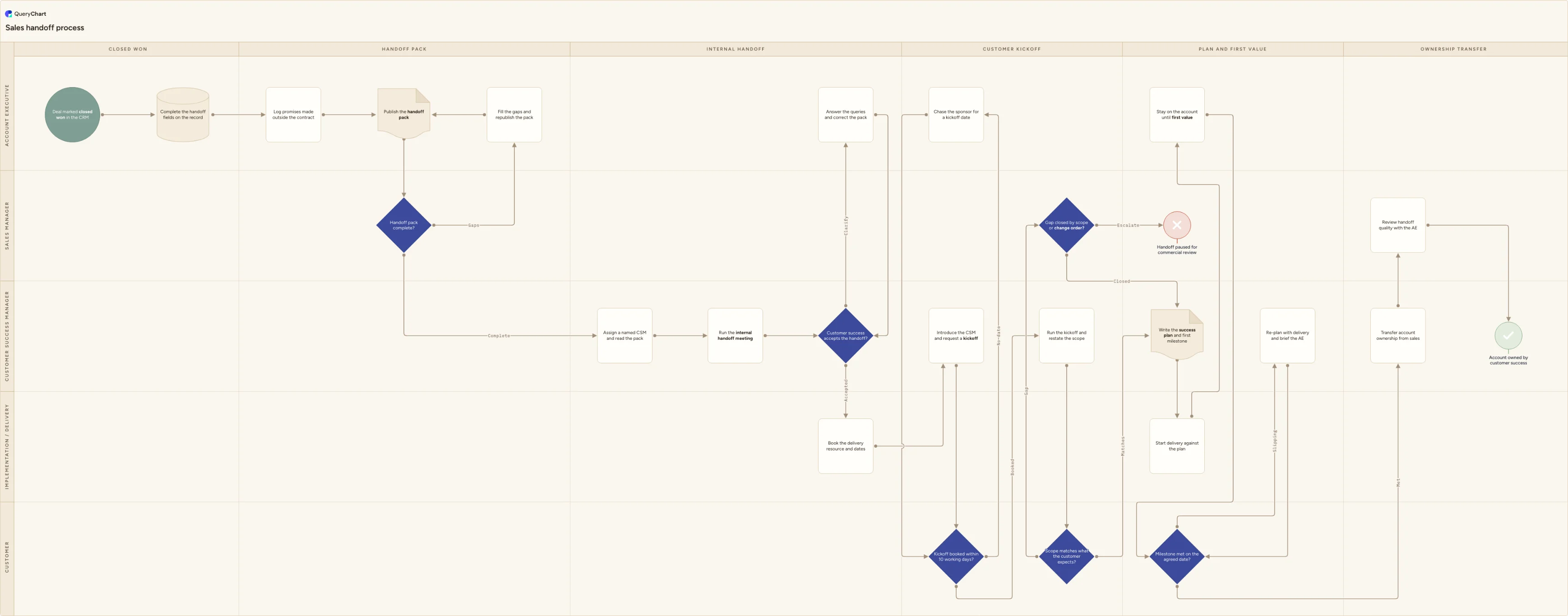
Sales handoff process flowchart (closed won to customer success)
Sales handoff process flowchart template: closed-won trigger, handoff pack of goals and promises made, internal handoff meeting, customer success acceptance, kickoff, expectation gaps and a first value milestone.
What the sales handoff process flowchart (closed won to customer success) process is
A sales handoff is the transfer of a customer from the people who sold the work to the people who have to deliver it. The trigger is a single event in the CRM, the opportunity moving to closed won, and almost everything downstream depends on what the account executive writes at that moment. The chart below follows one handoff end to end: the closed-won record and the fields it has to carry, the pack holding the customer's goals, stakeholders, scope, dates and the promises made along the way, an internal handoff meeting where customer success either accepts the account or sends it back for clarification, delivery booking the resource against the dates that were sold, a kickoff booked with the customer, a check that what was sold matches what the customer believes they bought, a success plan with a dated first milestone, and the point where account ownership formally moves from sales to customer success.
This is the handoff, not the onboarding. Everything the receiving team then does, account creation, credit and compliance checks, configuration, data migration, training and go-live, belongs to the customer onboarding process, which begins where this chart's success plan is written and runs for weeks after it. Nor is it a project closure, where a finished deliverable is accepted against criteria, invoiced and closed out at the far end of the relationship. The boundary matters because the two failures look identical from the customer's side. An onboarding that stalls because nobody configured an integration is a delivery problem. An onboarding that stalls because the customer expected something nobody sold them is a handoff problem, and no amount of implementation effort repairs it. Drawing the handoff on its own chart is what makes that difference visible in the week it can still be corrected cheaply.
Three decisions carry the process, and the lanes they sit in are the argument. 'Handoff pack complete?' sits with the sales manager rather than with customer success, because a pack sent back by the receiving team becomes a negotiation between departments, while a pack held by the seller's own manager is coaching. 'Customer success accepts the handoff?' is the acceptance gate: the named CSM can return the account with questions, and until they accept it the account is still the account executive's problem. The third is the one that earns the page. 'Scope matches what the customer expects?' is held in the Customer lane at the kickoff, because the gap between what was sold and what the customer believes they bought is only ever found by asking the customer, and it is far cheaper to find in the first meeting than in month three. A gap routes to the sales manager and not to the CSM, since only the commercial owner can close it with scope, a concession or a change order.
What this flowchart covers
In this template
- Five swimlanes (Account executive, Sales manager, Customer success manager, Implementation / delivery and Customer) across six phases: Closed won, Handoff pack, Internal handoff, Customer kickoff, Plan and first value, and Ownership transfer
- The pack itself: required fields completed on the closed-won record, then the step most CRMs have no field for at all, "Log promises made outside the contract", and a sales manager's gate that sends a thin pack back to be filled and republished
- An internal handoff meeting with a real acceptance gate, where "Customer success accepts the handoff?" either moves the account on or returns it to the account executive to answer the queries and correct the pack, so that no account is received by silence
- A booking loop for the post-close silence: "Kickoff booked within 10 working days?" sends an account with no date back to the account executive to chase the sponsor, rather than leaving a scheduling task nobody owns. The ten days is a placeholder
- The check this whole process exists for, "Scope matches what the customer expects?", asked in front of the customer at the kickoff, with any gap routed to the sales manager where "Gap closed by scope or change order?" decides between the plan and a pause
- A dated first milestone in the success plan, an account executive who stays on the account until it is met, a re-plan loop for when it slips, and a close that both moves account ownership and reviews the quality of the pack with the AE who wrote it
When to use this template
- You are setting the rule for what must be true before a deal can be marked closed won, and need the process that rule feeds
- Customer success managers are opening accounts cold, with a name, a close date and nothing about why the customer bought
- Onboarding keeps stalling in week two on things that were promised during the sales cycle and never written down anywhere
- You are moving handoffs out of email and chat into the CRM, and want the fields, the meeting and the acceptance gate agreed before anyone configures them
- Sales and customer success are arguing about who owns the account between signature and go-live, and the handover point has never been drawn
How it works
Rename the lanes to your roles
Replace Account executive, Sales manager, Customer success manager, Implementation / delivery and Customer with the roles you actually have. In a small team the CSM and the implementer are the same person: merge those two lanes rather than drawing a handoff that never happens in practice.
Set what closed won has to carry
List the fields that must be populated before an opportunity can move to closed won: the customer's goal, the buying committee and who signed, the contracted scope and its exclusions, the dates and the commercial terms. Make them required at the stage gate, and decide what happens to a deal closed early on a verbal.
Write your own promises-made rule
Decide how a promise made outside the contract is recorded, who is allowed to make one, and what the CSM does with it on arrival. Free text works as long as somebody reads it; a fixed list of promise types works better if you want to count how often the same one is being sold.
Set the kickoff booking window
Ten working days on the chart is a placeholder, not a standard. Set the window that fits your product, name who is chased when no date arrives, and agree how many chases happen before the account is flagged rather than left open in a CSM's list indefinitely.
Decide who owns an expectation gap
Agree who may absorb a gap, who may grant a concession and who has to raise a change order, then write those thresholds on the chart beside the sales manager's decision. Adapt them to your own delegated authority; the point of the branch is that the CSM never settles a commercial question alone.
Define what first value means
Name one dated milestone the customer would themselves call value: the first live user, the first invoice processed, the first report they run without help. State who confirms it and how, because a milestone signed off internally is a status update rather than evidence.
Walk it against a real handoff
Take two accounts that closed last quarter, one that went smoothly and one that went wrong, and trace both through the chart. The step people describe that is not drawn, and the step drawn that nobody actually does, are the two findings worth acting on before you publish it.
Frequently asked questions
What are the steps in a sales handoff process?
The deal is marked closed won in the CRM, the account executive completes the handoff fields on the record, logs the promises made outside the contract and publishes the handoff pack. The sales manager checks it and sends a thin pack back to be filled and republished. A named CSM is assigned, reads the pack and runs the internal handoff meeting, after which customer success either accepts the account or returns it with queries. Delivery books the resource and dates, the CSM introduces themselves and asks for a kickoff, and the account executive chases the sponsor if no date arrives. At the kickoff the scope is restated and tested against what the customer expects; a gap goes to the sales manager, who closes it with scope or a change order, or pauses the handoff for commercial review. A success plan with a dated first milestone is written, delivery starts, and once the milestone is met ownership moves to customer success.
When should the handoff happen, at signature or at the kickoff?
It starts at closed won and finishes at the kickoff, and treating either end as the whole event is what breaks it. The internal half should be done in days rather than weeks, while the seller still remembers the detail; the external half is the kickoff, which is the first time the customer hears the same scope from a second person. On larger deals it is worth introducing the CSM during the last stage of the sales cycle, so the customer meets them before the contract rather than after it. One caution on the trigger: marking a deal closed won is a CRM stage change, not a revenue event. Under IFRS 15 and ASC 606 revenue is recognised when control of the promised goods or services transfers to the customer, so agree with finance where that point falls in your own contracts before hanging any revenue reporting off this chart.
What should a sales-to-customer-success handoff document contain?
Enough for the receiving team to run the first customer conversation without reading the whole opportunity. In practice that is the business outcome the customer bought and how they said they would measure it; the buying committee, who signed, who championed it internally and who was sceptical; the contracted scope with its exclusions written as plainly as the inclusions; anything promised during the sales cycle that is not in the contract; the timeline the customer was given and what it depends on; the commercial shape, meaning term, renewal date, discounts and how invoicing works; known risks, competitors still in the account and any integration or data dependency. The test is not length. If the CSM has to go back to the AE for context on the first call, the pack was incomplete whatever it weighed.
Who owns the account between closed won and go-live?
The account executive owns it until customer success accepts the handoff, which is why the acceptance decision exists on the chart: an account is not transferred by sending a document, it is transferred when somebody agrees to receive it. After acceptance the CSM owns the relationship and delivery owns the work, but the AE does not disappear. On this chart they stay on the account until the first value milestone is met, because they hold the relationship with the sponsor and are the only person who can chase a date without it reading as an escalation. The transfer is worth making explicit in three places: the owner field in the CRM, whoever answers the customer's next email, and the compensation rule, since a seller measured only on bookings has no reason to be in the room at week six.
What is the difference between a sales handoff and customer onboarding?
The handoff is a transfer of knowledge and ownership and is measured in days. Onboarding is the work of making the customer productive and is measured in weeks or months. The handoff produces a pack, a meeting, an accepted account and a success plan; onboarding produces accounts, configuration, migrated data, trained users and a go-live. They are drawn separately because they fail separately and are fixed by different people. A late onboarding usually points at capacity, sequencing or a customer dependency. An onboarding that starts in the wrong direction almost always points back at the handoff, at a goal nobody recorded or a promise nobody passed on. Measuring them together hides which of the two you have.
Where this process fits
In most operations this process follows Sales pipeline process flowchart: opportunity to closed won and hands off to Customer onboarding process flowchart.
It is one step in Customer lifecycle.
Step 1: Sales lead qualification process flowchart: MQL to SAL
Step 2: Sales process flowchart: prospect to signed order
Sales process flowchart template: prospecting and fit, first contact and discovery, qualification on need, budget and authority, quote approval, negotiation, closed won or lost, and handover to onboarding.
Step 3: Sales handoff process flowchart (closed won to customer success) You are here
Sales handoff process flowchart template: closed-won trigger, handoff pack of goals and promises made, internal handoff meeting, customer success acceptance, kickoff, expectation gaps and a first value milestone.
Step 4: Customer onboarding process flowchart
Customer onboarding process flowchart with swimlanes for customer, sales, onboarding, finance and support, from contract signature to steady-state account.
Step 6: Customer support escalation process flowchart (tier 1 to tier 2)
Step 7: Customer cancellation process flowchart (request to account closed)
Step 8: Customer churn process flowchart (save play to win-back)