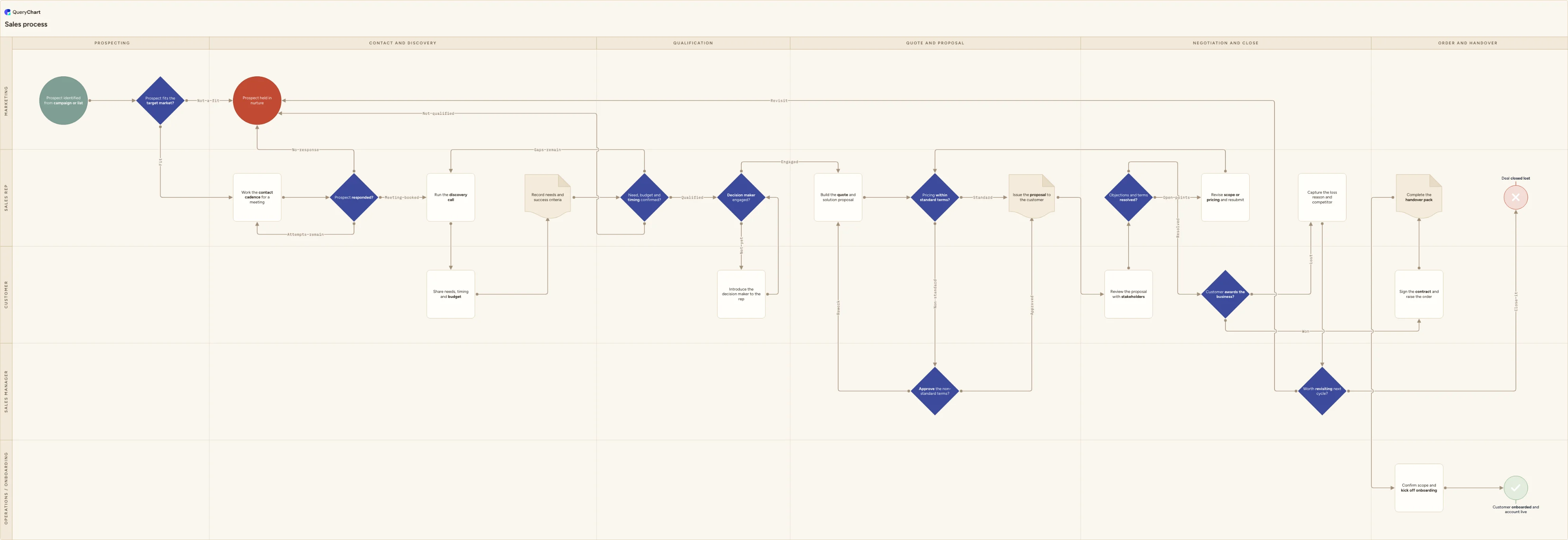
Sales process flowchart: prospect to signed order
Sales process flowchart template: prospecting and fit, first contact and discovery, qualification on need, budget and authority, quote approval, negotiation, closed won or lost, and handover to onboarding.
What the sales process flowchart: prospect to signed order process is
A sales process is the repeatable path a company takes a buyer along, and it exists so that every seller works the same way and the business can see where deals actually stall. The trigger here is a prospect appearing on a list: a campaign response, an event scan, a referral, an inbound enquiry or an outbound name a rep has researched. The chart follows that one prospect end to end. It covers the fit check before anyone picks up the phone, the outreach cadence and the meeting it is trying to book, a discovery call and a written record of what the buyer needs, a qualification gate on need, budget and timing, a second gate on whether the person who signs is actually engaged, a quote and its approval, the proposal, the objections it comes back with, the award decision, and either a signed order handed to onboarding or a loss reason written down before the deal is closed.
This is the generic end-to-end version, and it stops short of three neighbouring maps on purpose. It is not lead qualification: scoring a lead against the ideal customer profile, the marketing-qualified handover to an SDR and the reason codes that go with it sit upstream, and this chart assumes a named prospect is already in front of a seller. It is not pipeline stage management: forecast categories, stage exit criteria and the weekly pipeline review are how a manager runs a whole book of deals, whereas this follows one deal. And it stops at the handover, because picking, shipping and invoicing the order, chasing payment and growing the account afterwards belong to order fulfilment, order-to-cash and customer success. Contract terms, signature authority and consumer cancellation rights differ by country and by contract type, so treat the closing steps as a starting point to be adapted with your own legal advice rather than as a statement of what you may sign.
Four decisions carry the chart. 'Prospect fits the target market?' sits in the Marketing lane because fit is a targeting judgement rather than a seller's, and because it is far cheaper to drop a bad prospect there than three meetings later. 'Need, budget and timing confirmed?' and 'Decision maker engaged?' split what most teams run as a single qualification step, which is what stops a deal with a real need and no signatory from being forecast as though it were ready to close. 'Pricing within standard terms?' is the only gate that leaves the seller's lane: anything outside the price list, the standard contract or the usual payment terms goes to a sales manager, and a renegotiated price goes back through that same gate rather than around it. The award decision sits in the Customer lane deliberately, because it is the one step in the process that nobody in your organisation controls.
What this flowchart covers
In this template
- Five swimlanes (Marketing, Sales rep, Customer, Sales manager and Operations / onboarding) across six phases: Prospecting, Contact and discovery, Qualification, Quote and proposal, Negotiation and close, and Order and handover
- A fit gate before any effort is spent: "Prospect fits the target market?" either passes the name to a seller or parks it, so prospects nobody should be calling leave the process in the Marketing lane rather than in a rep's third follow-up
- An outreach loop with an honest exit: "Work the contact cadence for a meeting" feeds "Prospect responded?", whose 'Attempts remain' branch loops back for the next touch and whose 'No response' branch returns the prospect to nurture instead of leaving it open
- Qualification split into two gates: "Need, budget and timing confirmed?" sends gaps back to the discovery call, and "Decision maker engaged?" holds the deal until the customer introduces whoever signs, so authority is tested rather than assumed
- A pricing control that survives negotiation: "Pricing within standard terms?" routes anything non-standard to the sales manager's "Approve the non-standard terms?" gate, and "Revise scope or pricing and resubmit" sends a renegotiated price back through it
- Both endings drawn in full: a won deal is signed, packed into "Complete the handover pack" and kicked off by onboarding, while a lost deal goes through "Capture the loss reason and competitor" and a manager's "Worth revisiting next cycle?" before it is closed
When to use this template
- You are documenting a sales process for the first time and need one picture that marketing, sales and delivery can all argue with
- New sellers are ramping and you want the steps, the qualification questions and the approval points written down rather than held in a manager's head
- Deals stall somewhere between the first meeting and the signature, and you need to see whether they die at qualification, at authority or at pricing
- You are configuring or replacing a CRM and want the process agreed before stages, required fields, quote approval and loss reasons are set up
- Onboarding keeps inheriting promises nobody recorded, so the handover pack and the kick-off need to sit inside the sales process rather than after it
How it works
Rename the lanes to your roles
Replace Marketing, Sales rep, Customer, Sales manager and Operations / onboarding with the roles you genuinely have. In a small company the rep and the manager are the same person: merge those two lanes rather than drawing an approval handoff that is really one person pausing to think.
Write your fit rule onto the first decision
State what makes a prospect worth calling: sector, size, region, use case, and anything you cannot serve or will not sell to. Name who applies the rule and where the source of the prospect is recorded, because that one field is what later tells you which campaigns, referrals and lists are worth repeating.
Set the cadence and the give-up rule
Decide how many attempts, over how many days and across which channels count as a complete cadence, and what happens to a prospect who never replies. Most written sales processes are silent here, which is why one rep stops after two calls and another chases the same name for a year.
Adapt the two qualification gates
Rewrite both gates in your own language. Budget, authority, need and timing is a first-pass filter and suits shorter, simpler deals; larger ones usually need more, such as the decision process, the decision criteria and a named champion. Whatever you use, write down what a 'yes' has to be evidenced by.
Set the pricing threshold and the approver
Define what counts as standard: the price list, the standard contract and the usual payment terms. Take the discount, term-length and payment thresholds from your own delegation of authority, name who approves each level, and state how quickly an approval is expected so the gate does not become the delay.
Define the loss reasons and the handover pack
Replace the free-text loss note with a short fixed list of reasons plus the competitor or alternative, including the option of doing nothing. Then list what the handover pack must carry: scope, dates, pricing, contacts and anything promised verbally that onboarding will be held to.
Walk it against two real deals
Take one deal you won and one you lost in the last quarter and trace each of them through the chart. Any step people describe that is not drawn, and any box everyone admits is skipped in practice, is the finding worth acting on before you publish the process.
Frequently asked questions
What are the steps in a sales process?
A prospect is identified from a campaign, list, referral or enquiry and checked against the target market. A rep works an agreed outreach cadence until a meeting is booked or the attempts run out, then runs a discovery call in which the customer sets out needs, timing and budget, and records what was said together with the success criteria. Two gates follow: need, budget and timing, and whether the person who signs is engaged, with the customer introducing them if not. The rep builds a quote, and anything outside standard terms goes to a sales manager before the proposal is issued. The customer reviews it with their stakeholders, objections are either resolved or sent back as a revised price through the same approval gate, and the customer awards the business or does not. A won deal is signed, packed into a handover pack and kicked off by onboarding; a lost deal gets a reason and a competitor recorded.
What is the difference between a sales process and a sales pipeline?
The sales process is the sequence of things a seller does: contact, discovery, qualification, quoting, negotiating and closing. The pipeline is the set of live deals grouped by the stage each one has reached, and it exists to be managed in aggregate through stage exit criteria, forecast categories and pipeline reviews. One is a map of the work, the other is a view of the inventory. A methodology such as BANT or MEDDIC is a third thing again: it supplies the questions asked at the qualification gates rather than the steps themselves. In practice the three have to agree, because a CRM stage that does not correspond to a step in the process is a stage nobody can tell you how to exit.
Who owns the sales process?
Sales leadership owns it, but it cannot be written by sales alone, because four of the lanes on this chart do not report to them. Marketing owns the fit rule and the nurture list the process returns prospects to. Finance and legal own the standard terms, the approval thresholds and the contract. Delivery or customer success owns what the handover pack has to contain, since they inherit whatever it leaves out. Where there is a revenue operations function, it usually maintains the CRM implementation of the process: stages, required fields, quote approval routing and loss reason codes. A useful test of ownership is who is allowed to change the pricing threshold, because that is the step that most often gets quietly worked around.
What should the qualification gates ask?
BANT, which came out of IBM, asks four things: is there budget, is the person authorised, is there a real need, and is there a timeline. It works as a fast first-pass filter and suits shorter, more transactional deals. MEDDIC, developed in the sales organisation at Parametric Technology Corporation in the 1990s, is heavier and better suited to complex deals: metrics, economic buyer, decision criteria, decision process, identified pain and champion. This chart deliberately runs the light version and splits it, testing need, budget and timing at one gate and authority at the next, because authority is the answer sellers most often assume. If your deals involve a buying committee, a procurement team or a security review, expect to add stakeholder mapping and a decision process step rather than stretching these two gates.
When does the sale become a contract, and what should the closing steps say?
That depends on your jurisdiction, the contract and who the buyer is, so the closing boxes here are a placeholder for your own rule. Decide what constitutes acceptance in your business (a signed order form, a purchase order, an online checkout), who is authorised to sign at each value, and what has to exist before an order is raised. Selling to consumers adds a step business-to-business selling does not have: under the EU Consumer Rights Directive 2011/83/EU a consumer generally has 14 days to withdraw from a distance or off-premises contract without giving a reason, and the equivalent United Kingdom rule is regulation 30 of the Consumer Contracts (Information, Cancellation and Additional Charges) Regulations 2013, where the period can extend by up to 12 months if the required cancellation information was never given. Both apply to consumers rather than to business purchases, and both carry exceptions. Take your own legal advice rather than reading a flowchart as the rule.
Where this process fits
In most operations this process follows Sales lead qualification process flowchart: MQL to SAL and hands off to Sales handoff process flowchart (closed won to customer success).
It is one step in Customer lifecycle.
Step 1: Sales lead qualification process flowchart: MQL to SAL
A swimlane sales lead qualification process flowchart: lead capture, ICP scoring, the MQL decision, SDR cadence, discovery, BANT or MEDDIC and AE handover.
Step 2: Sales process flowchart: prospect to signed order You are here
Sales process flowchart template: prospecting and fit, first contact and discovery, qualification on need, budget and authority, quote approval, negotiation, closed won or lost, and handover to onboarding.
Step 3: Sales handoff process flowchart (closed won to customer success)
Sales handoff process flowchart template: closed-won trigger, handoff pack of goals and promises made, internal handoff meeting, customer success acceptance, kickoff, expectation gaps and a first value milestone.
Step 6: Customer support escalation process flowchart (tier 1 to tier 2)
Step 7: Customer cancellation process flowchart (request to account closed)
Step 8: Customer churn process flowchart (save play to win-back)