Customer churn process flowchart (save play to win-back)
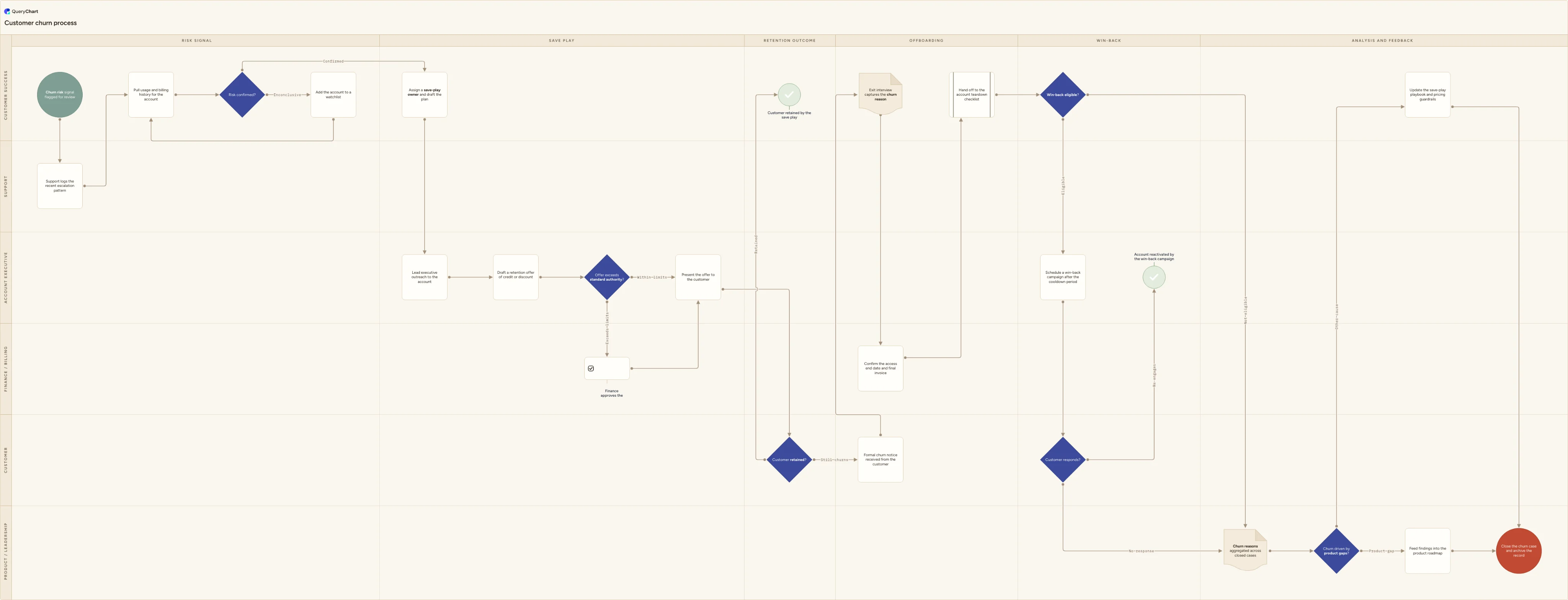
Customer churn process flowchart template: risk signal, save play, retained or churn decision, exit interview, offboarding handoff, win-back eligibility and churn analysis feedback loop.
What the customer churn process flowchart (save play to win-back) process is
This chart starts where a renewal health check leaves off: an account has tripped a real risk signal, not just a routine review. The trigger is a usage drop against baseline, a jump in support escalations, or an early non-renewal warning from the account itself, and customer success pulls the account's usage and billing history before treating it as real. From there the chart follows one churn case end to end: a save-play owner assigned, executive outreach, a retention offer sized to the actual reason for leaving, the customer's decision to stay or go, and, on the harder branch, the exit interview, the offboarding handoff, a win-back eligibility call, and the churn reasons that feed back into the product roadmap and the playbook for the next account at risk.
This is churn management, not the renewal cycle and not the cancellation paperwork. The health-score review that decides whether an account is at risk in the first place, the T-90-day renewal proposal, and the auto-renew clause belong to the customer renewal process, which this chart picks up from only at the point risk is already confirmed. And once the customer notice is in, the detailed data-export and access-teardown checklist, the entitlement shutdown and the exact final-invoice mechanics are their own administrative cancellation process; this chart only confirms the access end date and final invoice before handing off, on purpose, so the emotionally and commercially important half of churn (the save play, the reason, the win-back call) does not get buried inside a checklist of system steps. Keeping that boundary explicit is what stops a churn review turning into an offboarding ticket queue.
Three decisions carry the process. 'Risk confirmed?' is a genuine gate, not a formality: a quiet month is not churn, and the watchlist loop exists so a save-play owner's time is not spent on noise. 'Customer retained?' is the fork the whole chart is built around, and it sits in the Customer lane rather than the account executive's because the customer's decision, not the offer, is the actual outcome. 'Win-back eligible?' sits after offboarding rather than before it, deliberately: eligibility is judged on the churn reason and account standing once the case is closed, not decided in the heat of the save play, which is exactly when it would be judged too generously or too harshly.
What this flowchart covers
In this template
- Six swimlanes (Customer success, Account executive, Customer, Support, Finance / billing and Product / leadership) across six phases: risk signal, save play, retention outcome, offboarding, win-back and analysis and feedback
- A 'Risk confirmed?' gate with a genuine loop: an inconclusive signal is added to a watchlist and re-reviewed rather than either dropped or escalated on a single data point
- The save play as more than an apology call: a named save-play owner, executive outreach, and an 'Offer exceeds standard authority?' decision that routes larger discounts or credits to Finance before the account executive presents anything to the customer
- A 'Customer retained?' decision in the Customer lane, not the seller's, that splits the chart cleanly into a save that ends the case and a churn that starts the exit interview
- The exit interview and offboarding handled as a light handoff rather than a checklist: the 'churn reason' is captured, the access end date and final invoice are confirmed, and the account is handed to the account-teardown checklist as a separate step
- A 'Win-back eligible?' decision judged on reason and standing rather than tenure, a cooldown-gated win-back campaign, and a 'Churn driven by product gaps?' split that routes findings to the product roadmap or back into the save-play playbook
When to use this template
- You are building a customer success playbook and need one picture of who owns a churn risk from signal to save play to offboarding
- Save plays are inconsistent across account executives and you need the retention-offer approval and the executive outreach step made explicit
- Churned accounts are offboarded but never analysed, so the same avoidable reason keeps showing up a quarter later
- You are deciding whether a churned account is eligible for a win-back campaign and want the criteria and the cooldown made explicit rather than left to memory
- Leadership has asked for a documented churn process ahead of a board update on retention, and the save-play, offboarding and analysis steps need to be shown as one flow
How it works
Rename the lanes to your roles
Replace Customer success, Account executive, Customer, Support, Finance / billing and Product / leadership with the roles that actually exist in your organisation. A small team often merges customer success and the account executive into one save-play owner; do that rather than drawing a handoff that never happens.
Define what counts as a confirmed risk signal
State which usage metrics, support signals or notices are strong enough to open a case, and who has the authority to add an account to the watchlist instead. Vague criteria are how a save-play owner's time gets spent chasing noise instead of real accounts.
Set the retention-offer authority thresholds
Decide what an account executive can offer without sign-off and what needs Finance approval, in your own terms rather than a percentage borrowed from a different team's discount policy. Write down who Finance actually is for a small deal versus a strategic account.
Agree how the churn reason gets captured
Decide who runs the exit interview, what a completed reason record has to contain, and where it is stored. A reason nobody can retrieve six months later cannot feed the analysis step, no matter how well the interview itself went.
Write your own win-back eligibility rule
State which churn reasons and account conditions make an account eligible for a future campaign and which do not, and set your own cooldown length rather than the placeholder period on this chart. Name who owns the win-back list so it does not quietly stop being worked.
Decide where churn findings actually go
Agree who reviews aggregated churn reasons, on what cadence, and what happens to a finding that points at a product gap versus one that points at the save-play playbook itself. A review with no owner produces a slide nobody acts on.
Walk it against two real cases
Take one account that was saved and one that churned and trace both through the chart. Any step people describe from memory that is not drawn, or drawn but routinely skipped, is the finding worth fixing before you publish the process.
Frequently asked questions
What are the steps in a customer churn process?
A churn case opens when an account trips a real risk signal: a usage drop, a run of support escalations, or an early non-renewal warning. Customer success pulls the account's usage and billing history and confirms the risk is real rather than a single quiet month, which is added to a watchlist and reviewed again instead. A confirmed case gets a save-play owner, executive outreach, and a retention offer sized to the actual reason for leaving, with larger discounts routed to Finance first. The customer's decision is the fork: retained closes the case as a save, and still-churning triggers the formal churn notice, an exit interview that captures the reason, confirmation of the access end date and final invoice, and a handoff to the account-teardown checklist. The case then goes through a win-back eligibility decision, a cooldown-gated win-back campaign for eligible accounts, and a final step checking the reason against product gaps versus the save-play playbook before the case closes.
What is a save play and how is it different from a discount?
A save play is the whole retention attempt around an at-risk account, not just the offer at the end of it: a named owner, executive outreach so the customer hears from someone senior, and a plan that is supposed to match the actual reason the account is leaving. A discount is one possible lever inside that plan, and often the wrong one. An account leaving because a competitor shipped a feature is not fixed by a percentage off; it needs a roadmap commitment or a success plan showing how the gap gets closed. An account leaving on price genuinely might need the discount. Running every save play as a discount conversation is what makes a customer success team look like a pricing desk instead of a relationship one, and it is also what trains customers to threaten to leave for a better rate.
How do you decide whether a churned account is eligible for a win-back campaign?
Base it on the churn reason and the account's standing when it left, not on how long they were a customer or how the account executive feels about the loss. A competitor-feature loss where the gap is still open, or an account that left owing money or mid-dispute, is usually a poor win-back candidate until that specific condition changes. A price-sensitive loss on otherwise good terms, or a loss driven by a champion leaving the company, is often a genuine candidate once time has passed. Write the rule down and apply it consistently, because judging eligibility in the moment the account churns tends to be either too generous, out of guilt, or too harsh, out of frustration with how the save play went. The cooldown length before a campaign runs is a policy choice for your own team to set, not a fixed rule.
Why does churn analysis matter if the account is already gone?
One churned account is a loss; a pattern across several is a finding, and the whole point of the aggregation step is to tell the two apart. If the same reason keeps recurring, the fix usually is not another save play, it is a change to the product or to the save-play playbook itself, which is exactly what the 'Churn driven by product gaps?' decision routes toward. Skipping this step is how an organisation runs the same losing save play for years, each time treating the current account as an isolated case rather than the fifth instance of a pattern leadership has never seen assembled in one place. The record from the exit interview is what makes this possible later, which is why capturing a specific reason at the time matters more than it feels like it does in the moment.
Who should own the churn process: customer success, sales or product?
In most organisations customer success owns the process end to end, because they are closest to the account and the one relationship that has to hold together through a difficult conversation. The account executive is usually pulled in for the save play itself, since a customer often responds differently to someone more senior than their day-to-day contact, and Finance owns the approval on anything beyond standard discount authority. Product does not own the process, but it has to be a real recipient of the churn-reason findings, not just a lane on the chart, or the aggregation step becomes reporting nobody acts on. However you split it in your own organisation, name a single owner for the case from open to close; a churn case with no single owner is the one that gets the reason captured badly and the win-back opportunity missed entirely.
Where this process fits
In most operations this process follows Customer cancellation process flowchart (request to account closed).
It is one step in Customer lifecycle.
Step 1: Sales lead qualification process flowchart: MQL to SAL
Step 3: Sales handoff process flowchart (closed won to customer success)
Step 6: Customer support escalation process flowchart (tier 1 to tier 2)
Step 7: Customer cancellation process flowchart (request to account closed)
Customer cancellation process flowchart: contract terms and notice period, reason coded before any save attempt, the offer ladder and its limits, final billing, data export, deprovisioning and churn coding.
Step 8: Customer churn process flowchart (save play to win-back) You are here
Customer churn process flowchart template: risk signal, save play, retained or churn decision, exit interview, offboarding handoff, win-back eligibility and churn analysis feedback loop.