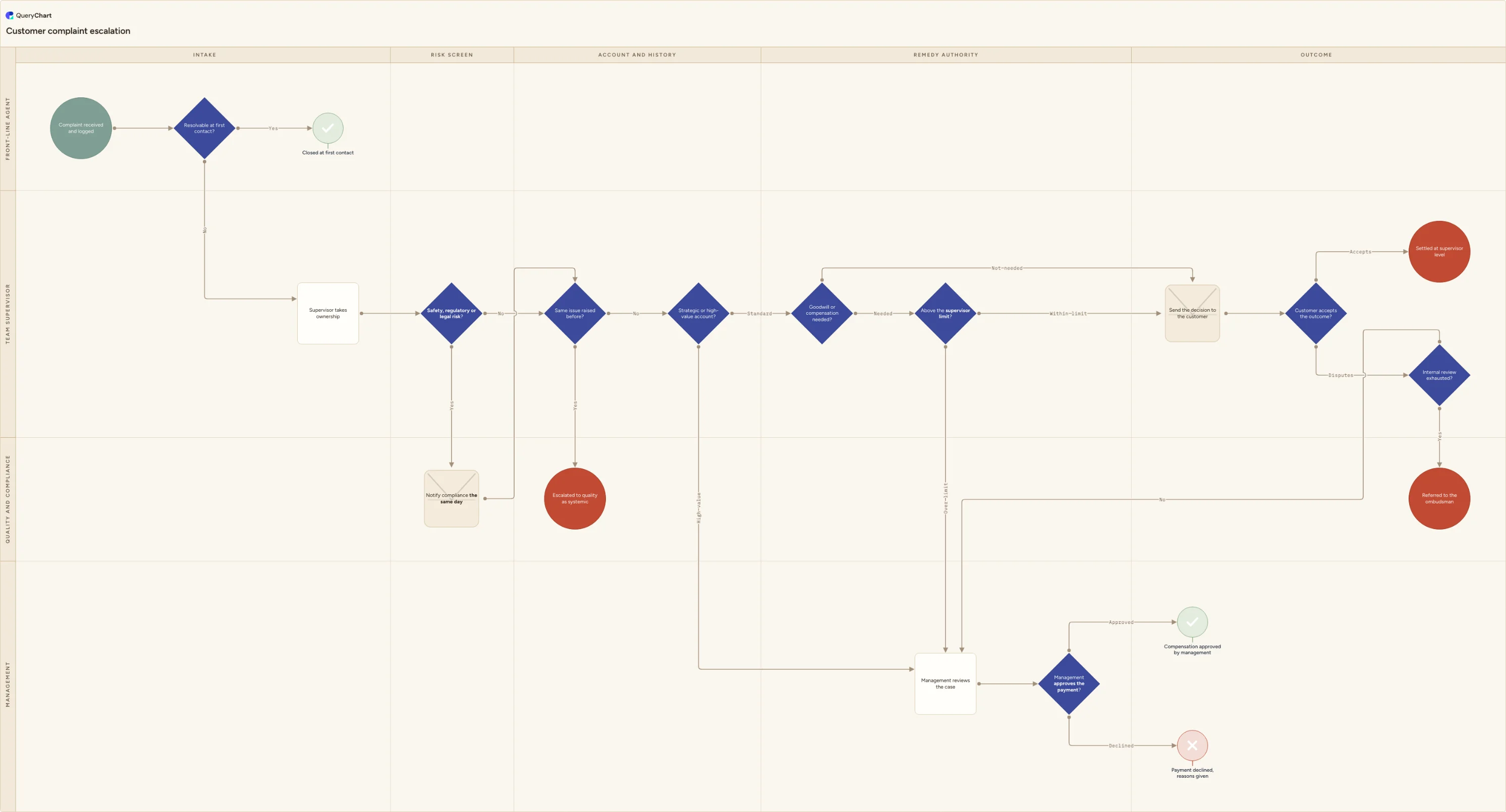
Customer complaint escalation flowchart
A customer complaint escalation flowchart as a decision tree: nine tests on risk, repeat complaints, account value and payment limits, six named outcomes.
What the customer complaint escalation process is
A customer complaint escalation flowchart answers one question: how far does this complaint travel, and who is authorised to decide? It is a decision tree, not a process map. Every node is a test the handler applies to the case in front of them, and every branch carries the answer rather than the next task. Is it fixable now. Is there a safety or regulatory dimension. Has this customer raised the same issue before. Is the account strategic. Is money involved, and is it above the limit the supervisor may sign.
That is deliberately narrower than a complaints procedure. If you need the end-to-end handling sequence, intake and acknowledgement, investigation, remedy, corrective action and confirmed closure across five swimlanes, use the customer complaint process flowchart at /templates/customer-complaint-process. This page sits inside that process, at the single moment where a handler has to decide whether to keep a case or pass it up. The process page tells you what happens next and who does it. This chart tells you which option to choose and who owns the choice.
The lanes name decision rights rather than departments. Front-line agent, Team supervisor, Quality and compliance and Management run down the left across five assessment stages, so you can see which questions an agent may answer alone and which ones move the decision to someone else. The criteria behind the pivotal tests are written on the nodes themselves, because a decision tree with unwritten thresholds is only a diagram of individual judgement.
What this flowchart covers
In this template
- The first-contact test at the top of the tree: 'Resolvable at first contact?' passes only when four conditions hold at once, the remedy sits inside the agent's published authority, no payment beyond the standard remedy, no safety or regulatory element and no earlier complaint on the same issue. A yes ends immediately at 'Closed at first contact'.
- A risk screen placed before any commercial judgement: 'Safety, regulatory or legal risk?' routes a yes to 'Notify compliance the same day', so a regulated or safety-related case is recognised before anyone weighs up how important the customer is.
- A repeat test that changes the owner rather than the answer: 'Same issue raised before?' sends a yes to 'Escalated to quality as systemic', taking the case out of the front-line queue instead of resolving the same failure twice.
- Two independent routes into 'Management reviews the case': a 'High value' branch from 'Strategic or high-value account?', which escalates regardless of amount, and an 'Over limit' branch from 'Above the supervisor limit?', which escalates on value alone.
- The payment decision and its two named endpoints: 'Management approves the payment?' splits into 'Compensation approved by management' and 'Payment declined, reasons given', so a decline is recorded as an outcome rather than left as an unfinished case.
- The dissatisfaction path: 'Customer accepts the outcome?' ends at 'Settled at supervisor level' on Accepts, while Disputes runs into 'Internal review exhausted?', which either returns the case to management for a further review or ends at 'Referred to the ombudsman'.
When to use this template
- Escalation is inconsistent: one agent settles a case that another passes to a supervisor, and nobody can point to the rule that separates them.
- You are setting or revising delegated authority, deciding who may authorise goodwill, up to what value, and when an account's strategic status overrides the value limit.
- You are inducting complaint handlers and need one page showing when to keep a case and when to hand it on, rather than a full procedure document.
- Regulated or safety-related complaints are being spotted late because the risk screen sits after the commercial assessment instead of before it.
- Cases are reaching an ombudsman or regulator without a recorded internal review, and you need the exhaustion test written down and applied consistently.
How it works
Rename the lanes as decision rights
Replace Front-line agent, Team supervisor, Quality and compliance and Management with the roles in your organisation that actually hold authority. Keep the lanes to three or four. This is not a department map, so a lane should exist only if someone in it answers a question that nobody below them may answer.
Write the four conditions on the first-contact test
'Resolvable at first contact?' carries the whole volume of the chart, because most complaints should stop there. State the agent's published authority, the standard remedy they may offer without asking, and the two disqualifiers, a risk element and a repeat. If a handler cannot apply the test without asking a supervisor, the test is not written tightly enough.
Set and publish the compensation limit
Give 'Above the supervisor limit?' a single figure per case, and a lower figure for repeat goodwill to the same customer. Decide separately whether a strategic account overrides the limit, as the chart's 'High value' branch does, or is simply notified. An unwritten limit is renegotiated on every call.
Define the repeat and systemic trigger
Decide what makes 'Same issue raised before?' a yes: the same root cause rather than the same wording, across all customers rather than just this one, inside a stated review window. Then agree what quality takes on when the branch fires, including whether they own this customer's remedy as well as the root-cause review.
Fix the external referral route for your sector
Replace 'Referred to the ombudsman' with the scheme that applies to you, and attach the conditions that must be met first. Many schemes will only accept a case once the organisation has issued a final response or a deadline has passed. In UK financial services, for example, the FCA's complaint rules require a final response inside a set period, eight weeks for most complaints, before the customer may go to the Financial Ombudsman Service.
Test the tree against closed cases
Take a sample of complaints already settled, walk each one down the chart and compare where the tree sends it with where it actually went. Every mismatch is either a missing branch or a criterion that people are not applying, and both are worth more than another round of redrafting.
Frequently asked questions
What is the difference between a complaint escalation flowchart and a complaint process flowchart?
They answer different questions. A complaint process flowchart is a sequence: log the complaint, acknowledge it, investigate, remedy, raise a corrective action, close it. It tells you what happens next and who performs each step. An escalation flowchart is a decision tree: it tells you which option to choose and who is authorised to choose it, and its branches end in different outcomes rather than converging on one path. Use the process chart to design the procedure and this chart to settle the judgement calls inside it. The end-to-end version lives at /templates/customer-complaint-process.
When should a complaint be escalated to a supervisor?
When any one of the first-contact conditions fails. In this chart that means the remedy falls outside the agent's published authority, a payment beyond the standard remedy is needed, there is a safety, regulatory or legal element, or the customer has complained about the same issue before. Framing it as four disqualifiers rather than a judgement call is what makes escalation consistent between handlers, and it also makes the rate measurable, because a first-contact resolution rate only means something if the test behind it is fixed.
Who should approve compensation or goodwill payments?
Split it by value and by account status, which is why this chart has two routes into management. A payment within the supervisor's published limit is authorised by the supervisor and the case ends at supervisor level. A payment over the limit goes to 'Management reviews the case' and then to an explicit approve or decline. Separately, a strategic or high-value account routes to management regardless of amount, because the commercial exposure sits in the relationship rather than in the sum. Both thresholds should be written down, since an undocumented limit tends to drift upwards under pressure.
When does a complaint go to an ombudsman or regulator?
When the customer disputes the outcome and the organisation's own review has been exhausted, which is the 'Internal review exhausted?' test at the bottom of the chart. A no returns the case to management for a further look, so the external route is never the first response to disagreement. The conditions vary by sector: many schemes require a final response letter, or the expiry of a deadline, before they will accept a referral, and there is usually a limited window in which the customer may take it up. Record the referral against the complaint rather than closing it, because those cases are the ones a regulator will ask about.
Should a repeat complaint be handled differently from a first one?
Yes, and that is why the repeat test sits above the commercial questions in this chart rather than below them. A second complaint about the same root cause is evidence that the first remedy fixed a case and not a cause. Sending it to 'Escalated to quality as systemic' transfers ownership, so the root-cause review and the customer's answer stay on the same record instead of running as two disconnected pieces of work. The trigger needs a written definition, usually the same root cause inside a stated review window, otherwise it either fires for everything or for nothing.