Sales pipeline process flowchart: opportunity to closed won
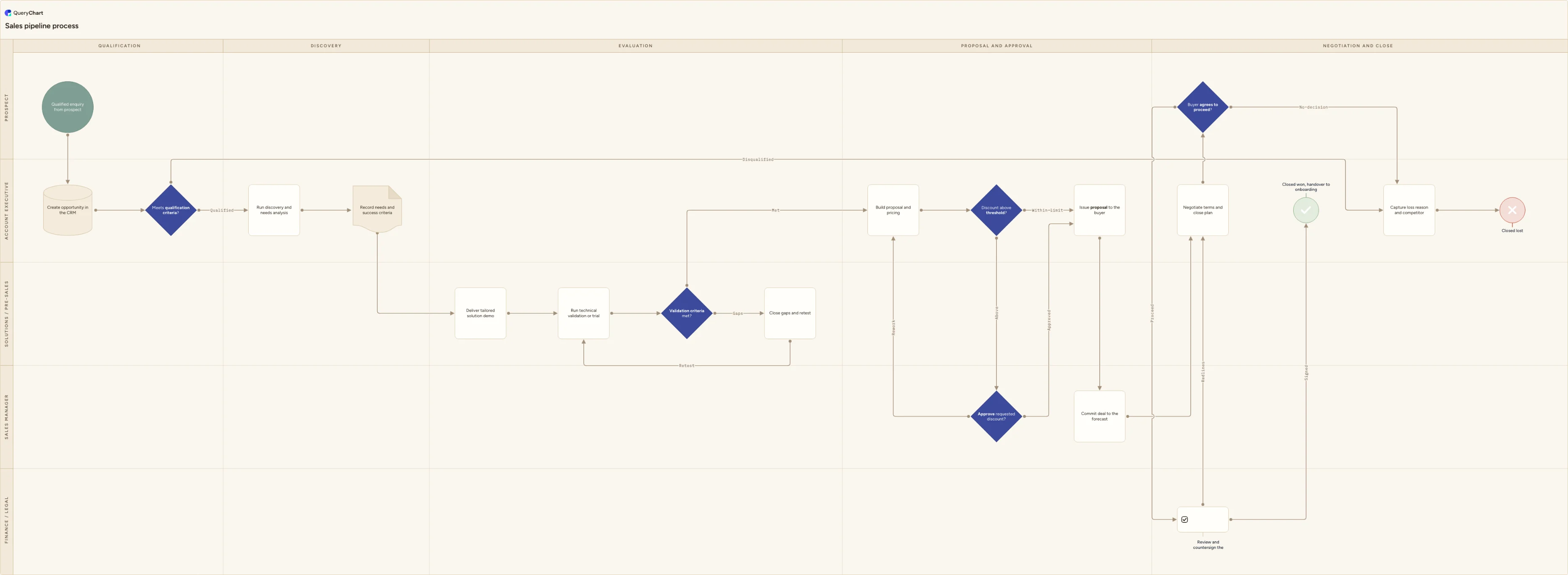
A five-lane sales pipeline process flowchart from qualified opportunity to closed won or lost: discovery, demo, validation, pricing, discount approval, close.
What the sales pipeline process flowchart: opportunity to closed won process is
The sales pipeline process is what a seller actually does with one opportunity after it has been qualified: discovery and needs analysis, a tailored demo, a technical validation or trial, a priced proposal, an internal approval when the discount goes past the rep's limit, negotiation, contract review, and a recorded outcome. It is deal-by-deal work owned by the account executive, with pre-sales, the sales manager and legal pulled in at defined points. That is what separates it from the conversion percentages the marketing team reports: a pipeline is a queue of individual opportunities, each sitting in a stage someone has to justify.
This chart starts and stops in deliberate places. It starts at a qualified opportunity, so lead capture, scoring, nurture and the marketing-to-sales handoff sit upstream in demand generation and are not drawn here. It ends at a signed contract and a handover to onboarding. Everything after signature belongs somewhere else: picking, dispatching and invoicing the order are the order fulfilment process, chasing payment and recognising revenue are order-to-cash, and expansion and renewal are account management. If what you need is the flow after the customer has bought, the order fulfilment template is the one to open.
Three things break most pipelines, and none of them is visible on a chart that only draws the happy path. Stage definitions that mean different things to different reps, so the forecast is a collection of opinions. Discounting agreed quickly by whoever was on the call, with no record of who authorised what. And closed-lost records that say nothing usable, so the same deals are lost the same way next quarter. This template maps five lanes, Prospect, Account executive, Solutions / pre-sales, Sales manager and Finance / legal, across five phases, and draws the branches that are usually left undocumented: a qualification gate that can disqualify, a validation-gap loop back into the trial, a discount threshold that routes above-limit deals to the sales manager, a legal redline loop back into negotiation, and a loss-reason capture that both exit routes have to pass through.
What this flowchart covers
In this template
- Five swimlanes, Prospect, Account executive, Solutions / pre-sales, Sales manager and Finance / legal, laid out across five phases: Qualification, Discovery, Evaluation, Proposal and approval, and Negotiation and close.
- Qualification with a real exit: the opportunity is created in the CRM, then a "Meets qualification criteria?" gate either moves it to discovery or sends it straight to the loss-reason capture, so disqualified deals leave the pipeline on the record instead of ageing quietly in an early stage.
- Discovery and needs analysis in the account executive lane, ending in a written record of the buyer's needs and success criteria that pre-sales and legal both work from later.
- Evaluation in the Solutions / pre-sales lane: a tailored demo, a technical validation or trial, and a "Validation criteria met?" decision whose gap branch loops back through a fix-and-retest step rather than letting an unproven requirement reach the proposal.
- The discount control: a "Discount above threshold?" decision keeps within-limit pricing with the account executive and routes above-threshold deals to a sales manager "Approve requested discount?" gate, which either releases the proposal or sends the pricing back for rework. The threshold step carries a note on taking it from your delegation of authority.
- Close-out both ways: forecast commit, negotiation and close plan, a "Buyer agrees to proceed?" gate, legal review and countersignature with a redlines loop back into negotiation, then either closed won with handover to onboarding, or loss reason and competitor captured before the deal is marked closed lost.
When to use this template
- You are writing a sales playbook or onboarding new account executives and need the stages, the handoffs to pre-sales and legal, and the approval points on one page instead of scattered across a deck.
- Deals stall and nobody agrees where: you need to see whether the time goes in validation, in waiting for discount approval, or in contract review before you try to fix it.
- You are configuring opportunity stages in a CRM and want the process agreed first, so stage entry and exit criteria reflect decisions your organisation has actually made.
- Discounting is inconsistent and unrecorded, and you need a documented threshold with a named approver that finance and internal audit can follow.
- Closed-lost data is unusable, and you want the loss reason captured on a fixed route out of the pipeline rather than filled in from memory at quarter end.
How it works
Rename the lanes to the roles you really have
Replace Prospect, Account executive, Solutions / pre-sales, Sales manager and Finance / legal with your own functions. If your reps run their own demos, delete the pre-sales lane rather than pretending a handoff exists. If deal desk, revenue operations or a procurement counterpart is genuinely involved, give them a lane so the boundary is visible. Keep it to five lanes or the chart stops being readable.
Write entry and exit criteria into each stage
The value of the chart is not the box order, it is what has to be true to move on. State what qualifies an opportunity, what counts as discovery being complete, and what a passed validation means. Put those criteria in the step comments so the forecast is based on evidence rather than on how confident the rep sounded.
Set the discount threshold from your delegation of authority
The "Discount above threshold?" decision is where your pricing policy lives. Write down the actual limit, whether it is a percentage off list or an absolute value, what else triggers approval such as contract length, payment terms or non-standard clauses, and who the approver is when the sales manager is unavailable. Record the approval against the opportunity, not in a chat thread.
Agree the legal handoff before you need it
Decide what goes to Finance / legal and what does not: standard paper on standard terms may not need review at all, while a customer paper deal always does. The redlines branch loops back into negotiation, so name who owns the response and what turnaround the buyer is promised. If revenue is recognised under IFRS 15 or ASC 606, the signed contract and its terms are what finance works from, so make the signature step produce a clean record.
Fix the loss reasons, then walk it with the team
Replace free text with a short pick-list everyone applies the same way, and keep the competitor as a separate field. Then take the chart to two or three real deals, one won and one lost, and follow them through it. Correct the chart, not the story. If it becomes a controlled sales procedure, route it through approval so the version reps work from is the version that was authorised, and keep the change history.
Frequently asked questions
What are the stages of the sales pipeline process?
In this chart: qualified opportunity created, qualification check, discovery and needs analysis, tailored demo, technical validation or trial, proposal and pricing, discount approval where the discount is above threshold, proposal issued, forecast commit, negotiation, contract review and countersignature, then closed won with handover to onboarding or closed lost with a recorded reason. The stage names matter less than the exit criteria you attach to each one.
What is the difference between a sales pipeline and a sales funnel?
A pipeline is the seller's view of individual opportunities and the stages each one is in, which is what this chart maps. A funnel is the aggregate view of volume and conversion between stages, usually starting further upstream with leads and enquiries. They use similar stage names, but you manage a pipeline deal by deal and analyse a funnel in cohorts, and this template is built for the first.
When should a discount go to the sales manager?
When it exceeds the limit delegated to the account executive. The chart puts a "Discount above threshold?" gate before the proposal is issued, so within-limit pricing goes straight out and anything above it is decided and recorded by the sales manager first. Set the threshold from your delegation of authority and be explicit about what else needs approval, such as extended payment terms or non-standard contract clauses, because those often cost more than the headline percentage.
Where does this process end, and what takes over?
It ends at the signed contract and the handover to onboarding. Fulfilling the order, invoicing and delivery are covered by the order fulfilment process; collecting payment and recognising revenue sit in order-to-cash; onboarding, adoption, expansion and renewal belong to customer success and account management. Keeping the boundary at signature stops the chart from becoming a map of the whole company.
How should closed-lost deals be handled?
Make the loss reason a required step on the way out, not an optional field. Both exits in this chart, disqualification at the qualification gate and no decision after negotiation, pass through a capture step before the deal is marked closed lost. Use a short pick-list applied consistently, record the competitor separately, and review the reasons at a set interval, because a list of twenty free-text reasons cannot be analysed.
Where this process fits
In most operations this process follows Opportunity management process flowchart (stage exit criteria) and hands off to Sales handoff process flowchart (closed won to customer success).
It is one step in Sales pipeline.
Step 1: CRM lead management process flowchart (dedupe to conversion)
Step 2: Sales lead qualification process flowchart: MQL to SAL
Step 3: Opportunity management process flowchart (stage exit criteria)
Opportunity management process flowchart template: qualification gate, stage exit criteria, forecast category and manager review, deal review threshold, stalled-deal re-engagement, and closed won or lost with a win/loss review.
Step 4: Sales pipeline process flowchart: opportunity to closed won You are here
A five-lane sales pipeline process flowchart from qualified opportunity to closed won or lost: discovery, demo, validation, pricing, discount approval, close.
Step 5: Lead-to-order process flowchart (lead capture to booked order)
Lead-to-order process flowchart template: capture and deduplication, lead scoring and the MQL gate, SDR outreach and sales acceptance, CPQ configuration, discount approval, quote acceptance, credit check and order booking.