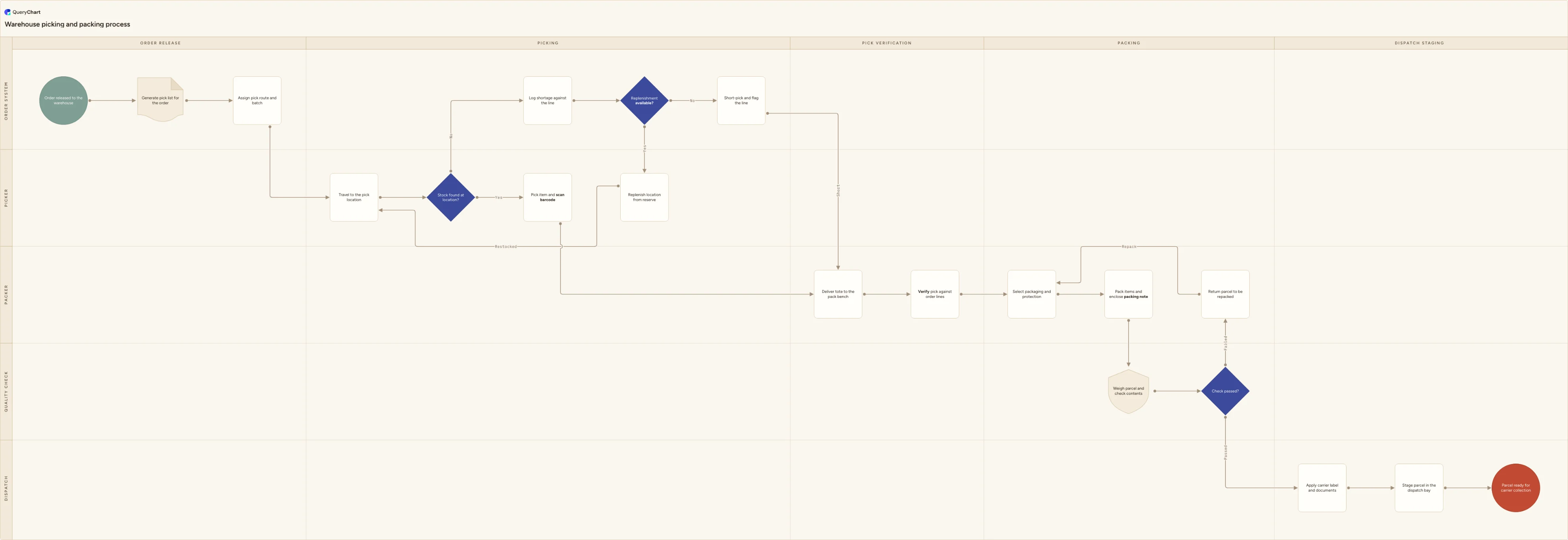
Warehouse picking and packing process flowchart
Warehouse picking and packing process flowchart, released order to staged parcel: pick route, stock shortage and short-pick branches, packing, weight check.
What the warehouse picking and packing process is
Picking and packing is the physical half of fulfilment. An order that has already been accepted is released to the warehouse, a pick list and route are generated, a picker walks the route and scans what they take, the tote is verified against the order lines at the bench, the items are packed with the right protection and paperwork, the parcel is weighed and content-checked, and it is labelled and staged in the dispatch bay for the carrier. Two people typically touch it, a picker and a packer, and almost everything that goes wrong downstream (wrong item, wrong quantity, missing line, damaged goods) was either created or catchable inside that window.
This chart deliberately stops at both ends. It does not cover order capture, validation, credit checks or stock allocation, which happen before the order is released; the order fulfilment template covers that wider flow. It does not cover carrier collection, transit, proof of delivery or invoicing, which begin once the parcel leaves the bay. It is not the replenishment cycle either: reorder points, cycle counting and stock adjustments belong to inventory management, and the only replenishment question this process asks is whether the same item can be moved from reserve to the pick face right now. Returns are a separate inbound process. If you want the whole customer order lifecycle on one page, use the order fulfilment chart; if you want the warehouse floor drawn properly, use this one.
Three decisions carry the flow. 'Stock found at location?' is the one most picking procedures skip, and it is where the process either recovers or quietly ships short. Its 'No' branch runs into 'Replenishment available?', which separates a fixable gap (stock sitting in reserve) from a genuine short-pick that has to be flagged so the rest of the order is not held for one line. 'Check passed?' at the weigh station decides whether a parcel goes to the label printer or back to the packing bench. Each of those needs a named owner and a written rule before the diagram becomes a control rather than a description.
What this flowchart covers
In this template
- Five swimlanes (Order system, Picker, Packer, Quality check and Dispatch) laid across five phases: order release, picking, pick verification, packing and dispatch staging.
- Release in the Order system lane: the order is released to the warehouse, a pick list is generated as a document, and a pick route and batch are assigned, with a note prompting you to state whether you pick by single order, batch, zone or wave.
- Picking in the Picker lane: travel to the pick location, then a 'Stock found at location?' decision whose 'Yes' branch picks the item and scans the barcode at the face.
- The shortage path most procedures leave undrawn: 'No' logs the shortage against the line, then a 'Replenishment available?' decision either replenishes the location from reserve and loops the picker back to the same location, or short-picks and flags the line so the remaining items still move to the bench.
- Verification and packing: the tote is delivered to the pack bench and verified against the order lines, then packaging and protection are selected, the items packed and a packing note enclosed, with a note on catching variant errors, the right product in the wrong size or colour.
- A 'Check passed?' decision in the Quality check lane after the parcel is weighed and its contents checked, with a failed check returning the parcel to be repacked and a passed check moving to carrier label and documents, staging in the dispatch bay, and the parcel being ready for collection.
When to use this template
- You are writing a picking and packing SOP or a work instruction for the pack bench and need the picker, packer, checker and dispatch handoffs on one page instead of four laminated cards that quietly disagree.
- Mis-picks and short shipments are being found by customers rather than at the bench, and you need to see which control (the location scan, the pick verification or the weight check) is missing or being skipped.
- You are configuring picking and packing in a WMS and want the route rule, the shortage handling and the pack-verification step agreed before anyone builds them.
- Shortages at the pick face are handled by whoever is on shift, so some become replenishments, some become silent substitutions and some become an order that sits waiting on one line.
- New warehouse staff need to know what to do when the bin is empty, and what happens to a parcel that fails the weight check.
How it works
Rename the lanes to your real roles
Replace Order system, Picker, Packer, Quality check and Dispatch with the roles you actually have. If pickers pack their own orders, merge the Picker and Packer lanes rather than drawing a handoff that never happens. If a third-party logistics provider runs the floor, give the 3PL a lane so the boundary of your control is visible. If the packer also performs the weight check, say so — a separate Quality check lane implies a second pair of eyes.
Write in your picking method and route rule
The 'Assign pick route and batch' step is where your method lives. State whether you pick single order, batch, zone or wave, and what drives the sequence: location sequence, carrier cut-off, or order priority. Batch and zone picking both create sortation or consolidation work later, so if you use them, add that step to the chart rather than leaving it implied.
Make the shortage rule explicit
Decide who may declare a short-pick, when a replenishment from reserve is triggered instead, and how customer service finds out that a line went short. Substitution deserves its own written rule: if a picker may swap a variant, say under what conditions and who records it; if they may not, say that too. This is the branch that determines whether shortages surface at the bench or at the customer.
Define what 'check passed' means and who records it
Set the weight tolerance yourself, based on your item master weights plus packaging, and test it against real parcels before you trust it. Decide whether the content check runs on every parcel or on a sample, and state the sampling basis. Record who performed the check and when, because a check with no record cannot be evidenced afterwards.
Add your packaging, labelling and any restricted-goods branch
Attach the packaging specification to the 'Select packaging and protection' step: box grades, void fill, fragile and cold-chain handling. If you ship items subject to transport restrictions, such as lithium batteries or aerosols, add a branch for the additional labelling, documentation and carrier declarations they require, and name the person authorised to release them.
Walk it on the floor with real orders
Follow two or three live orders through the chart at the pick face and the bench, including one that went short and one that failed the weight check. Fix the chart against what people actually do, not what the procedure says. If it becomes a controlled document, route it through approval so the version on the wall is the version that was authorised.
Frequently asked questions
What are the steps in the warehouse picking and packing process?
Order released to the warehouse, pick list generated, pick route and batch assigned, travel to the pick location, check that stock is at the location, pick the item and scan the barcode, deliver the tote to the pack bench, verify the pick against the order lines, select packaging and protection, pack the items and enclose the packing note, weigh the parcel and check the contents, then apply the carrier label and documents and stage the parcel in the dispatch bay. The steps that separate a working process from a paper one are the exceptions: what happens when the bin is empty, and what happens when the check fails.
What is the difference between picking and packing?
Picking is retrieving items from their storage locations against a pick list: travel, location scan, item scan and quantity confirmation. Packing is turning those items into a shippable parcel, which means choosing the packaging and protection, enclosing the packing note, and applying the label and documents. The control that joins them is verification at the bench, where the tote is checked against the order lines. Skip that and picking errors become packing errors, and packing errors become customer complaints.
How should a stock shortage during picking be handled?
Log it against the line at the face, while the picker is standing at the empty bin, not later at the bench where the detail is lost. Then answer one question: is the same item available in reserve or bulk? If it is, replenish the location and pick it. If it is not, short-pick the line, flag it so customer service can act, and let the rest of the order continue to the bench rather than holding the whole parcel for one line. Substituting a different variant without recording it is what turns a shortage into a return.
What should the weight and content check catch?
It is the last gate before the parcel is sealed and labelled, and it catches two classes of error: a missing or extra item, which shows up as a variance against the expected weight from the item master plus packaging, and a wrong item of similar weight, which only a content check will find. Its usefulness depends entirely on those item weights being accurate, so validate them before relying on the tolerance. A failed check should return the parcel to be repacked and the reason recorded, otherwise you lose the only data that tells you why parcels fail.
Does this template help with ISO 9001?
It gives you a documented process to work from, which is not the same as compliance. Two clauses are genuinely relevant. Clause 8.5.4, preservation, expects outputs to be preserved to the extent necessary to ensure conformity, and the standard's own note gives packaging, handling, protection and transportation as examples, which maps to the packaging and protection step. Clause 8.6, release of products and services, expects planned verification that requirements have been met before release, with records of conformity and traceability to whoever authorised it, which maps to the pick verification and the weight and content check. You still need the underlying records, and an auditor will want evidence that the floor follows the chart.