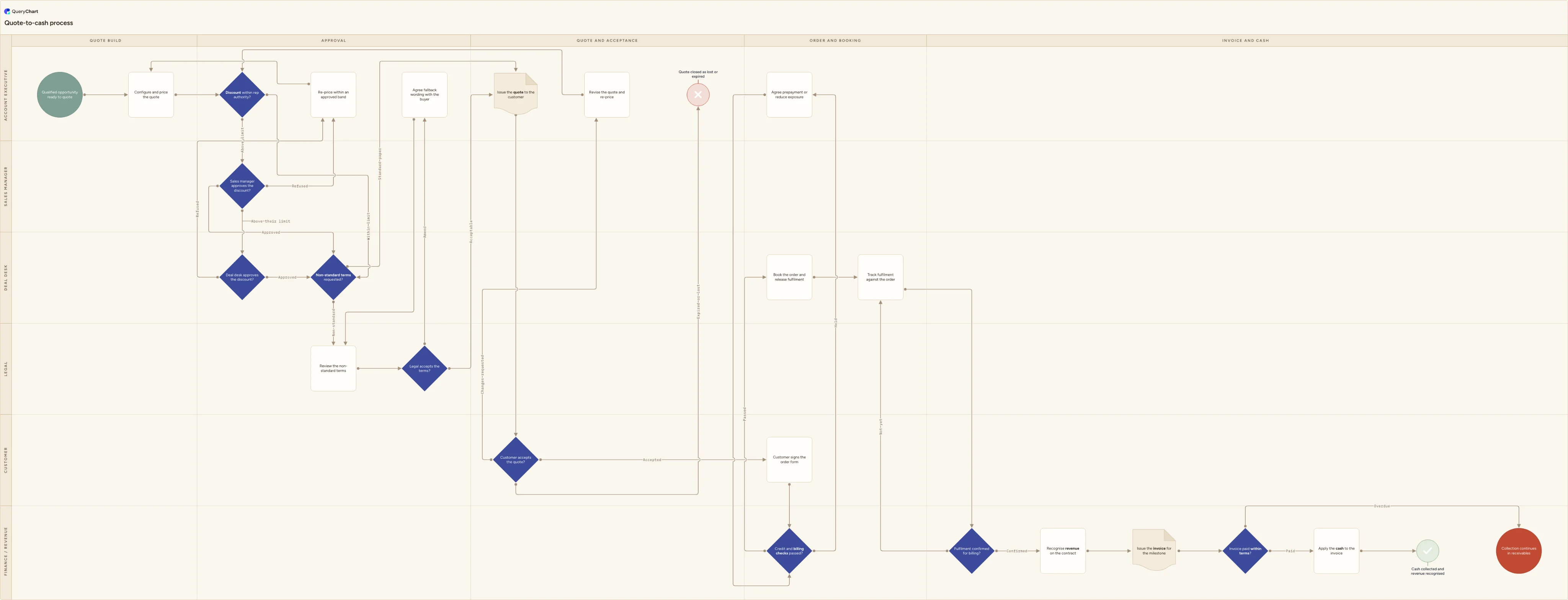
Quote-to-cash process flowchart (opportunity to cash collected)
Quote-to-cash (Q2C) process flowchart: configure and price the quote, clear the discount ladder and the legal review of non-standard terms, issue the quote, book the order, invoice the milestone and collect the cash.
What the quote-to-cash process flowchart (opportunity to cash collected) process is
Most quote-to-cash problems are not pricing problems; they are version problems. What was quoted, what was signed, what was booked and what was billed are four documents in four systems, and in a great many companies no two of them agree. A discount is conceded on a call and never reaches the order form. A payment term is changed in a redline and never reaches the billing schedule. A milestone is delivered and nobody tells finance it can be invoiced, so an invoice that could have gone out in March goes out in June and the payment clock starts three months late. Each gap is small on its own and each one costs either margin or days. The second failure is an approval ladder that only measures percentage off list. Extended payment terms, a ramped commitment, free professional services, a capped uplift and a bespoke service level all give margin away without ever registering as a discount, so the deals that most deserve scrutiny sail through while a routine ten per cent waits for a director who is on holiday. Both failures live at the joins between functions rather than inside them, which is why they only become visible when the cycle is drawn end to end.
This chart spans the whole arc from qualified opportunity to collected cash, but it is deliberately deep in the front half and shallow in the back. The selling motion (discovery, demonstrations, technical validation and the forecast the deal is carried in) is drawn at /templates/sales-pipeline-process, and everything upstream of an opportunity, from lead capture through scoring to the sales-accepted handover, sits at /templates/sales-lead-qualification-process. The internal route a contract takes through delegated authority, signature and filing is a process in its own right at /templates/contract-approval-process; here it is compressed into the customer signing the order form. Downstream, "Track fulfilment against the order" is a single box standing in for the whole of /templates/order-fulfillment-process, and the "Overdue" branch leaves the chart for /templates/accounts-receivable-process instead of redrawing the dunning ladder. The nearest neighbour is /templates/order-to-cash-process, which starts at the accepted order and goes deep on credit holds, proof of delivery, short payments and collections. Quote-to-cash starts earlier, at the opportunity, and carries its detail in the pricing and approval work that happens before an order exists at all. Use this page for the commercial front half; use order-to-cash for the fulfilment and collections half.
Three modelling decisions here are usually left implicit in written pricing policy. The first is that the discount control is a ladder, not a single gate: "Discount within rep authority?" hands up to "Sales manager approves the discount?", which has three exits ("Approved", "Above their limit" and "Refused") so escalating a deal and refusing one are different outcomes, and only refusal drops to "Re-price within an approved band". Nor is a revision a way round the ladder: "Revise the quote and re-price" returns to the first test, because a shorter term or a payment-term concession can move a deal into a tier the rep was never allowed to approve. The second is that price and paper are decided apart. "Non-standard terms requested?" is answered by the deal desk before legal is involved at all, so a standard-paper deal never queues behind a redline and legal is asked about clauses rather than about a price. The third is that "Fulfilment confirmed for billing?" releases the revenue entry and the invoice together, so revenue follows the obligation that was met rather than the cash that arrives later, and its "Not yet" loop needs somebody to age it, because a delivered but unbilled order produces no complaint from anyone.
What this flowchart covers
In this template
- Six swimlanes (Customer, Account executive, Sales manager, Deal desk, Legal and Finance / revenue) laid across five phases: Quote build, Approval, Quote and acceptance, Order and booking, and Invoice and cash.
- Quote build in one deliberate step: "Configure and price the quote" ties the configuration, the term and the volumes to the price book version in force, so the order form later carries product codes finance can actually bill.
- A three-tier discount ladder ("Discount within rep authority?", then "Sales manager approves the discount?" with a separate branch for a deal above their own limit, then "Deal desk approves the discount?") where a refusal by either approver drops to "Re-price within an approved band", which returns to "Configure and price the quote" and runs the ladder again.
- A separate terms route: "Non-standard terms requested?" sends standard paper straight to issue, and non-standard requests to "Review the non-standard terms" and "Legal accepts the terms?", whose amend branch loops through "Agree fallback wording with the buyer" and back into legal review.
- Acceptance with three real outcomes at "Customer accepts the quote?": accepted goes to signature, changes requested loops back through "Revise the quote and re-price" to the first discount test, and a quote that lapses ends at "Quote closed as lost or expired".
- The cash tail: "Credit and billing checks passed?" with a prepayment loop, "Book the order and release fulfilment", then the gate "Fulfilment confirmed for billing?" releasing both "Recognise revenue on the contract" and "Issue the invoice for the milestone", ending at "Cash collected and revenue recognised" or handing off at "Collection continues in receivables".
When to use this template
- You are implementing or replacing a CPQ tool and need the approval ladder, the terms route and the booking hand-off agreed on paper before anyone configures a rule.
- Your average deal takes days to quote and you cannot say whether the time goes in configuration, in waiting for a discount approver, or in legal reviewing terms that were never non-standard.
- Finance keeps finding orders that were delivered months ago and never invoiced, and you need the billing trigger and the booked-but-unbilled loop drawn rather than assumed.
- You are writing a pricing and delegation-of-authority policy and want the thresholds tied to a picture of who decides what, in what order, and what happens on a refusal.
- An auditor or an incoming finance director has asked who authorised a particular price, and nothing on the quote record says who approved it, when, or which version they approved.
How it works
Rename the lanes to your own functions
Replace Customer, Account executive, Sales manager, Deal desk, Legal and Finance / revenue with the roles you actually have. Not every organisation has a deal desk: if margin and precedent are judged by revenue operations, a commercial director or the CFO, rename the lane rather than pretending a team exists. If legal is outside counsel, keep the lane and put the turnaround time in the step comment, because an external review changes what the process can promise a buyer. Merge lanes only when the same person really does both jobs.
Write the discount ladder as figures
The ladder is inert until each tier has a number. Set what a rep may concede unaided, where the sales manager's authority stops and what only the deal desk or a finance director may sign, and express it as both a percentage off list and an absolute value so a five per cent discount on a £400,000 deal is not treated as routine. Then decide what the ladder actually measures: the effective discount across the whole committed term and the margin left after delivery cost, rather than the headline percentage on the first year.
Define what non-standard actually means
"Non-standard terms requested?" only works if somebody maintains a list. Write down the standard order form, the pre-approved fallback positions for the clauses buyers push on most — liability cap, indemnity, termination for convenience, data processing, auto-renewal — and the rule that anything outside them goes to legal. Publish the fallbacks to the sales team so they can concede a pre-approved position on the call without a review at all. Review the list twice a year against the redlines you actually received, not against the ones you feared.
Make the quote document carry its own approvals
Decide what an issued quote must show: a version number, a validity date, currency and tax treatment, what is in scope and explicitly what is not, the billing schedule, and the approvals it carries with the approver and date. Version revisions instead of overwriting them, so the record shows which quote the customer signed and what was authorised for it. This is the step that answers the audit question later, and it costs nothing to build in now and a great deal to reconstruct afterwards.
Set the billing trigger and age the backlog
Decide per product what "Fulfilment confirmed for billing?" requires: a signed delivery note, an acceptance certificate, a go-live date, a usage reading or simply the subscription start. Write it into the order at booking rather than settling it at invoice time, and note that the same confirmation releases the revenue entry, so a loose definition moves two numbers and not one. Then give the loop an owner and a report: a weekly list of booked orders whose milestones are due and unbilled, read by finance rather than by whoever delivered the work, with a target age past which every remaining line needs a name against it.
Walk it through with the people who do it, then publish a version
Take the finished chart to a rep, a deal desk reviewer, the lawyer who sees the redlines and the person who raises invoices, and run two real deals through it — one that went straight through and one that went round the approval loop twice. Correct the chart to what they actually do, not to what the policy says. Then publish that revision through approval and keep the earlier ones, so anyone opening it later can tell which version of the pricing policy they are reading.
Frequently asked questions
What are the steps in a quote-to-cash process?
In this chart: a qualified opportunity is confirmed as ready to quote, the solution is configured and priced against the current price book, the discount is tested against the rep's authority and escalated up a ladder to the sales manager and then the deal desk if it exceeds it, any non-standard terms are reviewed by legal, the quote is issued, the customer accepts it or asks for changes, the order form is signed, credit and billing checks are cleared, the order is booked and released to fulfilment, the milestone is confirmed, revenue is recognised against the contract and the invoice goes out, and the cash is applied when it arrives. Two routes leave the process rather than completing it: a quote that lapses is closed as lost or expired, and an overdue invoice is handed to receivables. What makes the process work is not the list of steps but four things hung on it: the figures behind each rung of the discount ladder, a written definition of what counts as non-standard terms, the evidence that counts as fulfilment, and a record on the quote of who approved what and when.
What is the difference between quote-to-cash and order-to-cash?
They overlap on purpose and are cut at different points. Order-to-cash begins at the order you have already accepted and covers what it takes to fulfil and collect it: order and master data validation, credit holds and releases, dispatch, proof of delivery, invoicing, cash application, short payments, dunning and write-off. Quote-to-cash begins earlier, at the qualified opportunity, and its detail sits in the commercial work that creates the order in the first place — configuration, pricing, the discount approval ladder, the legal review of non-standard terms, the issued quote and the booking of the signed order. This chart carries the spine through to cash so the whole revenue chain is visible on one page, but it compresses fulfilment and collections into a handful of steps. If your problem is the price, the paper and the approvals, use this page; if it is credit, delivery evidence and getting paid, use /templates/order-to-cash-process.
How is quote-to-cash different from the sales pipeline process?
A sales pipeline chart maps the selling motion: discovery, needs analysis, demonstrations, technical validation, negotiation, the forecast commit and the closed-won or closed-lost outcome. It is owned by sales and it ends at signature. Quote-to-cash maps the commercial transaction that runs alongside and then past it: what is configured, what it costs, who authorised the discount, whether the terms are standard, what was booked, when it can be billed and when the cash and the revenue land. The two share a boundary at the quote and the signature, but they answer different questions and they are usually owned by different people — sales operations and the deal desk own quote-to-cash, sales management owns the pipeline. If you are defining stages, exit criteria and forecast discipline, use /templates/sales-pipeline-process. If you are defining pricing authority, quoting and billing, use this one.
What does a deal desk do, and do we need one?
A deal desk owns the commercial shape of a deal rather than the relationship. It holds the price book and the approved discount bands, judges margin and precedent on the deals that fall outside them, rules on the paperwork before a lawyer opens it, and checks that what was approved is what actually gets booked. In this chart it takes escalated pricing at "Deal desk approves the discount?" and answers "Non-standard terms requested?", which is why standard paper can go straight to issue. You need the function once exceptions are frequent enough that sales managers are approving concessions they have no way of costing, or once the same concession is being granted in three regions on three different bases. Below that volume the work still exists and is being done by default rather than by design, so name whoever is doing it and give them the lane. What you should not do is leave it with the account executive who negotiated the deal.
Where does revenue leak in a quote-to-cash process?
In four predictable places. Concessions that never register as a discount — long payment terms, ramped commitments, free professional services, capped uplifts — pass through the ladder untouched because it only measures percentage off list. Verbal or emailed price agreements made after the quote was issued reach the order form without ever being approved. What was signed and what was booked drift apart, so the invoice, the revenue schedule and the renewal all inherit the difference. And work that has been delivered is never billed, because the person who delivered it has no reason to think about invoicing and the person who invoices does not know the milestone was met. The last is the largest and the quietest: nobody outside the company will ever chase you for an invoice you failed to send. This chart puts a gate in front of it and a loop behind it, and the loop needs an owner and an ageing report to be worth anything.
Where this process fits
In most operations this process follows Sales lead qualification process flowchart: MQL to SAL and hands off to Accounts receivable process flowchart (invoice to cash).
Comes before
- Sales lead qualification process flowchart: MQL to SAL — A swimlane sales lead qualification process flowchart: lead capture, ICP scoring, the MQL decision, SDR cadence, discovery, BANT or MEDDIC and AE handover.
Comes after
- Accounts receivable process flowchart (invoice to cash) — A five-lane accounts receivable process flowchart: credit check, invoice issue, payment terms, dunning, disputes, payment plans, cash application, write-off.