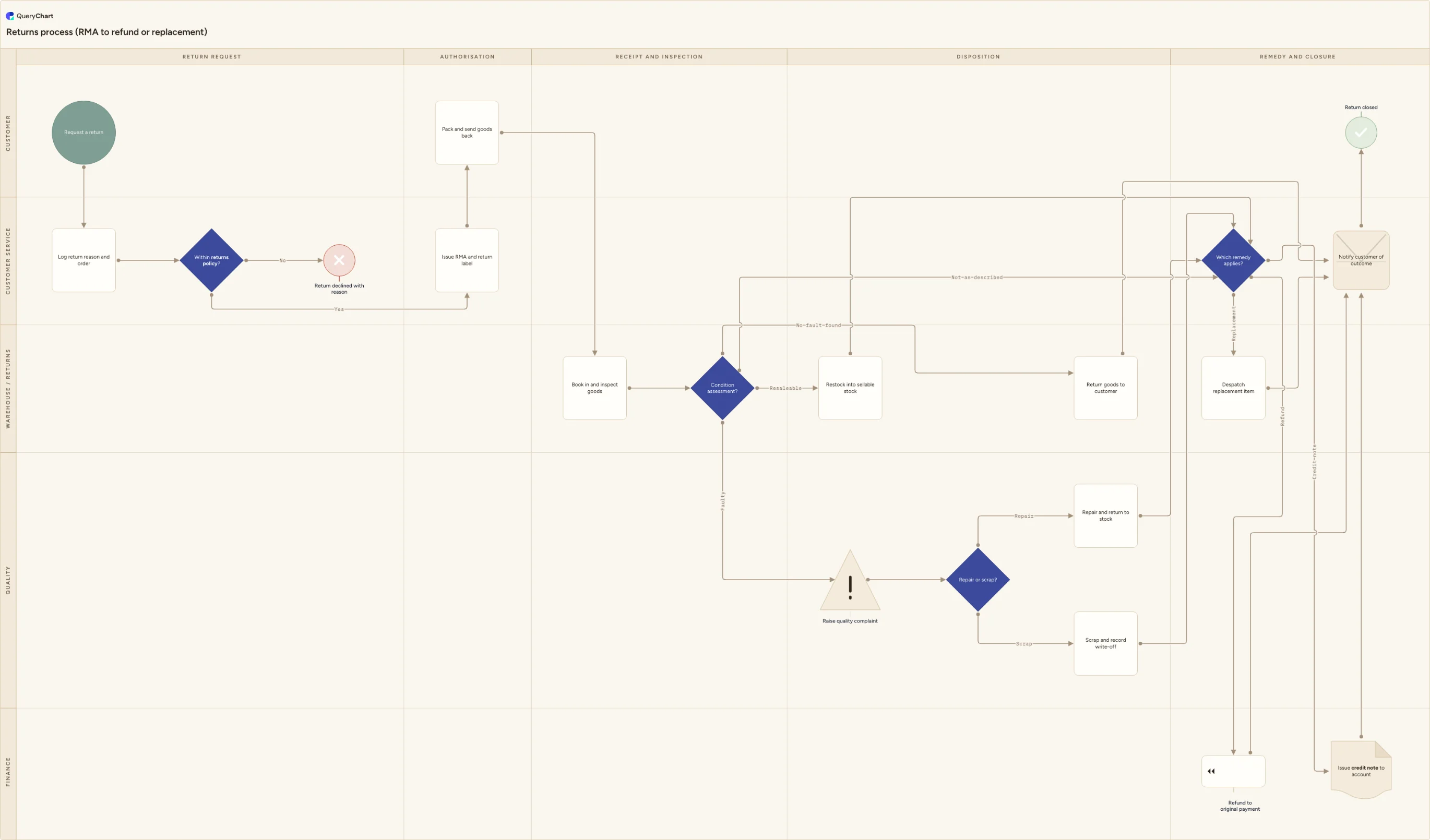
Returns process flowchart template (RMA to refund)
Returns process flowchart template covering the RMA route from return request and policy check through inspection and disposition to refund or replacement.
What the returns process flowchart template (RMA to refund) process is
A returns process settles two things at once: where the physical goods end up, and what the customer gets back. Those two threads run at different speeds and through different teams. The customer wants a refund; the warehouse wants stock accounted for; finance wants a documented reason before money leaves. Most returns problems are not decision problems, they are handover problems between those threads.
The hinge is the condition assessment. Until someone has looked at the goods and graded them, no downstream step can be settled: you cannot restock, you cannot raise a quality complaint, and you cannot fairly choose between a refund, a replacement and a credit note. That is why the two failure modes worth designing out are parcels that arrive but are never booked in against their RMA, and condition grades that were never written down, so two inspectors grade the same item differently.
This template maps the full route across five lanes and five phases. It covers the ordinary path (request, policy check, RMA, receipt, inspection, restock, refund) and the awkward ones: a return declined as outside policy, a faulty item that becomes a quality complaint and is repaired or scrapped, and a no fault found return that goes back to the customer. Every path ends in a customer notification, because the return is not closed until the customer has been told what happened.
What this flowchart covers
In this template
- Five lanes (Customer, Customer service, Warehouse / Returns, Quality and Finance) across five phases: return request, authorisation, receipt and inspection, disposition, and remedy and closure
- A "Within returns policy?" decision that either issues an RMA with a return label or declines the request with a stated reason
- Goods booked in and inspected against the RMA number, then a four-way condition assessment: resaleable, faulty, not as described, or no fault found
- The faulty route into a quality complaint, with a repair-or-scrap decision leading to either repair and return to stock, or scrap and a recorded write-off
- A remedy decision splitting three ways into a refund to the original payment method, a replacement despatch, or a credit note raised against the account
- A no fault found path that returns the goods to the customer, and a single notification step every route passes through before the return is closed
When to use this template
- You are writing or reworking a returns policy and need to see who actually performs each step, not just what the policy promises
- You are inducting customer service or warehouse staff and want one diagram that shows where their part starts and ends
- Returns are stalling and you need to find the stall point: usually unbooked parcels, undefined condition grades, or a remedy nobody is authorised to approve
- You are configuring a returns or RMA tool and need agreement on the customer service, warehouse and finance split before anything is built
- Reverse logistics costs are rising and you need to attribute them: restocked, repaired, scrapped, or returned as no fault found
How it works
Set your policy tests
Replace the "Within returns policy?" decision with your actual tests: the return window in days, the excluded item list, and the proof required. Note the exception explicitly — statutory rights for faulty goods normally sit outside your policy window, so faults should not be declined on age alone.
Name the teams in the lanes
Rename the five lanes to your real functions. If one team runs both customer service and finance, merge those lanes rather than leaving an empty one. If a third-party logistics provider handles receipt and inspection, rename the Warehouse / Returns lane after them so the external handover is visible.
Define your condition grades
The four branches off "Condition assessment?" are the part most worth adapting. Write a one-line definition for resaleable, faulty, not as described and no fault found, and record who is authorised to apply each. Add or remove grades if your goods need them, such as opened but unused.
Set remedy authority and timings
Against the "Which remedy applies?" decision, record who may approve each remedy and up to what value, and the target time from goods received to money returned. Decide whether credit notes are offered at all — for consumer refunds they usually are not an acceptable substitute.
Connect the quality route
Point "Raise quality complaint" at whatever record your organisation already uses for nonconformities, and make sure the batch or serial number is captured so repeat failures can be traced back to a supplier or production run.
Walk the exception paths
Test the three routes people forget: a declined request, a no fault found return going back to the customer, and a scrapped item where the customer is still owed a remedy. Confirm each one reaches the notification step, then share the chart with the teams in the lanes for correction.
Frequently asked questions
What is the difference between a return and an RMA?
A return is the customer's intent to send something back. An RMA — return merchandise authorisation — is the reference your organisation issues to permit it, and it is what makes the return trackable. The RMA number travels on or in the parcel so the warehouse can book the goods in against the original request rather than receiving an anonymous box. Without one, goods arrive that nobody can link to a customer, which is the most common cause of a refund that is owed but never paid.
Who decides between a refund, a replacement and a credit note?
In this chart, customer service owns the "Which remedy applies?" decision, and finance executes the refund or credit note while the warehouse despatches a replacement. In practice the decision is constrained rather than free: for faulty goods the customer usually has a statutory entitlement that limits what you can offer, and consumer refunds normally go back to the original payment method. Credit notes suit trade accounts with an open ledger. Set an approval threshold by value so high-value remedies are escalated rather than settled at the desk.
What should happen when no fault is found?
The goods go back to the customer and no remedy is paid, which makes this the grade most likely to be disputed. Two things protect it: a defined test that the inspector follows rather than a judgement call, and evidence — photographs taken at book-in and a recorded test result. Track your no fault found rate by product. A high rate is rarely a customer problem; it usually points to unclear instructions, a misleading listing, or a setup step customers cannot complete.
How does this fit with a quality management system?
The faulty branch is where returns meet quality management. ISO 9001 requires nonconforming outputs to be identified and controlled, and to have their disposition recorded — which is exactly what the repair-or-scrap decision and the write-off step do. Using the template does not make a process compliant; it gives you a documented process description, and if you keep it under version control with a review and approval record, it can serve as the controlled procedure your auditor asks to see.
Where this process fits
In most operations this process hands off to Returns management process flowchart (reverse logistics).
Comes after
- Returns management process flowchart (reverse logistics) — Returns management process flowchart template covering goods receipt against an authorisation, inspection and grading, disposition, supplier claims and credit.
- Quality complaint process flowchart template — A quality complaint process flowchart across five lanes: logging and acknowledgement, safety and reportability checks, investigation, remedy, CAPA and closure.
- Customer refund process flowchart (request to money returned) — Customer refund process flowchart: policy and window eligibility, manager goodwill approval, payment verification, refund to the original method, chargebacks.