Inventory management process flowchart
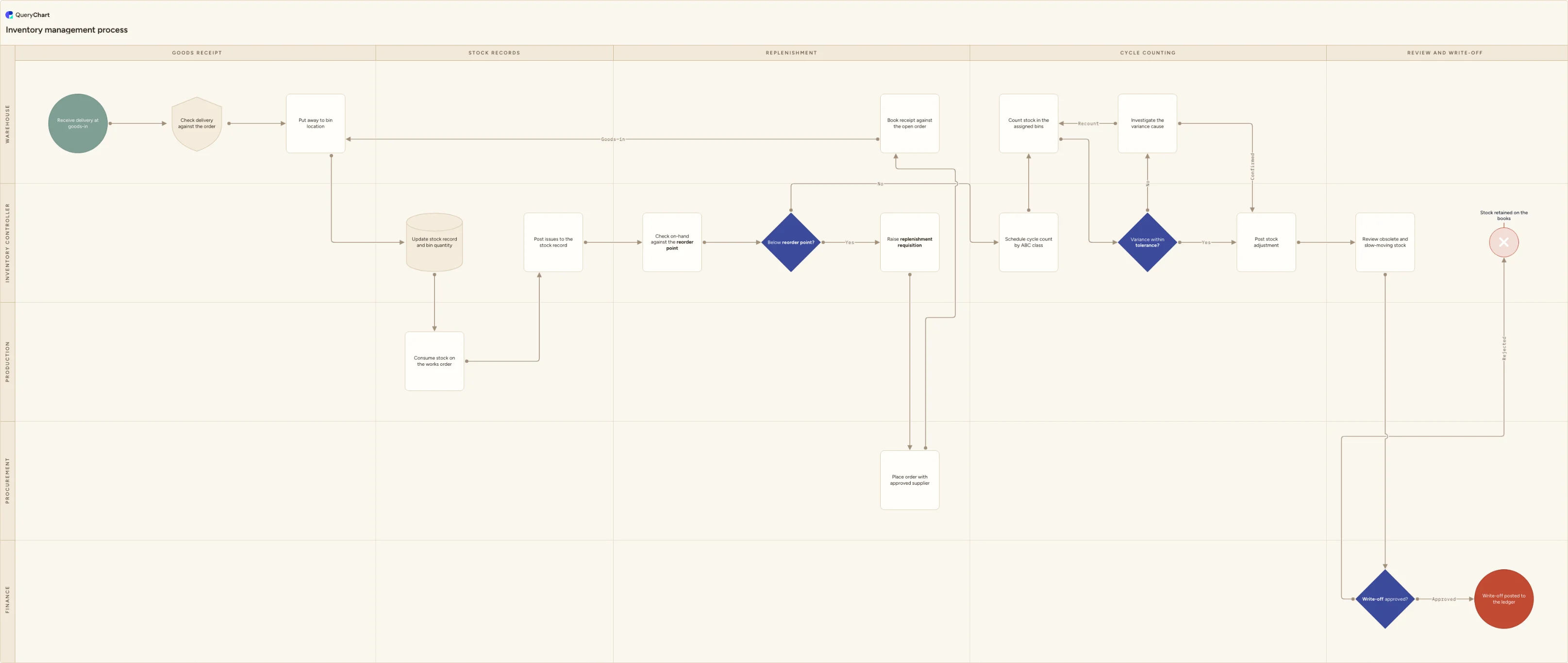
Inventory management process flowchart template covering goods receipt, put-away, reorder-point replenishment, cycle counting, stock adjustment and write-off.
What the inventory management process is
Inventory management is a loop rather than a line. Stock arrives, is put away and recorded, is drawn down by production or customer demand, and the record has to keep pace with every one of those movements. This template covers the loop end to end: goods receipt and put-away, the stock record update, consumption, a reorder-point check that triggers replenishment, cycle counting, and the review and write-off of stock that is no longer worth holding.
Most inventory problems are record problems. On-hand figures drift away from physical stock because put-away is booked late, issues are posted in batches at the end of the week, or a receipt is matched against the wrong order. Once the record drifts, the reorder point fires at the wrong moment: either tying up cash in stock nobody needs, or stopping a line for a part the system believes is sitting in the bin.
Two decisions carry the process. 'Below reorder point?' decides whether a replenishment requisition goes to procurement. 'Variance within tolerance?' decides whether a counting difference is posted as a routine adjustment or investigated first. Both thresholds need a number and a named owner. Without them the diagram describes an intention rather than a control.
What this flowchart covers
In this template
- Five swimlanes (Warehouse, Inventory controller, Production, Procurement and Finance) across five phases: goods receipt, stock records, replenishment, cycle counting, and review and write-off
- Inbound flow in the Warehouse lane: receive the delivery at goods-in, check it against the order and put it away to a bin location, with the stock record and bin quantity then updated as a document step
- Demand consumption: Production consumes stock on the works order and the inventory controller posts the issues back to the stock record, so on-hand is current before the reorder point is checked
- A 'Below reorder point?' decision that either raises a replenishment requisition for Procurement to place with an approved supplier, or moves straight to counting; the receipt is booked against the open order and loops back to put-away, closing the replenishment cycle
- Cycle counting scheduled by ABC class and counted in assigned bins, with a 'Variance within tolerance?' decision routing out-of-tolerance results to a warehouse investigation that triggers either a recount or a confirmed stock adjustment
- Obsolete and slow-moving stock review ending at a Finance 'Write-off approved?' decision, with an approved write-off posted to the ledger and a rejected one leaving the stock on the books
When to use this template
- You are documenting stock control for an ERP or WMS implementation and the handoffs between warehouse, inventory control and procurement have to be agreed before anything is configured
- On-hand accuracy is poor and you need to see where the record falls behind the physical movement, which is usually a posting point rather than a counting problem
- You are writing an inventory SOP and need one picture of receipt, put-away, replenishment, counting and adjustment instead of five separate desk instructions
- You want to agree count tolerances and write-off authority with finance, so adjustments above a threshold are routed for sign-off rather than posted quietly
- An auditor or certification body has asked for a current, documented description of how stock is received, counted and adjusted
How it works
Rename the lanes to your roles
Replace Warehouse, Inventory controller, Production, Procurement and Finance with the roles that genuinely exist in your organisation. If one person is both inventory controller and buyer, merge those lanes rather than pretending the handoff happens.
Write your reorder point rule onto the chart
Replace the generic check with your own rule, for example expected demand over the replenishment lead time plus safety stock. Note whether it is recalculated automatically in the ERP or reviewed manually, and how often.
Define the count cycle and the tolerance
Set the ABC classes and count frequency (for example A items monthly, B quarterly, C annually) and state the variance tolerance in both units and value. That number is what separates a routine adjustment from an investigation.
Name the approval thresholds
Record who may post a stock adjustment, above what value it needs a second signature, and who authorises a write-off. The Finance decision is where that delegated authority is actually exercised, so it should carry the threshold.
Map the steps to real system transactions
Annotate each step with the transaction people click in your ERP or WMS: goods receipt, put-away confirmation, issue posting, count entry, adjustment, write-off. A diagram that does not match the screens gets ignored.
Walk it against real movements
Run the chart against two or three recent receipts and one completed count. Any step people describe that is missing from the chart, or drawn but skipped in practice, is the finding worth acting on.
Frequently asked questions
What are the main steps in the inventory management process?
Receive and check goods against the order, put them away to a bin location, and update the stock record. Stock is then consumed against demand and the issues posted back, on-hand is compared to the reorder point, and anything below it triggers a replenishment requisition that procurement converts into an order. In parallel, stock is cycle counted, variances are either adjusted or investigated, and obsolete or slow-moving stock is reviewed and written off with approval. The chart above shows all of this across five lanes.
What is a reorder point and where does it sit in the process?
The reorder point is the on-hand quantity at which replenishment must start so stock does not run out before the new order arrives. It is normally expected demand over the replenishment lead time plus safety stock. In this process it is checked immediately after consumption is posted, because checking it against a stale on-hand figure is the most common reason a stock-out happens on an item that was technically in reorder for a fortnight.
How should a stock count variance be handled?
Compare the count to the system quantity and apply a pre-agreed tolerance. Within tolerance, post the adjustment with a reason code. Outside tolerance, investigate before adjusting: the usual causes are put-away booked to the wrong bin, issues not posted, unit-of-measure errors, unrecorded scrap or a miscount, and several of those are fixed by a recount rather than an adjustment. Recording the cause is what makes the adjustment data useful later.
What is the difference between cycle counting and a full stock take?
Cycle counting counts a subset of items continuously, usually prioritised by ABC class so high-value or fast-moving lines are counted more often, and it runs without stopping operations. A full stock take counts everything at a single point in time and normally needs a freeze on movements. Some organisations run a demonstrated cycle-counting programme in place of an annual wall-to-wall count, but that depends on the accuracy they can evidence and on their auditor's agreement.
Where this process fits
In most operations this process hands off to Purchase requisition process flowchart.
Comes after
- Purchase requisition process flowchart — Purchase requisition process flowchart: specification and GL coding, budget check, manager and threshold approval, procurement review and an urgent fast track.