Goods receiving process flowchart (goods-in to GRN)
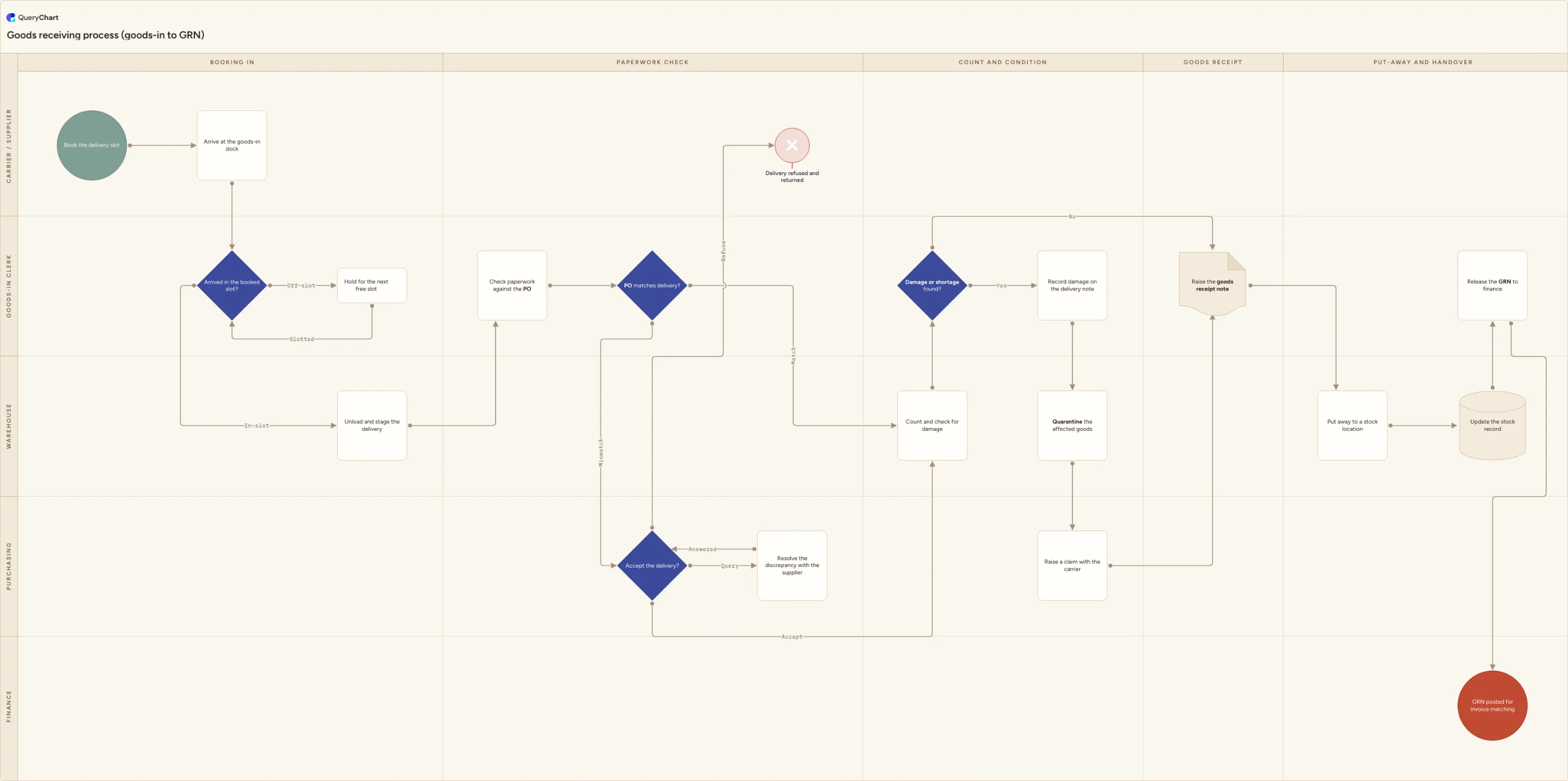
A goods receiving process flowchart for the goods-in dock: booking-in, PO paperwork check, count and damage check, carrier claim, GRN and put-away to stock.
What the goods receiving process flowchart (goods-in to GRN) process is
Goods receiving is the dock process. It covers what a receiving bay does between a vehicle arriving and the stock sitting in a location with a record behind it: the booked delivery slot, the paperwork check against the purchase order, the physical count and damage check, the goods receipt note, put-away, the stock record update, and the release of the GRN to finance. That span is short, repetitive and almost entirely evidential, which is why it is worth drawing properly.
It is deliberately not an inspection process. Establishing that the right quantity of the right items arrived in apparently sound condition is a different job from establishing that they conform to specification, and it is normally done by different people holding different evidence. Where sampling, testing and the disposition of nonconforming stock begin, incoming quality inspection takes over, commonly with the receipt booked into a quality-hold location so the stock exists in the system while it waits. The chart also stops at the handover to finance: the three-way match of purchase order, GRN and invoice belongs to invoice approval, and the wider loop of replenishment, cycle counting and write-off belongs to inventory management. Customer returns come through the same doors but follow the returns process, because the paperwork behind them is an RMA rather than a purchase order.
Two decisions carry the chart. 'PO matches delivery?' decides whether goods are booked in at all, and it is the point at which an unordered or over-delivered pallet is either referred to purchasing or quietly absorbed into stock. 'Damage or shortage found?' decides whether anything is written down while the driver is still on site, which is the only moment at which a carrier claim is straightforward to evidence. Most receiving disputes trace back to one of those two moments passing without a record.
What this flowchart covers
In this template
- Five swimlanes (Carrier / supplier, Goods-in clerk, Warehouse, Purchasing and Finance) across five phases: booking in, paperwork check, count and condition, goods receipt, and put-away and handover
- Arrival control: the carrier books a delivery slot and arrives at the dock, then an 'Arrived in the booked slot?' decision either releases the vehicle for unloading and staging or holds it for the next free slot and loops back
- A paperwork check of the delivery note against the open purchase order, and a 'PO matches delivery?' decision that hands mismatches to Purchasing instead of settling them on the dock
- A Purchasing 'Accept the delivery?' decision with three branches: accept and carry on, query and resolve the discrepancy with the supplier before returning to the same decision, or refuse the delivery and return it to the carrier
- A 'Damage or shortage found?' decision whose damaged-goods branch records the damage on the delivery note, quarantines the affected goods and raises a claim with the carrier before any receipt is booked
- The system leg: the goods receipt note raised as a document step for the accepted quantity, put-away to a stock location, the stock record update, and release of the GRN to Finance for matching against the invoice
When to use this template
- You are writing a goods-in SOP or dock work instruction that agency and shift staff have to follow without a verbal handover
- You are configuring receiving in an ERP or WMS and the handoffs between the dock, purchasing and finance need to be agreed before any transaction is set up
- Invoices keep failing the three-way match and the cause is upstream: receipts booked against the wrong PO, booked days late, or booked at delivery-note quantity rather than accepted quantity
- Damaged pallets are being signed for clean, so carrier claims are refused for want of evidence and the cost lands on your own stock
- An auditor or a customer has asked for a documented description of how inbound goods are received, recorded and put away
How it works
Rename the lanes to your roles
Replace Carrier / supplier, Goods-in clerk, Warehouse, Purchasing and Finance with the roles that exist on your site. On a small dock the clerk and the warehouse operative are the same person; merge those lanes rather than drawing a handover that never happens.
Write down your booking-in rule
State how slots are booked, how long a vehicle may be held, and what happens to an unbooked delivery that turns up anyway. If the honest answer is that everything is taken whenever it arrives, draw that: a rule nobody applies is worse on a chart than no rule at all.
Define what 'matches the PO' means
List the fields that must agree before goods are accepted: PO number, part code, quantity, unit of measure and delivery date. Add your quantity tolerance and name who may accept an over-delivery, so the mismatch branch carries an owner and a threshold rather than a judgement call.
Decide where receipted stock lands
If incoming goods are inspected, choose whether the receipt books them into a quality-hold location or waits until inspection passes. Booking into a hold location keeps the record and the physical stock in step. Mark that location on the put-away step and show where the inspection process takes over.
Fix the damage evidence rule
Record what the clerk must do before the driver leaves: annotate the delivery note, photograph the pallet, retain the packaging. Add the notification window from the carriage terms you actually trade on, and name who raises the claim, since it is rarely the person who found the damage.
Agree the GRN cut-off with finance
Set when receipts must be booked, ideally before the end of the shift, and how the GRN reaches accounts payable. A receipt booked three days late looks to finance like an invoice with no delivery behind it, and it is queried as one.
Walk it against recent deliveries
Run the chart against two or three deliveries from last week, including one that went wrong. Any step people describe that is missing, or drawn but skipped in practice, is the finding worth acting on.
Frequently asked questions
What are the steps in the goods receiving process?
The carrier books a delivery slot and arrives at the dock, and the clerk checks the booking before the vehicle is unloaded and staged. The delivery note is checked against the open purchase order; anything that does not match is referred to purchasing, which accepts, queries or refuses the delivery. Accepted goods are counted and checked for damage. Damage or shortage is recorded on the delivery note, the affected goods are quarantined and a claim is raised with the carrier. A goods receipt note is then raised for the accepted quantity, the goods are put away to a stock location, the stock record is updated, and the GRN is released to finance for matching against the invoice.
What is a goods receipt note (GRN) and how does it differ from a delivery note?
The delivery note is the supplier's or carrier's document, stating what they say they sent. The GRN is your own record of what you actually accepted: quantity, date, condition and the PO line it was booked against. They are not interchangeable, and booking the GRN at delivery-note quantity rather than counted quantity is one of the most common causes of overpayment, because the GRN is the receipt leg that the invoice is later matched against.
Is goods receiving the same as incoming quality inspection?
No. Receiving establishes identity, quantity and apparent condition, and books the stock. Inspection establishes conformance to specification through sampling and testing, and decides the disposition of anything that fails. They are usually separate steps with separate records, and many organisations book the receipt into a quality-hold or quarantine location so the stock exists in the system while inspection runs. This chart covers the receiving half and hands over at that point.
What should happen when a delivery does not match the purchase order?
Do not book what you cannot evidence. Stop at the paperwork check and refer it to purchasing, who decide whether to accept it, query it with the supplier, or refuse it and send it back with the carrier. Whichever way it goes, record the decision against the PO rather than in an email thread, and book only the quantity actually accepted. Over-deliveries, early deliveries and unordered lines each deserve their own rule, agreed in advance, so the dock is not making commercial decisions under time pressure with a driver waiting.
Should a damage claim go to the carrier or the supplier?
It follows whoever contracted the carriage under your delivery terms. If the supplier arranged and paid for delivery, the claim normally goes to the supplier; if you arranged collection, it goes to the carrier. Either way the practical part happens on the dock: annotate the delivery note as damaged or unexamined rather than signing clean, photograph the pallet before it is broken down, and keep the packaging. Carriage terms allow only a short window for notifying loss or damage, and it is typically shorter for visible damage than for concealed damage, so check the window in the terms you actually trade on.
Where this process fits
In most operations this process follows Purchase order process flowchart and hands off to Incoming inspection process flowchart (goods-in quality).
It is one step in Procure-to-pay.
Step 2: Purchase order process flowchart
Purchase order process flowchart: requisition, budget check, approval thresholds, supplier quotes, PO issue, goods receipt, three-way match and payment.
Step 3: Goods receiving process flowchart (goods-in to GRN) You are here
A goods receiving process flowchart for the goods-in dock: booking-in, PO paperwork check, count and damage check, carrier claim, GRN and put-away to stock.
Step 4: Three-way matching process flowchart
Three-way matching process flowchart for comparing a supplier invoice, purchase order and goods or service receipt, with tolerance controls and discrepancy handling.