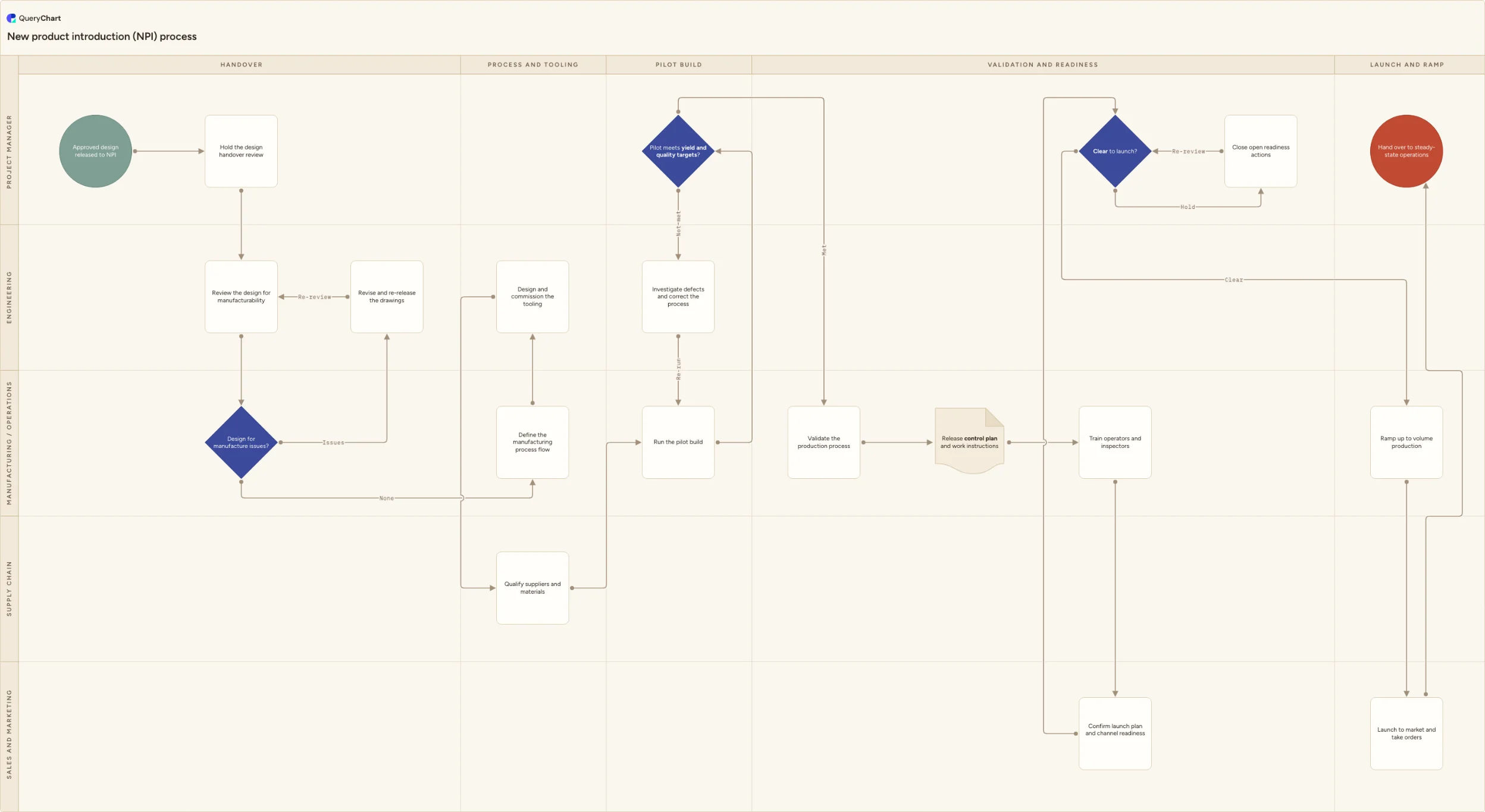
New product introduction (NPI) process flowchart
New product introduction (NPI) process flowchart template: handover, manufacturability review, tooling, supplier qualification, pilot build and ramp-up.
What the new product introduction (NPI) process is
New product introduction is what happens after a design is signed off and before the factory can build it every day without help. The design already works; what is unproven is whether it can be made repeatably, on production tooling, by production operators, from parts that suppliers can deliver at volume. Most of the cost and nearly all of the delay in NPI comes from two places: a handover that was an email rather than a reviewed transfer of ownership, and a pilot build whose pass criteria were agreed after the pilot had run.
This is not the product development process. Concept, requirements, design iterations and design verification sit upstream and end where this chart begins, at the release of an approved design. It is also not the routine quality loop that follows: once the product is handed to steady-state operations, sampling, inspection and disposition belong to the quality control process at /templates/quality-control-process, and any later change to the design, the process or the supplier goes through change control at /templates/change-control-process. Two neighbouring pages pick up specific pieces. The launch readiness review appears here as one decision, "Clear to launch?"; if you need the questions inside that gate and the decision rights behind them, use the go/no-go decision tree at /templates/go-no-go-decision-process. Qualifying a supplier here assumes the organisation is already authorised to trade with them: admitting a new supplier to the approved list is the vendor approval process at /templates/vendor-approval-process.
The chart below runs twenty steps across five swimlanes (Project manager, Engineering, Manufacturing / Operations, Supply chain, and Sales and marketing) over five phases: Handover, Process and tooling, Pilot build, Validation and readiness, and Launch and ramp. Three decisions carry loops rather than dead ends: manufacturability issues return to engineering to revise and re-release the drawings, a pilot that misses its targets returns to defect investigation and another pilot, and a hold at launch readiness routes through closing the open actions before the same question is asked again.
What this flowchart covers
In this template
- Five role lanes (Project manager, Engineering, Manufacturing / Operations, Supply chain, and Sales and marketing) laid out over five phases: Handover, Process and tooling, Pilot build, Validation and readiness, and Launch and ramp.
- The handover front end: an approved design released to NPI, a design handover review, and a manufacturability review ending at "Design for manufacture issues?", where Issues returns to engineering to revise and re-release the drawings and the review then runs again.
- Industrialisation and sourcing in the same phase: define the manufacturing process flow, design and commission the tooling, and qualify suppliers and materials, with long-lead ordering called out so the pilot date does not slip.
- The pilot gate: run the pilot build, then "Pilot meets yield and quality targets?": Not met routes to engineering to investigate defects and correct the process before re-running the pilot, so a pilot cannot pass by being discussed rather than repeated.
- Readiness before volume: validate the production process, release the control plan and work instructions, train operators and inspectors, confirm the launch plan and channel readiness, then "Clear to launch?", where Hold loops through closing the open readiness actions and re-asks the question.
- An explicit end to the project: ramp up to volume production, launch to market and take first orders, then hand over to steady-state operations as the terminating step rather than letting the project fade out.
When to use this template
- Designs reach the factory as a folder of drawings and a date, and the first anyone hears of a manufacturability problem is when the line stops.
- Nobody can say who owns the product between design release and steady-state production, so open issues sit between engineering and operations for weeks.
- You run pilot builds, but the yield and quality targets are argued about afterwards, which means the pilot always passes.
- You are introducing an existing product at a new site or moving it to a contract manufacturer, and need the sequence and the ownership written down for both parties.
- You need to show a customer or an auditor how new products are qualified (process validation, control plan, training records) before the first shipment.
How it works
Rename the lanes to your real owners
Replace Project manager, Engineering, Manufacturing / Operations, Supply chain, and Sales and marketing with the roles that actually hold the work. In smaller organisations the NPI engineer often covers two lanes; merge them rather than leaving a lane nobody answers for. Keep each lane to whoever is accountable for the step, not everyone who attends the meeting.
Define what "released" means at the handover
The handover review is only a gate if there is a list to check against. Agree what the pack contains — released drawings and bill of materials, tolerances and critical dimensions, specification and test method, packaging, target cost and the volume forecast — and record who accepts it on behalf of manufacturing. An incomplete pack should be a reason to stop, not a note in the minutes.
Give manufacturing a real veto on the DFM decision
"Design for manufacture issues?" is where the chart pays for itself, so decide in advance who arbitrates when manufacturing wants a change that engineering says alters the design intent, and how many times the loop may run before it escalates. An issue found here costs a drawing revision; the same issue found after tooling is cut costs a tool.
Write the pilot targets before the pilot runs
Record what the pilot must demonstrate: first-pass yield, defect rates by type, cycle time, and that units were built on production tooling by production operators against the released work instructions. Set the build quantity from your own volumes and from the confidence you need in the numbers rather than from habit. Criteria agreed after the build are always met.
Make the control plan and training real artefacts
"Release control plan and work instructions" should produce controlled, versioned documents: characteristics to be monitored, method, frequency, sample size, and the reaction plan when a result falls outside limits. Training is complete when operators and inspectors have been assessed against those instructions and the records exist, not when the session has been held.
Agree the exit criteria for the handover to steady state
Name what has to be true before the project closes: yield sustained over an agreed period, no open critical actions, documentation released, spares and support in place, and operations formally accepting ownership. Publish the chart where the team works, capture sign-off from the people named in the lanes, and route every change made after handover through change control so the version history shows what was agreed and when.
Frequently asked questions
What is the new product introduction (NPI) process?
NPI is the process that takes a finished, approved design into repeatable production and to market. It starts at design release and covers the handover to manufacturing, a manufacturability review, development of the manufacturing process and tooling, qualification of suppliers and materials, a pilot build, validation of the production process, the control plan and work instructions, training, a launch readiness decision, ramp-up to volume and handover to steady-state operations. Its output is not a design — it is a production system that can make the design consistently.
What is the difference between NPI and new product development?
Product development creates the design: concept, requirements, design iterations, prototypes and design verification. NPI industrialises it. The two are often run by different people with different measures of success — development is judged on whether the product meets its requirements, NPI on whether it can be built to cost, quality and rate. Design release is the boundary, and it is the point this chart begins. Where the two overlap in practice is the manufacturability review, which is why that decision loops straight back to engineering rather than being handled inside operations.
What are the stages of the NPI process?
This chart uses five: handover and manufacturability review; process and tooling development alongside supplier and material qualification; the pilot build and its yield and quality gate; validation, control plan, documentation and training; then launch, ramp-up and handover to steady state. Names vary by industry — automotive and aerospace organisations often align these to the phases of Advanced Product Quality Planning, and consumer electronics teams commonly use EVT, DVT and PVT build phases — but the sequence of decisions is broadly the same.
Who owns the NPI process?
A project manager or NPI engineer usually owns the project, but ownership of the product moves during it. Before handover the design belongs to engineering; after the handover to steady-state operations it belongs to manufacturing. The value of writing NPI as swimlanes is that this transfer becomes visible: manufacturing answers the manufacturability decision, supply chain answers for qualified suppliers and materials, sales and marketing answers for launch and channel readiness, and the project manager holds the two gates and the final handover.
What is a pilot build, and what should it prove?
A pilot build is a production run made on production tooling, by production operators, following the released work instructions, at a rate representative of normal operation. It is not another prototype run by engineers. It should produce evidence against targets set beforehand: first-pass yield, defect rates by type, cycle time, and confirmation that the process, tooling, fixtures and inspection method work together. The quantity depends on your volumes and on the confidence you need in the result, so set it deliberately rather than by convention. If the targets are missed, the honest route is defect investigation and another pilot, which is why that branch loops in this chart.
How does NPI relate to APQP, PPAP and ISO 9001?
Advanced Product Quality Planning (APQP) is a structured framework for planning product and process quality, published by AIAG and used widely in automotive supply chains; the control plan is one of its standard outputs, which is why it appears as a released document in this chart. The Production Part Approval Process (PPAP) is the associated supplier submission that demonstrates a part can be made to requirement under production conditions, and it typically sits inside the supplier and material qualification step. ISO 9001:2015 addresses design and development in clause 8.3 and control of production in clause 8.5, but it does not prescribe an "NPI process" by that name. A flowchart is a description of how you work, not evidence of conformance on its own — that comes from the records the process produces and from an assessment against the standard you are working to.
Where this process fits
In most operations this process follows Product development process flowchart (stage-gate template) and hands off to Quality control process flowchart.
It is one step in Product development.
Step 1: Product development process flowchart (stage-gate template)
A stage-gate product development process flowchart: idea screening, business case, gate 1 go or kill, design, validation, pilot, gate 2 and launch review.
Step 2: New product introduction (NPI) process flowchart You are here
New product introduction (NPI) process flowchart template: handover, manufacturability review, tooling, supplier qualification, pilot build and ramp-up.
Step 3: Engineering change request process flowchart (ECR to ECN)
An engineering change request process flowchart: ECR justification, form, fit and function assessment, change board approval, ECN, effectivity and old stock.
Part of
- Manufacturing
- Product development