Engineering change request process flowchart (ECR to ECN)
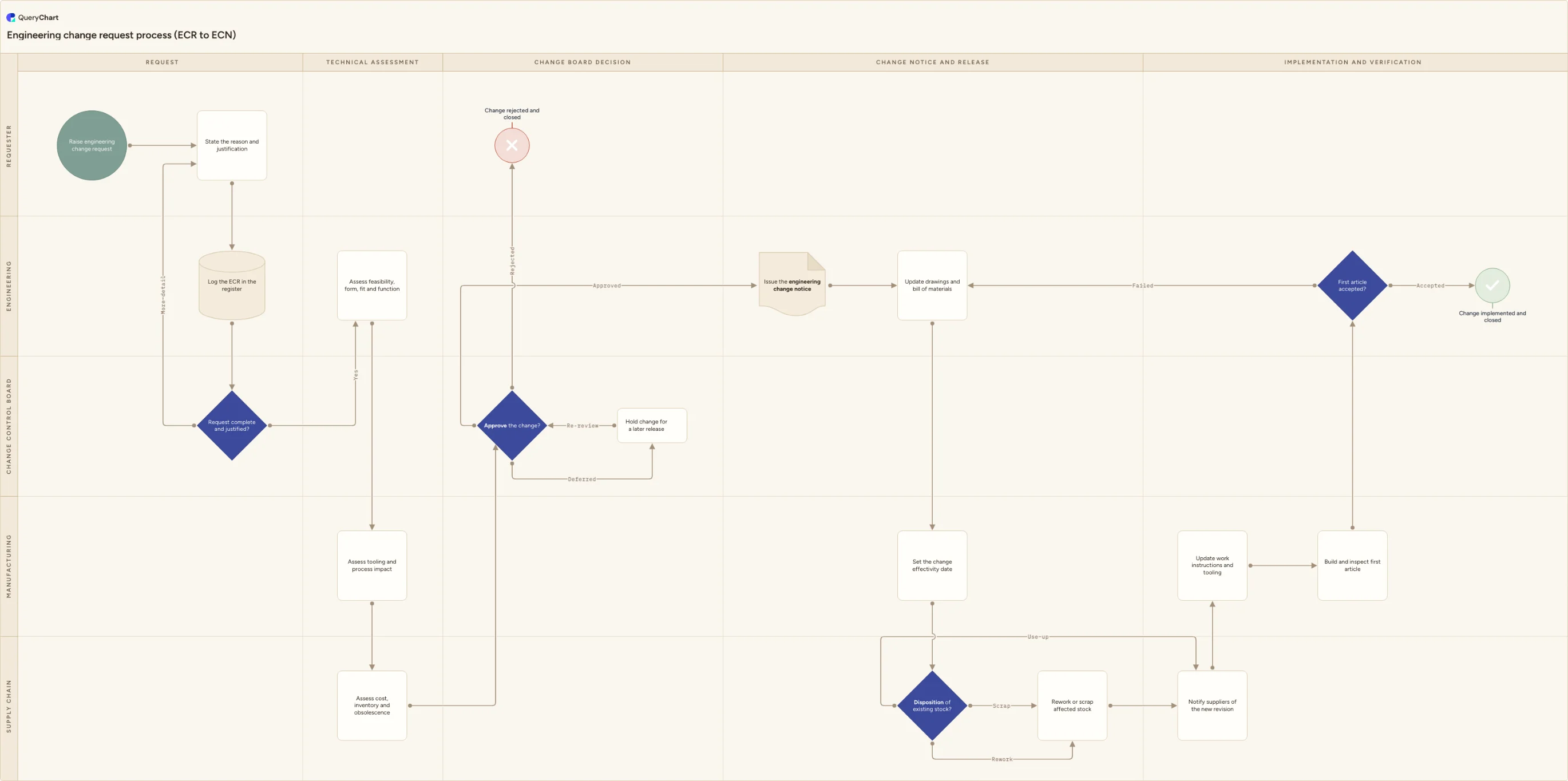
An engineering change request process flowchart: ECR justification, form, fit and function assessment, change board approval, ECN, effectivity and old stock.
ECR, ECN and ECO: from proposal to effectivity
| Record or stage | Question answered | Evidence to retain |
|---|---|---|
| ECR: engineering change request | Why change? | ECR-014; proposed P-014 rev A → rev B, reason and requester; not yet authorised |
| Assessment and approval | Are the impacts and risks acceptable? | Board owner; D-014, BOM-100, V-014, cost and 35 old units; request details, approve, reject or defer |
| ECN/ECO: notice or order | What is authorised, and when? | ECN-014; P-014 rev B, D-014 rev B, BOM-100 rev D; from L-015; implementer and approval record |
| Old-stock disposition | What happens to the old revision? | Named authority: 20 for L-014, 10 for rework/reinspection, 5 for scrap; pending quarantine cannot close |
| Implementation, verification and closure | What proves completion? | WI-014 rev B, accepted FA-014, supplier notification, release and disposition records; owner confirms closure |
What the engineering change request process flowchart (ECR to ECN) process is
An engineering change request (ECR) is a proposal to change something that has already been released: a part, an assembly, a drawing, a bill of materials, a material or an approved supplier part. The ECR carries the problem and the justification. If the change control board approves it, the output is an engineering change notice (ECN, called an engineering change order or ECO in many organisations). The ECN is the instruction that authorises the new revision: it names the parts, drawings and BOMs affected, states when the change takes effect, and says what happens to stock already built to the old revision.
This template handles physical-product changes after design release: interchangeability, tooling, supplier lead times and old stock. Development decisions, IT downtime and rollback, and document publication have their own workflows. Engineering approval decides what may change in the product; document control receives the approved drawings, BOM and work instructions, checks revisions and effectivity, and controls distribution. The two processes need an explicit handoff.
Most engineering change procedures are strong on the technical assessment and thin everywhere else. Feasibility gets a proper review, then the cost of obsolete stock, tooling and supplier lead time is guessed at in a corridor, the effectivity date is recorded as "as soon as possible", and the buyer finds out when a delivery is rejected at goods-in. This template is drawn across five lanes for that reason: Requester, Engineering, Change control board, Manufacturing and Supply chain. Cost, inventory and obsolescence exposure is its own step in the supply chain lane before the board votes, and effectivity and stock disposition are explicit steps rather than assumptions.
Illustrative example, not a real engineering approval: ECR-014 proposes changing P-014 rev A from material A to material B, with rev B as the target. The change-board owner coordinates engineering, quality, manufacturing and purchasing. Engineering identifies D-014 rev A → rev B and BOM-100 rev C → rev D, whose P-014 entry must reference rev B, and supplies material, fit and function validation report V-014. Incomplete requests return for details. Once the complete request is approved, engineering issues ECN-014 (which the company may call an ECO), effective from production lot L-015.
In this example, P-014 rev A stock is quarantined pending a decision; quarantine is a waiting status, not completed disposition. Based on engineering and quality assessment, the board authorises 20 units for use in L-014 only, 10 for rework under controlled instructions and reinspection, and 5 for scrap: 35 in total. Supply chain checks work in progress, goods in transit and open orders, then executes the authorised decision. It cannot choose to use up old stock on its own. Undecided or quarantined items remain open. The chart’s use-up branch applies only within the authorised scope; rev A cannot be used in L-015.
The document controller releases D-014 rev B, BOM-100 rev D and WI-014 rev B against ECN-014, checks that all reference P-014 rev B and L-015, and withdraws old copies from points of use. Manufacturing updates instructions and tooling; quality records first-article inspection FA-014. Failure follows the chart back to controlled drawing and BOM updates, with renewed review, approval and release. The change owner closes only after first-article acceptance, supplier notification, document release and disposition records for all 35 units are complete. These roles and identifiers are illustrative; adapt them to your authority rules.
Connect engineering decisions to controlled documents
What this flowchart covers
In this template
- Five swimlanes (Requester, Engineering, Change control board, Manufacturing, Supply chain) across five phases: request, technical assessment, change board decision, change notice and release, and implementation and verification.
- Intake in the requester and engineering lanes: raise the engineering change request, state the reason and justification, log the ECR in the register, then a board screening decision, "Request complete and justified?", that returns thin requests for more detail before engineering time is committed.
- A three-part assessment, one step per lane: engineering assesses feasibility and impact on form, fit and function; manufacturing assesses tooling and process impact; supply chain assesses cost, inventory and obsolescence across on-hand stock, work in progress, goods in transit and open supplier commitments.
- The "Approve the change?" decision with three named outcomes: approved into the change notice, rejected and closed in the requester lane, or deferred, which holds the change for a later release and loops it back to the board rather than leaving it open.
- Release: issue ECN, update drawings and BOM, and set the effective lot or date. The stock decision follows named authority to permitted use-up, rework or scrap; stock awaiting a decision stays quarantined and is not a completed branch.
- Implementation and verification: notify suppliers, update instructions and tooling, and inspect the first article. Failure returns to controlled drawing/BOM updates; acceptance is followed by checking release, notification and stock evidence before the change owner closes the record.
When to use this template
- Writing or reworking an ECR/ECN procedure for a manufacturing, hardware or engineering-to-order business, particularly where the current process is a form with no agreed route behind it.
- Agreeing who sits on the change control board, what they see before they decide, and which changes an engineering manager can authorise without convening the board.
- Mapping the process before you configure change workflows in a PLM or ERP system, so the tool encodes a route people have agreed rather than one the software implies.
- Onboarding design engineers, planners, buyers and quality staff who need to know what happens to a change after they sign it off, and where their own step sits.
- Answering a customer or auditor asking how design changes are controlled, and settling customer change-notification obligations that sit in supply agreements.
How it works
Rename the lanes to your real roles
Replace Requester, Engineering, Change control board, Manufacturing and Supply chain with the functions you actually have. In a smaller organisation the change control board may be two people meeting weekly, and manufacturing engineering and production planning may be one lane. Merge lanes rather than inventing roles, and keep the total at or below five so the chart stays readable.
Define what makes an ECR complete
The screening decision only works if "complete and justified" means something written down. A workable minimum: affected part numbers and their current revisions, the reason (defect, cost reduction, customer request, supplier or component obsolescence, safety or regulatory), the evidence behind it, the urgency, and whether the change touches anything safety-related or a customer-approved characteristic.
Write down your form, fit and function test
The assessment step decides whether the changed part is still interchangeable with the old one. Record your rule for what that means and what follows from it, since a non-interchangeable change normally needs a new part number rather than a new revision of the existing one. Configuration management practice keys this to interchangeability, not to how large the change looks.
Make the cost assessment cover every location of old stock
Give the supply chain step a checklist: on-hand stock, work in progress, goods in transit, open purchase orders and supplier commitments, finished goods, consignment stock and service spares. Obsolescence is the cost most change requests underestimate, and it is usually what turns an obviously good change into a deferred one.
Set the effectivity and disposition rules
Record the effective date, serial number or lot and the old/new part, drawing and BOM revisions on the ECN. Name who may authorise use-as-is, rework, quarantine or scrap; supply chain executes that scope and keeps records. Quarantined stock cannot enter production, and first-article acceptance cannot close an unresolved disposition.
Define what first article verification means and publish the chart
Specify who builds and inspects the first article, the characteristics checked and the signatory, according to the change risk and applicable requirements. Failure returns to controlled document updates and renewed review and authority. Acceptance requires the inspection report, drawing/BOM release, supplier notification and all old-stock records; a named change owner confirms closure. This is an illustrative evidence list, not a universal inspection specification.
Frequently asked questions
What is the difference between an ECR, an ECN and an ECO?
An engineering change request is the proposal: what is wrong or could be better, why it matters, and which parts it touches. It is a question put to the change control board. An engineering change notice is the answer, issued only after approval: it authorises the new revision, lists the drawings, part numbers and BOMs affected, sets the effectivity point and states the disposition of existing stock. Engineering change order (ECO) is used interchangeably with ECN in many organisations, and some use ECO for the internal work instruction and ECN for the notification sent to customers and suppliers. Pick one convention and define it in your procedure, because mixed usage in the same company causes real confusion about what has actually been authorised.
How is this different from IT change management or a general change control process?
The shape is similar (request, assess, approve, implement, verify) but the content is not. IT change management moves a change into a live service, so the assessment is about affected services, downtime windows, rollback plans and blast radius, and it is normally run by a change manager and a CAB. An engineering change moves a revision into a physical product, so the assessment is about interchangeability, tooling, cost, supplier lead time and what to do with stock built to the old revision, and it is normally run by a change control board that includes engineering, manufacturing and supply chain. If you are documenting how code or infrastructure reaches production, use the IT change management or change control templates instead.
When does a change need a new part number rather than a new revision?
The usual test is interchangeability. If a part built to the new definition can replace an old one in every application without any other change, and the old one can replace the new one, it is a revision. If it cannot, because form, fit or function has moved, it normally needs a new part number so that both versions can coexist in stock, in BOMs and in service. Configuration management practice and drawing revision standards build this rule on interchangeability rather than on how large the change appears, which is why the form, fit and function assessment sits before the board decision in this chart rather than after it.
What happens to stock already built to the old revision?
Record affected items, quantities, locations, approver and disposition scope on the ECN/ECO. The relevant authority decides permitted use, rework, quarantine or scrap based on engineering and quality assessment; supply chain executes rather than decides. Use is limited to authorised lots or purposes. Rework needs controlled instructions and reinspection; scrap needs a disposition record. Quarantine is pending or awaiting inspection, and cannot be released without authority. Check stock on hand, in progress, in transit and at suppliers; unresolved items remain open and are escalated.
Who should sit on the change control board, and does every change need one?
The board needs whoever can commit the money and the capacity: engineering, manufacturing or industrialisation, supply chain or purchasing, and quality, with sales or programme management involved when a change is visible to a customer. It does not need everybody. Most organisations set a threshold so that low-risk changes (a drawing note, a tolerance clarification, a change with no cost or interchangeability impact) are approved by a named engineering authority, and only changes above that threshold go to the full board. Write the threshold next to the approval decision, and record the deferred decisions as carefully as the approvals, because a deferred change usually returns once the blocking stock or contract clears.
Where this process fits
In most operations this process follows CAPA process flowchart (corrective and preventive action).
It is one step in Product development.
Step 1: Product development process flowchart (stage-gate template)
Step 2: New product introduction (NPI) process flowchart
New product introduction (NPI) process flowchart template: handover, manufacturability review, tooling, supplier qualification, pilot build and ramp-up.
Step 3: Engineering change request process flowchart (ECR to ECN) You are here
An engineering change request process flowchart: ECR justification, form, fit and function assessment, change board approval, ECN, effectivity and old stock.
Part of
- Manufacturing
- Product development