Product roadmap Gantt chart template: four quarters
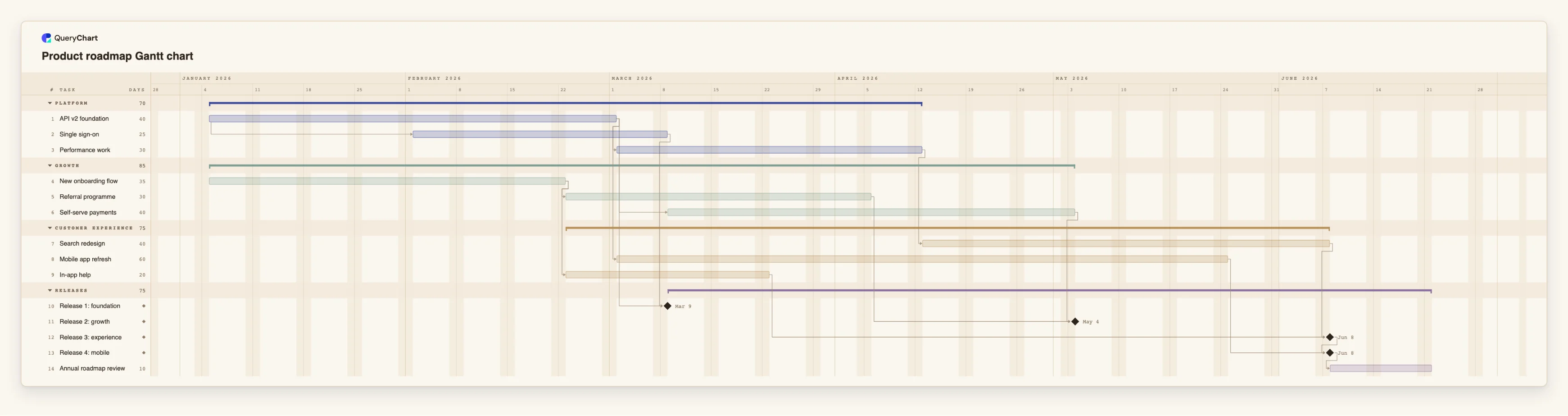
An editable product roadmap Gantt chart: four quarterly themes with initiatives, dependencies and release milestones. Change a duration and every dependent initiative moves.
What the product roadmap gantt chart template: four quarters process is
A roadmap and a project plan look alike and answer different questions. A project plan says when work will be done; a roadmap says what the team intends to work on, in what order, and why. The difference matters because roadmaps are read by customers and executives, who treat a bar on a chart as a promise. A Gantt chart is a useful roadmap format when initiatives genuinely depend on each other, and a misleading one when they do not.
This template is a year of initiatives grouped by theme: Platform, Growth, Customer experience, and the releases that package them. Dependencies show the real constraints. Single sign-on starts twenty days into the API foundation because it needs the new endpoints but not all of them. Payments, the mobile app and performance work all need the platform. Referral and help build on the new onboarding flow. Each release is a milestone that depends on the initiatives it ships.
Durations are working days, so a quarter is about 60. They are deliberately coarse. If a bar on your roadmap is more precise than your confidence, make it longer, or show it as a range elsewhere. The plan carries no fixed dates, so it starts when you create it; for a calendar roadmap, pin the first initiative to the first day of the year.
Roadmaps are not commitments. A roadmap that is shared externally should say so. For the plan to ship one initiative, use the software project plan at /templates/software-project-gantt-chart.
What this flowchart covers
In this template
- Three themes, Platform, Growth and Customer experience, plus a Releases group, with 14 tasks and four release milestones: "Release 1: foundation", "Release 2: growth", "Release 3: experience" and "Release 4: mobile".
- A platform initiative that others build on: "Self-serve payments", "Performance work" and "Mobile app refresh" all depend on "API v2 foundation".
- Partial dependencies: "Single sign-on" starts twenty days into "API v2 foundation".
- Independent starts: "New onboarding flow" has no predecessor, and "Referral programme" and "In-app help" build on it.
- A closing review: "Annual roadmap review" waits for "Release 4: mobile".
When to use this template
- You need to show a year of initiatives and which depend on which.
- A stakeholder asks what slips if the platform work takes longer.
- You are planning releases and need to see what each ships.
- You want a roadmap that is more than a list of quarters.
The plan, task by task
Every task in the chart with its length in working days and what it waits for. A dependency is a step number; SS is start-to-start, FF is finish-to-finish, and +n is a lag in working days.
| # | Task | Group | Working days | Depends on |
|---|---|---|---|---|
| 1 | API v2 foundation | Platform | 40 | |
| 2 | Single sign-on | Platform | 25 | 1SS+20 |
| 3 | Performance work | Platform | 30 | 1 |
| 4 | New onboarding flow | Growth | 35 | |
| 5 | Referral programme | Growth | 30 | 4 |
| 6 | Self-serve payments | Growth | 40 | 1+5 |
| 7 | Search redesign | Customer experience | 40 | 3 |
| 8 | Mobile app refresh | Customer experience | 60 | 1 |
| 9 | In-app help | Customer experience | 20 | 4 |
| 10 | Release 1: foundation | Releases | Milestone | 1, 2 |
| 11 | Release 2: growth | Releases | Milestone | 5, 6 |
| 12 | Release 3: experience | Releases | Milestone | 7, 9 |
| 13 | Release 4: mobile | Releases | Milestone | 8, 12 |
| 14 | Annual roadmap review | Releases | 10 | 13 |
How it works
Group by theme, not by team
Name the groups after the outcomes you are working toward. Teams change; themes last the year.
Use coarse durations
Round to weeks or half-quarters. A roadmap that implies precision it does not have will be held to it.
Link only real dependencies
Join initiatives only where one cannot start or finish without the other. Unnecessary links hide the true critical path.
Show releases as milestones
Link each release to the initiatives it ships so you can see what is at risk.
Pin the first start if you need a calendar
Set a start date on the first initiative if the roadmap must follow the calendar year.
Review regularly
Keep the review in the plan and update durations as you learn.
Frequently asked questions
What is a product roadmap Gantt chart?
A roadmap drawn as bars over time, with dependencies. It suits roadmaps where initiatives genuinely depend on each other. It is less suitable for a now / next / later view that avoids dates.
Is a roadmap a commitment?
No, and a roadmap shared outside the team should say so.
How is this different from a project plan?
A project plan schedules the work to deliver one outcome. A roadmap shows what the team plans to work on across many outcomes, with dependencies between them.
Can I show quarters?
Yes. Set the time scale to month or quarter in the toolbar.