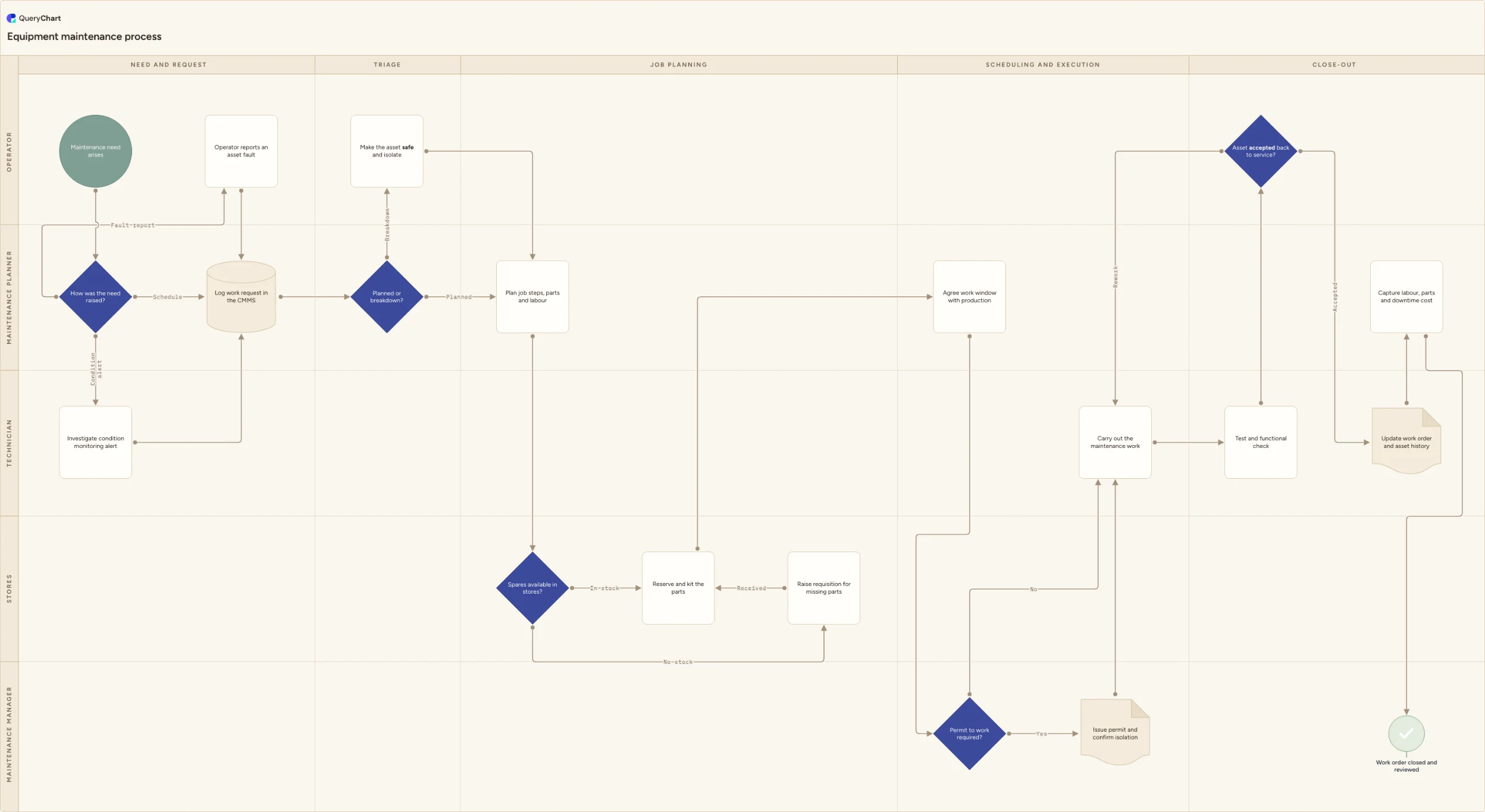
Equipment maintenance process flowchart
Five-lane equipment maintenance process flowchart: work request, planned or breakdown triage, job planning, spares check, permit to work and costed close-out.
What the equipment maintenance process is
Equipment maintenance runs as one cycle with three entrances. A task falls due on the maintenance plan, a condition monitoring reading crosses its alarm limit, or an operator reports that something on the line is not right. However the need arrives, it becomes the same object (a work request with an asset number against it) and from there the route is common: triage, job planning, parts, a window agreed with production, execution, a functional check, then a record and a cost. Drawing the three triggers converging on one queue is what stops breakdown work being run over the radio while planned work lives in a separate spreadsheet.
This is the work order cycle, not the asset lifecycle and not the stockroom. Deciding whether to repair, refurbish or replace an ageing machine, and the capital case behind that, sits above this process. Reorder points, cycle counting and stock accuracy belong to the inventory management process; here Stores appears only long enough to answer whether the parts exist, and when they do not, the requisition leaves for the purchase requisition and purchase order route. A repeat failure that deserves a real investigation is handed to root cause analysis and CAPA rather than absorbed as another repair, and a permanent modification to the asset (a different part, a changed setting, a new guard) belongs in change control before it is fitted. If the asset in question is an IT service rather than a physical machine, incident management is the closer template.
Two decisions carry the chart. 'Planned or breakdown?' separates work that can be planned, kitted and scheduled from work where the asset is already down and the first job is to make it safe; the branches then rejoin, because a breakdown still needs parts, a permit and a record. 'Spares available in stores?' is the check most written procedures leave out, and it is where planned jobs quietly die: the job is planned, the window is booked, and the seal turns out to be a six-week lead time. Putting the parts check before the scheduling step rather than discovering it on the tools is the single change that does most for schedule compliance.
What this flowchart covers
In this template
- Five swimlanes (Operator, Maintenance planner, Technician, Stores and Maintenance manager) across five phases: need and request, triage, job planning, scheduling and execution, and close-out.
- Three entry routes from one 'How was the need raised?' decision: a scheduled PM task, a condition monitoring alert the technician investigates first, and a fault the operator reports, all converging on 'Log work request in the CMMS'.
- The 'Planned or breakdown?' triage, whose breakdown branch runs 'Make the asset safe and isolate' in the Operator lane before rejoining the planned route at 'Plan job steps, parts and labour'.
- A 'Spares available in stores?' decision in the Stores lane that either reserves and kits the parts or raises a requisition for the missing ones and loops back once they are received.
- 'Agree work window with production' before any tooling is picked up, then a 'Permit to work required?' gate in the Maintenance manager lane covering permit issue and confirmed isolation.
- Close-out in four steps: the technician's test and functional check, an 'Asset accepted back to service?' decision in the Operator lane with a rework loop back to the job, then the asset history update and 'Capture labour, parts and downtime cost' before the work order is closed and reviewed.
When to use this template
- Writing a maintenance procedure or CMMS work order instruction that has to cover preventive, condition-based and reactive work in one picture rather than three separate documents.
- Configuring or re-configuring a CMMS: the request fields, priority codes, job plans, permit flags, failure codes and cost postings in the chart map onto screens you have to set up.
- Schedule compliance is poor and you need to see where planned jobs are displaced: normally at the parts check or the production window, not on the tools.
- Agreeing the handoffs with production and stores: who hands the asset over, who confirms isolation, who reserves parts, and who accepts the asset back into service.
- Inducting new technicians, planners or contractors so they can see where their part of a job begins and ends.
How it works
Rename the lanes to your real roles
Replace Operator, Maintenance planner, Technician, Stores and Maintenance manager with the roles that exist in your organisation. Small teams routinely merge planner and manager into one lane; sites that outsource specialist work should add a contractor lane rather than pretending the technician lane covers it.
List your actual maintenance triggers
Write out every route a job can enter by: the PM plan, condition monitoring routes and alarms, statutory examinations, operator fault reports, and findings raised during other work. Mark which of them raise a work order automatically in your CMMS and which depend on someone typing it in — the manual ones are where needs go missing.
Write the triage rule down
Put your priority definitions on the 'Planned or breakdown?' decision: safety and environmental risk, production impact, whether there is redundancy, and the target response for each priority. State who is allowed to call something a breakdown, because that call is what lets a job jump the schedule.
Set the spares rule
Decide what the Stores decision actually checks: free stock against existing reservations, the critical spares list, and the lead time beyond which the planner and manager are told before the job is scheduled. Record who may authorise a temporary repair when the part will not arrive in time.
Attach your permit and isolation rules
Name the task types that require a permit — for example hot work, confined space entry, work on or near live electrical systems, work at height, or breaking into lines carrying hazardous substances — and who is authorised to issue one. Keep the issuer separate from the person doing the work, and state how isolation and lock-off are confirmed before the job starts.
Fix the close-out data, then walk the chart with each lane
Agree the failure, cause and action codes, the downtime start and stop points, and how labour hours and parts reach the work order. Then trace two recent jobs through the chart, one PM and one breakdown, and correct any step people describe that is not drawn, or is drawn but skipped.
Frequently asked questions
What are the steps in the equipment maintenance process?
A need is raised by the maintenance schedule, by a condition monitoring alert, or by an operator reporting a fault. It is logged as a work request against an asset, then triaged as planned work or a breakdown; a breakdown is made safe and isolated first. The planner writes the job steps, parts and labour, stores confirms whether the spares exist and either kits them or raises a requisition, and the job is scheduled into a window agreed with production. A permit to work is issued where the task requires one, the technician carries out the work and tests it, the operator accepts the asset back into service, and the work order is closed once the asset history and the labour, parts and downtime costs are recorded.
What is the difference between planned and breakdown maintenance here?
Planned work is known about before the equipment stops, so it can be scoped, kitted and scheduled: the parts are on the shelf, the window is agreed, and the technician starts with everything to hand. Breakdown work starts from an asset that has already failed, so the first action is making it safe and isolating it, and the planning happens in compressed form. The important point in this chart is that the two branches rejoin. A breakdown still needs parts, may still need a permit, and still needs its history and cost recorded, so it goes through the same work order rather than a verbal fix that leaves no trace. Most teams track the share of labour hours spent on planned work as a headline measure; sensible targets differ by industry and asset type, so set yours against your own baseline rather than a borrowed benchmark.
Where should the spares check sit in the process?
Immediately after job planning and before scheduling. Planning establishes what the job needs; scheduling commits a window and a technician. If the parts check happens after that commitment, the job is either postponed at the last minute or started and left half-finished waiting for a delivery. In this chart the Stores lane answers 'Spares available in stores?' before the production window is agreed, and the no-stock branch raises a requisition and loops back once the parts are received. Kitting matters as much as availability: parts reserved but scattered around the stores still cost the technician the first hour of the window.
When is a permit to work needed?
When the risk of the task justifies a formal, written authorisation before work starts. Typical triggers are hot work, confined space entry, work on or near live electrical systems, work at height, pressure systems, and breaking into lines that carry hazardous substances. The permit records the isolation, the precautions, who authorised it, the time limit and who hands it back. Which tasks need one at your site comes from your own risk assessments and the law that applies to you, so the chart draws the gate rather than its content. Two conventions are worth keeping in whatever you write: the person issuing the permit is not the person doing the work, and the isolation is physically confirmed rather than assumed.
How is this different from the inventory management or root cause analysis process?
Scope. Inventory management owns stock as a subject in its own right — reorder points, cycle counting, adjustments and write-off — while this process only asks whether the parts for one job exist and hands the buying to the purchase requisition route. Root cause analysis owns the question of why a failure keeps happening; here a repeat failure is passed out to that investigation rather than absorbed as one more repair. Incident management covers restoring a disrupted IT service, which runs on a different clock with different roles from a physical asset repair. If you are documenting a whole maintenance function you will need more than one of these charts, but they should meet at defined handoffs rather than be merged into a single diagram.
What should the process record at close-out?
Enough to make the asset history usable a year later: what failed and how, what was done, who did it, when the asset stopped and restarted, the parts consumed, the labour hours, and any test or measurement results. Coded failure and cause fields are what make that history analysable; free text alone rarely is. Where equipment is subject to statutory examination — lifting equipment or pressure systems, for example — those examinations run on their own schedules and produce their own reports, and they are not interchangeable with routine maintenance records. In Great Britain, PUWER also requires work equipment to be maintained in an efficient state, in efficient working order and in good repair, with any maintenance log kept up to date. Check what applies to your equipment and your jurisdiction: a flowchart shows the route people are meant to follow, and on its own it does not demonstrate compliance.
Where this process fits
In most operations this process follows Corrective maintenance process flowchart (planned repair of a known defect) and hands off to Equipment failure investigation process flowchart (RCFA).
It is one step in Maintenance.
Step 1: Maintenance work order process flowchart (request to close-out)
Step 2: Preventive maintenance process flowchart (scheduled PM)
Step 3: Corrective maintenance process flowchart (planned repair of a known defect)
Corrective maintenance process flowchart template: defect report, triage and priority, safe-to-run decision, job planning, parts and lead time, deferral approval, scheduled repair, test and failure code close-out.
Step 4: Equipment maintenance process flowchart You are here
Five-lane equipment maintenance process flowchart: work request, planned or breakdown triage, job planning, spares check, permit to work and costed close-out.
Step 5: Equipment failure investigation process flowchart (RCFA)
Equipment failure investigation process flowchart template: investigation trigger, preserved evidence, failure mode, root cause analysis, corrective actions and monitored effectiveness.