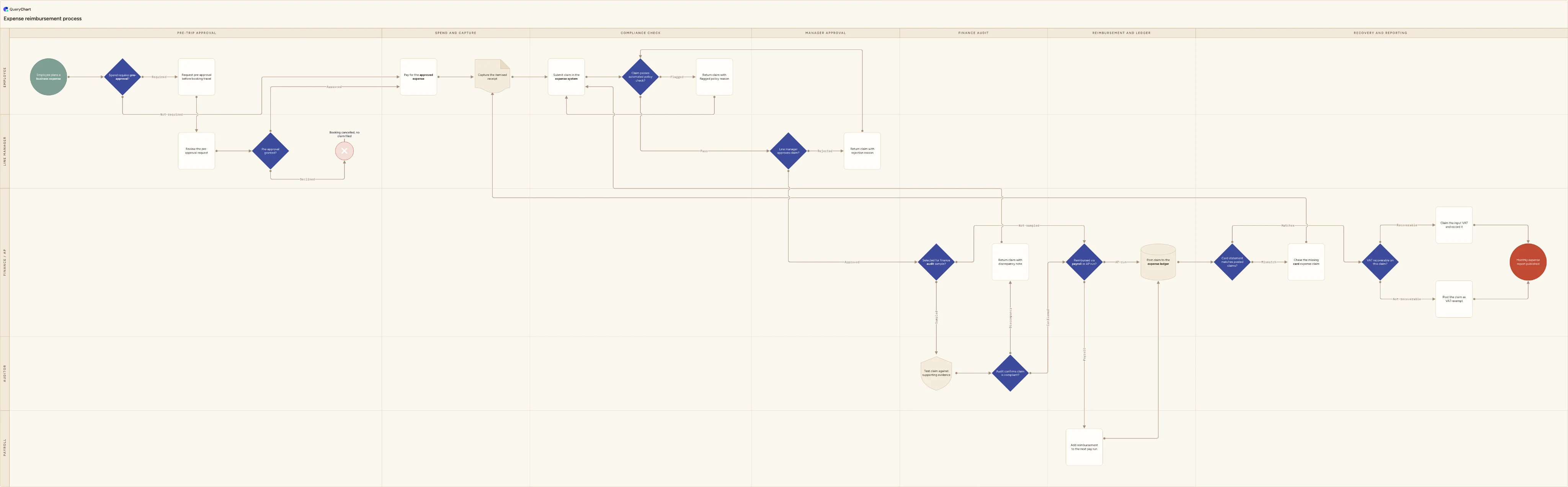
Expense reimbursement process flowchart (claim to payout)
Expense reimbursement process flowchart template: travel pre-approval, automated policy check, manager approval, finance audit sample, payroll or AP payout, corporate card reconciliation and VAT recovery.
What the expense reimbursement process flowchart (claim to payout) process is
The expense reimbursement process is what turns money an employee has already spent, or is about to spend on an approved trip, into a paid claim closed out on the books. The trigger is a piece of business spend: a taxi fare, a hotel bill, a client lunch, sometimes a trip booked before the spend even happens. The chart below follows one claim from that moment through to the report finance publishes at month end: an optional pre-approval for travel, the receipt captured, the claim submitted in the expense system, an automated policy check on receipts and per diem, a line manager's approval, a finance audit sample, the payout itself through payroll or an accounts payable run, the ledger posting, a corporate card reconciliation and a VAT recovery decision.
This chart is not the expense approval process, which is where the value-threshold routing, the duplicate-claim check and the second-approver escalation actually live; that boundary sits deliberately behind a single 'Line manager approves claim?' step here so the reimbursement mechanics after approval have room to breathe. It is not the payroll process either: 'Add reimbursement to the next pay run' is one step here, not the cut-off, gross-to-net and independent pre-payment review a payroll run goes through in its own right. The tax and VAT figures on this chart are placeholders; statutory VAT, sales-tax and per diem rules vary by jurisdiction and change on their own schedule, so treat every rate and threshold here as something to replace with your own current policy and tax guidance, not as advice.
Four decisions carry this chart. 'Spend requires pre-approval?' and 'Pre-approval granted?' sit at the very start because travel especially benefits from a yes or no before money leaves anyone's account; a declined pre-approval ends the chart before a claim exists, rather than after. 'Selected for finance audit sample?' sits in the Finance / AP lane rather than the line manager's, because sampling after approval is a control on the approver as much as on the claimant, and it would defeat the point for the same person to both approve and audit a claim. 'Reimbursed via payroll or AP run?' decides the payout mechanism rather than whether to pay, which is why it comes after approval and audit are already settled. The last two decisions, the corporate card reconciliation and the VAT recovery check, are what separates a reimbursement chart from an approval chart: they run after the money has already moved, catching card spend nobody claimed and coding tax recovery correctly, which a chart that stops at 'approved' never reaches.
What this flowchart covers
In this template
- Five swimlanes, Employee, Line manager, Finance / AP, Payroll and Auditor, across seven phases: Pre-trip approval, Spend and capture, Compliance check, Manager approval, Finance audit, Reimbursement and ledger, and Recovery and reporting.
- A 'Spend requires pre-approval?' gate at the very top, so travel that needs authorising before booking and everyday spend that does not share the same chart; a 'Pre-approval granted?' decline ends at 'Booking cancelled, no claim filed' before any expense exists.
- An automated 'Claim passes automated policy check?' step that flags claims against receipt and per diem rules, with a Flagged branch that returns the claim to the employee and loops it back through the same check once corrected.
- A 'Line manager approves claim?' gate followed by a separate 'Selected for finance audit sample?' check in the Finance / AP lane, so approval and audit stay two different controls held by two different people rather than one signature standing in for both.
- A 'Reimbursed via payroll or AP run?' decision that splits the payout itself, with the Payroll branch adding the amount to the next pay run and the AP run branch posting straight to the ledger, both converging on the same 'Post claim to the expense ledger' record.
- The two checks a reimbursement chart owns that an approval chart never reaches: 'Card statement matches posted claims?', which chases corporate card spend nobody expensed, and 'VAT recoverable on this claim?', which decides whether the input tax is claimed before the month closes.
When to use this template
- You are writing or rewriting a reimbursement procedure and need the payout mechanics, not just the approval, drawn as one picture.
- You are configuring an expense system or ERP module and the payroll-versus-AP split, the audit sample and the VAT step need agreeing before anyone builds them.
- Corporate card spend keeps going unclaimed, and you need the reconciliation control that catches it drawn as a real step rather than assumed.
- You are setting the audit sampling rule for expense claims and want it drawn as visibly separate from the approval it checks.
- Finance or a tax adviser has asked how VAT recovery on employee expenses is decided and recorded before the monthly close.
How it works
Rename the lanes to your roles
Replace Employee, Line manager, Finance / AP, Payroll and Auditor with the roles that genuinely exist in your organisation. On a small team finance and payroll are often one desk: merge those lanes rather than drawing a hand-off that never happens, and add a shared-service lane only if claims are pre-checked before a manager ever sees them.
State which spend needs pre-approval
List the categories that need sign-off before the money is spent, typically travel above a value or any trip abroad, and separate them clearly from everyday spend that only needs a claim afterwards. Put the actual value and categories onto 'Spend requires pre-approval?' so nobody is guessing which gate applies to their trip.
Set the receipt and per diem thresholds
The automated check on 'Claim passes automated policy check?' is only as good as the numbers behind it. Decide the value above which a receipt is mandatory, the daily per diem rate for meals and incidentals, and whether mileage is checked automatically or left for the line manager to judge on approval.
Agree the audit sampling rule
Decide how 'Selected for finance audit sample?' actually picks claims: at random, weighted toward high value and cash reimbursements, or targeted at approvals a manager gave to their own direct report. Write down who holds the sample size and how often it is reviewed, so the rule survives a change of auditor or a rise in claim volume.
Fix the payout and card reconciliation rules
Decide which claims go through payroll and which go through an accounts payable run, and publish the cut-off for each so the 'Reimbursed via payroll or AP run?' split is predictable. Then state how often the corporate card statement is reconciled against posted claims and who is chased when 'Card statement matches posted claims?' finds a gap.
Write your VAT and record-keeping rule onto the chart
Replace the placeholder on 'VAT recoverable on this claim?' with your own jurisdiction's rule for what counts as a valid receipt, which categories of spend are recoverable, and how long the record must be kept. Tax rules change on their own schedule, so name who owns updating this step when they do change.
Walk it against a real claim
Take two or three finished claims, one paid through payroll and one through an AP run, and one that was flagged, rejected or picked for audit, and trace each through the chart. Any step people describe that is not drawn, or drawn but skipped in practice, is the finding worth acting on before you publish it.
Frequently asked questions
What are the steps in an expense reimbursement process?
If the spend needs it, the employee requests pre-approval before booking and a line manager grants or declines it; a decline ends the chart with the booking cancelled and no claim filed. The employee pays for the expense, captures an itemised receipt, then submits the claim in the expense system, where an automated check flags anything missing a required receipt or over the per diem rate and returns it to be corrected and resubmitted. A line manager approves the claim, or returns it with a rejection reason. Finance selects a sample of approved claims for audit; a failed audit is returned with a discrepancy note, and a confirmed claim is reimbursed through the next payroll run or an accounts payable run, then posted to the expense ledger. Finance then reconciles the corporate card statement against posted claims, chasing any spend nobody claimed, and decides whether the VAT is recoverable before folding the claim into the monthly report.
What is the difference between expense reimbursement and expense approval?
They cover the same claim from opposite ends. An expense approval process is about the decision: the policy check, the value threshold that decides whether a second approver is needed, and the duplicate-claim check that runs before anyone commits to paying. An expense reimbursement process is about what happens once that decision is made: how the money actually reaches the employee, whether through payroll or a separate accounts payable run, how the claim is posted to the ledger, how corporate card spend is reconciled against what was claimed, and how VAT recovery is decided and recorded. Many organisations run both as one continuous procedure, which is exactly why it helps to see them as two charts: the approval chart tells you whether to pay, and this one tells you how the payment actually happens and how it is recorded and recovered afterwards.
Who owns the expense reimbursement process, and how often is the audit sample reviewed?
Finance typically owns the process end to end, including the payroll-versus-AP routing rule, the ledger coding and the VAT recovery decision, while the line manager owns the approval that sits inside it and the auditor or an internal audit function owns the sampling. Sampling frequency is a policy choice rather than a fixed figure: some organisations sample every payment run, others sample monthly or quarterly and weight the sample toward higher-value or cash claims. What matters more than the frequency is that the sample size and the weighting are written down and reviewed periodically, so a thin sample does not quietly become the norm as claim volume grows over time.
What records does the expense reimbursement process need to keep?
Each claim needs the itemised receipt or equivalent evidence, the business purpose, the category and cost centre it is coded to, the approval decision and who gave it, and, where the claim was audited, the outcome of that check. The ledger posting needs to be traceable back to the original claim, and the corporate card reconciliation needs a record of which statement lines were matched and which were chased. How long these records must be kept, and in what format, is set by tax and accounting rules that vary by jurisdiction and by the size of the organisation, so check the retention period that applies to you rather than assuming a single figure covers every record type.
What does an auditor look for, and where does the process usually break?
An auditor checking this process usually wants evidence that the sample was actually drawn and reviewed, that a rejected or flagged claim was genuinely corrected rather than resubmitted unchanged, and that the person who approved a claim is not the same person who processed its payment. The process most often breaks at the corporate card reconciliation, which is easy to treat as optional because card spend already looks like it has been paid: without it, card transactions that were never turned into a claim simply disappear from the record. The other common failure is the audit sample thinning out unnoticed as claim volume grows, so the proportion actually checked falls even though the process still looks intact on paper.