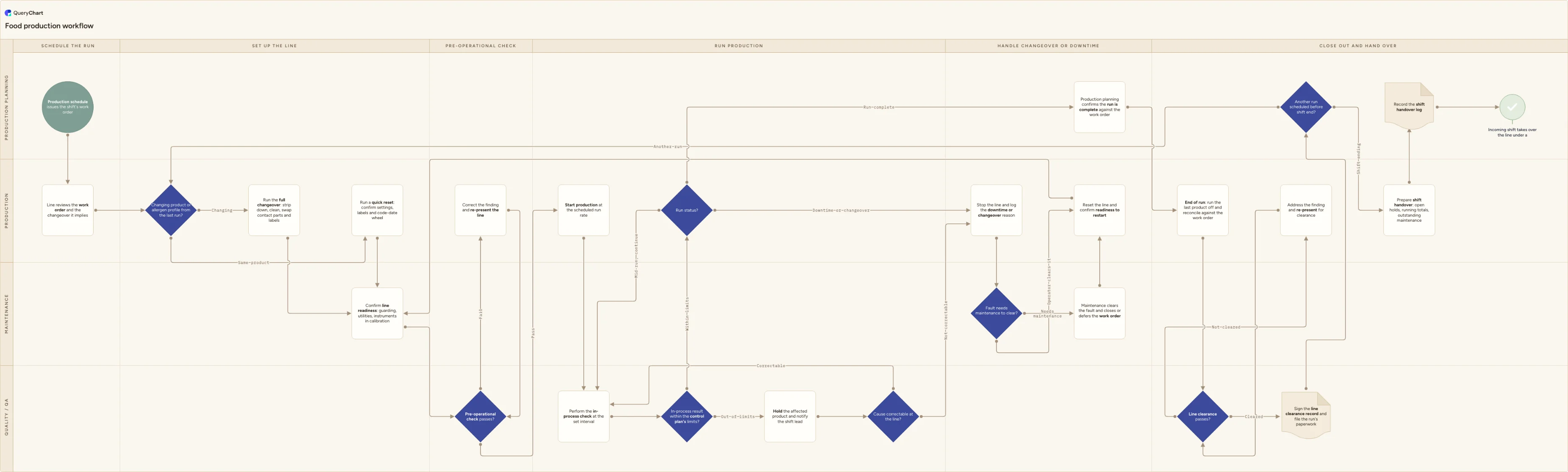
Food production workflow flowchart (shift production floor cadence)
Food production workflow flowchart template: work order to line setup, pre-operational check, in-process monitoring, changeover or downtime handling, end-of-run reconciliation, line clearance and shift handover.
What the food production workflow flowchart (shift production floor cadence) process is
A production shift on a food or beverage line does not start from a blank floor; it starts from a work order that production planning has already issued, naming the product, the lot or batch code and the target quantity. The chart below follows one shift end to end, and it is built to repeat: the line checks whether the product or allergen profile is changing from the last run and completes a full changeover or a quick reset accordingly, equipment readiness is confirmed, and Quality / QA runs the pre-operational check that gates the start. Once running, the shift spends most of its time in one loop — in-process checks recurring at whatever interval the product's control plan sets, each result routing back into the run or out to a hold, a correction, or a stop for changeover or downtime. The run ends with output reconciled against the work order, the line cleared by Quality / QA before the next product can start, and a documented handover to whoever runs the line next.
This chart is deliberately not the end-to-end manufacturing chain, and it is not a record of one batch. A food manufacturing process flowchart follows raw material from receipt through production to finished-goods dispatch — one pass through the whole plant, with its own steps for incoming inspection, formulation and warehousing that this chart does not repeat. A batch production record documents the execution of one specific batch against its own recipe, critical limits and required sign-offs — it exists because that batch was made, and it is retained as evidence for that batch alone. This chart is neither of those: it is the operating rhythm the line runs every shift, whichever product or batch happens to be on it that day, and it is meant to be walked from the top every time a shift starts rather than filed once a run is done. Verifying incoming raw material against its certificate of analysis belongs to receiving, not here; the site's cleaning and environmental monitoring schedule is a separate document this chart only touches at the pre-operational check; and a hold that turns into a full nonconformance investigation or recall hands off to those processes rather than being resolved on this canvas. Treat the chart as a starting point to adapt under your own procedures, the food safety plan that applies to your product, and the regulations and certification scheme that govern where you operate.
Three decisions carry the process. 'Changing product or allergen profile from the last run?' sits before setup even starts, because a quick reset run against a full-changeover product is the fastest way to carry an allergen or a wrong label into a new run. 'Pre-operational check passes?' is owned by Quality / QA rather than Production, and it is deliberately the same gate a restart after downtime has to clear — a line is not assumed safe to run again just because the original changeover passed. And the three-way 'Run status?' is where the shape of a real shift shows: most passes through it just loop the in-process checks and keep the line running, one branch peels off into changeover or downtime handling, and the third closes the run out — which is what makes the chart a repeating cycle rather than a straight line from start to end.
What this flowchart covers
In this template
- Four swimlanes (Production Planning, Production, Quality / QA and Maintenance) across six phases — schedule the run, set up the line, pre-operational check, run production, handle changeover or downtime, and close out and hand over — so the shift has one picture of who owns each step
- A "Changing product or allergen profile from the last run?" decision at the top that routes the line into a full changeover or a quick reset before setup even starts, so the changeover matrix decides the work rather than habit
- A "Pre-operational check passes?" gate owned by Quality / QA, not Production, before the line is allowed to start — and the same gate is repeated after any stoppage, because a restart is not assumed safe just because the original changeover was
- In-process checks that loop for the length of the run through a three-way "Run status?" decision — continue, handle a changeover or downtime event, or the run is complete — so the chart shows a shift as the repeating cycle it actually is, not a straight line
- A hold-and-correct path for an out-of-limits in-process result, kept separate from the downtime path for a mechanical fault, both converging on end-of-run reconciliation, a signed line clearance record and a documented shift handover
When to use this template
- You are writing the standard operating procedure for line startup, run and shutdown and need one picture of who owns pre-operational sign-off, in-process monitoring and line clearance
- Shifts are inconsistent about what happens to an in-process result outside spec or a changeover mid-run, and you want the hold, correct and downtime routes drawn and owned by a named role
- You are separating this recurring operating cadence from your end-to-end manufacturing process map and from your batch production record, so each document answers one question instead of all three
- Line clearance is being treated as a formality rather than a checked handoff, and you want it drawn as its own gate with its own sign-off before the next product starts
- A new shift supervisor or line lead is being trained and needs to see the whole shift — not just the machine settings — as one process with decision points, not a list of tasks
How it works
Rename the lanes to your roles
Replace Production Planning, Production, Quality / QA and Maintenance with the titles that exist on your shift. On a smaller site QA may be a floating technician covering several lines rather than a dedicated presence on every one — move the pre-operational and line clearance sign-off into whichever role genuinely holds it rather than drawing a handoff that never happens.
Write the changeover matrix and pre-operational check content
State what separates a full changeover from a quick reset for your product range, and what the pre-operational check actually verifies — sanitation verification, an allergen swab where the changeover crosses one, foreign-material and label checks, calibration status. All of this comes from your own prerequisite program and food safety plan; this chart only fixes that the check happens and that it gates the start.
Set the in-process check interval and control plan
Decide how often the line is checked during a run, what is measured and what the acceptable range is. Frequency and limits are product- and hazard-specific, driven by your validated control plan, not a constant you can copy from a template — a fill-weight check and a metal-detection check plausibly run on different clocks on the same line.
Agree the hold, correct and downtime rules
Set the rule for what happens to an out-of-limits result before you need it: what may be corrected without stopping the line, what puts product on hold and under what label, and who is authorized to release a hold. Separately, agree when a stoppage is an operator reset and when it opens a maintenance work order — the chart routes both, but the threshold between them is a decision only your maintenance team can set.
Define the line clearance checklist and sign-off authority
List what must be verified before the next product can start: previous product and packaging cleared, allergen residue addressed per your changeover procedure, labels and code-date wheel updated, the area free of loose materials. Name who signs it — usually Quality / QA — and whether a failed clearance can be corrected on the spot or needs a second check.
Decide what a shift handover must capture
List the fields a handover record needs: open holds, in-progress runs, running totals against the work order, deferred maintenance and its work order number, anything the incoming lead should watch for. Say where it lives — a paper log, an e-log, your CMMS — and who is expected to read it before touching the line.
Walk it against a week of real shift logs
Take a handful of completed shifts, including one with a stoppage and one with more than one run, and trace them through the chart. Any step people describe from memory that is not drawn, or drawn but skipped under pressure, is the finding worth fixing before you publish — and check that every hold and every deferred maintenance item has a visible resolution.
Frequently asked questions
What are the steps in a shift-level food production workflow?
The shift starts from the work order production planning issues, naming the product, the lot or batch code and the target quantity. The line checks whether the product or allergen profile is changing from the last run and runs a full changeover or a quick reset accordingly, then confirms equipment readiness. Quality / QA runs the pre-operational check, and production only starts once it passes — with the same check repeated after any stoppage. Once running, in-process checks recur through the run: a result inside the control plan's limits keeps the run moving through a three-way check on whether the run continues, hits a changeover or downtime event, or has finished; a result outside limits puts the product on hold and either gets corrected at the line or routes into the same downtime handling as a mechanical fault. At end of run the output is reconciled against the work order, the line is cleared and the clearance signed, and the shift closes with a documented handover to whoever runs the line next.
How is this different from a food manufacturing process flowchart or a batch production record?
They answer different questions. A food manufacturing process flowchart is the end-to-end chain from raw material receipt through production to finished-goods dispatch — one pass through the whole plant. A batch production record documents the execution of one specific batch against its own recipe, critical limits and required sign-offs, and exists because that batch was made. This chart is neither: it is the operating rhythm a line runs every shift, whatever product or batch is on it that day — schedule, setup, pre-operational check, run, handle whatever the run throws at it, close out, hand over — and it repeats regardless of which batch record it happens to be generating at the time.
What should the pre-operational check and line clearance cover?
There is no universal checklist; both are defined by your own prerequisite program, food safety plan and, where you changed allergen, your allergen control procedure. In practice most facilities cover sanitation verification since the last clean, an allergen check where the changeover crossed one, foreign-material and metal-detector function checks, label and code-date accuracy, and the calibration status of critical instruments. If you run a prerequisite programme alongside ISO 22000 or FSSC 22000, ISO/TS 22002-1 is a commonly used reference for what a food manufacturing prerequisite programme — including changeover and cross-contamination control — should address, but treat it as a starting point for your own risk assessment rather than a checklist to copy, since the certification scheme and the product decide the specifics.
How often should in-process checks happen during a production run?
There is no universal frequency; it is set by the hazard, the product and your own validated control plan, and it can legitimately differ for different checks on the same line. In the United States, a facility subject to FDA's Preventive Controls for Human Food regulation (21 CFR Part 117, Subpart C) must monitor its preventive controls with a frequency adequate to provide assurance they are consistently performed, but the rule does not name a number, and not every facility is subject to it. Codex Alimentarius's General Principles of Food Hygiene (CXC 1-1969) sets out the same expectation — monitoring capable of detecting a loss of control — as an internationally recognised baseline, again without prescribing an interval. Set your own frequency from your hazard analysis and revisit it when the product, the line or the hazard changes.
Does this template make our shift process HACCP compliant?
No. This is a flowchart template you adapt, not a HACCP plan, a certification, or a substitute for one — it does not identify your hazards, set your critical limits, or establish which of your steps are critical control points, all of which depend on your specific product, process and facility. Use it as a starting point for documenting the shift-level process, then have it reviewed and validated by your food safety team against your own hazard analysis and against whichever regulatory framework and certification scheme applies where you operate and sell.
Where this process fits
In most operations this process follows Food equipment maintenance process flowchart (breakdown to hygiene release) and hands off to Nonconforming food product process flowchart (food-safety disposition and CAPA).
It is one step in Food production.
Step 1: Production line changeover process flowchart (allergen check to QA release)
Step 2: Cleaning-in-place (CIP) process flowchart (pre-rinse to final release)
Cleaning-in-Place (CIP) process flowchart: pre-rinse, wash, intermediate rinse, sanitize, final rinse, verification and release-or-reclean disposition.
Step 3: Food production workflow flowchart (shift production floor cadence) You are here
Food production workflow flowchart template: work order to line setup, pre-operational check, in-process monitoring, changeover or downtime handling, end-of-run reconciliation, line clearance and shift handover.
Step 4: Batch production process flowchart (batch record to warehouse handoff)
Batch production process flowchart: ingredients weighed against the formula, line clearance, parameters logged, QA review, then released, held or rejected.
Step 5: Food quality control process flowchart (inspection, hold and disposition)
Step 6: Food product release process flowchart (COA, disposition and dispatch)