Food quality control process flowchart (inspection, hold and disposition)
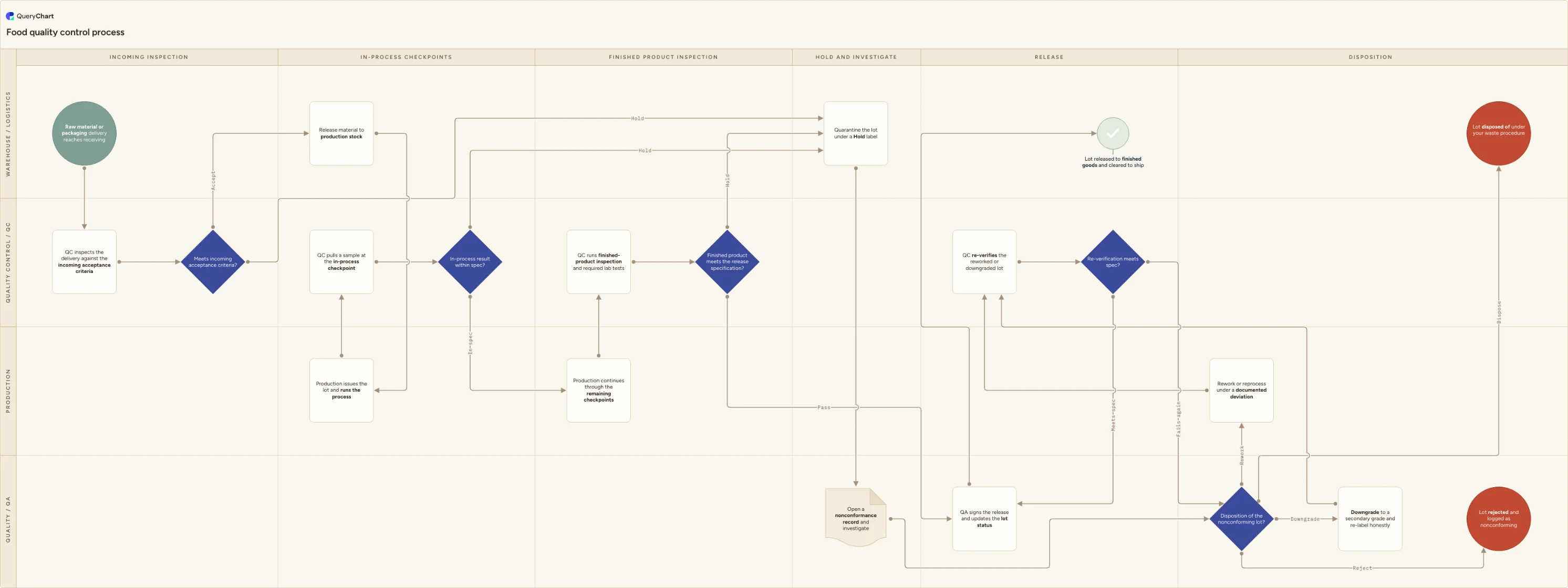
Food quality control process flowchart: incoming, in-process and finished-product inspection routed into one shared hold and disposition path before release.
What the food quality control process flowchart (inspection, hold and disposition) process is
This chart is the quality control network for a food or beverage plant: the three checkpoints — incoming inspection, in-process sampling and finished-product inspection — and the single hold, investigation and disposition path every one of them feeds into when something fails. A delivery is inspected against the plant's own acceptance criteria before it reaches production stock; an in-process sample is pulled at the checkpoint the process control plan sets; and a finished lot is inspected against its release specification before QA signs it off. Whichever of the three catches a failure, the lot is quarantined under a hold, a nonconformance record is opened, and Quality / QA reaches one of four dispositions: reworked, downgraded to a secondary grade, rejected, or disposed of. A reworked or downgraded lot is re-verified against the specification it originally failed before it can reach release, and a second failure returns to disposition rather than shipping on a second attempt. Four swimlanes — Warehouse / Logistics, Production, Quality Control / QC and Quality / QA — carry it, so a hold always has a named owner instead of stalling with whoever happened to catch it.
This is the QC network's own shape, not the plant's full manufacturing flow or either of the two procedures a hold actually leads into. It is not the plant's raw-material-to-dispatch process: receiving, storage, formula and processing detail belong to a dedicated food manufacturing process chart, and folding them in here would bury the QC system under the flow it sits inside. It is not a HACCP plan either — nothing on this chart names a critical control point, a monitoring frequency or a critical limit, because CCP status is a product- and process-specific finding your own hazard analysis makes, not something a generic chart can assert. And it stops short of the two procedures a hold hands off to. What happens after the nonconformance record is opened — root cause, containment of any other lot made under the same conditions, the corrective action that follows — is the detail a dedicated nonconforming food product process is built to carry, not this one. What has to be true of the batch record, certificate of analysis and shipping documentation before a released lot actually leaves quarantine is, likewise, the detail a dedicated food product release process is built to carry. Treat this chart as the map that shows where those two procedures attach, and adapt all three under your own quality system and the regulations that apply where you manufacture and sell.
Three decisions carry the checkpoint side of the chart, and they are deliberately shaped alike: "Meets incoming acceptance criteria?", "In-process result within spec?" and "Finished product meets the release specification?" all route a fail into the same hold rather than each growing its own disposition logic, which is what keeps three different checkpoints readable as one system instead of three. "Disposition of the nonconforming lot?" is the chart's real decision, and it is four-way rather than a binary pass/fail because a real QC program needs more outcomes than "reject" — rework and downgrade are both legitimate for a lot that failed on a quality attribute, and are reserved from a lot that failed on a food-safety limit, where reprocessing doesn't undo what the check exists to catch. "Re-verification meets spec?" closes the loop against the specification the lot originally failed, not a looser one written to pass it, so a correction actually has to work rather than just be attempted.
What this flowchart covers
In this template
- Four swimlanes (Warehouse / Logistics, Production, Quality Control / QC and Quality / QA) across six phases — incoming inspection, in-process checkpoints, finished-product inspection, hold and investigate, disposition, and release — so a hold always has a named owner instead of stalling with whoever caught it
- Three checkpoints — the incoming "Meets incoming acceptance criteria?" check, the "In-process result within spec?" sample, and the "Finished product meets the release specification?" inspection — that all feed the same shared hold rather than three separate procedures that happen to look alike
- A four-way "Disposition of the nonconforming lot?" decision owned by Quality / QA, splitting a held lot into rework, downgrade, reject or dispose rather than collapsing every failure into one generic "fail" outcome
- A "Re-verification meets spec?" loop that sends a reworked or downgraded lot back through QC against the same specification it originally failed, with a second failure routed back to disposition rather than waved through on a second attempt
- A nonconformance record opened at the point of hold, so a lot that ends up corrected, downgraded, rejected or disposed of carries a documented reason rather than disappearing off the production schedule
When to use this template
- You are documenting your plant's QC checkpoints and need one picture of how incoming inspection, in-process sampling and finished-product inspection all feed the same hold and disposition process
- Failures are reaching final inspection that an earlier checkpoint should have caught, and you need to see whether the gap is at receiving, at the in-process sample, or between the two
- Nonconforming lots are being reworked, downgraded or scrapped on an ad hoc call at the line, and you need the disposition decision owned by a named role with the routes it can actually take drawn out
- You want a QC-focused overview to sit above the detailed nonconforming-product investigation and batch-release procedures, rather than repeating their disposition and paperwork detail on every page
- A customer, auditor or new quality manager has asked for a documented picture of how your QC program actually catches and routes a failure, before you build the detailed HACCP, nonconforming-product and release procedures underneath it
How it works
Rename the lanes to your roles
Replace Warehouse / Logistics, Production, Quality Control / QC and Quality / QA with the functions you actually run. A smaller plant often merges QC and QA into one role or one shift lead; merge the lanes rather than drawing a handoff that never happens.
Write your own acceptance criteria at each checkpoint
This chart names three checkpoints — incoming, in-process and finished-product — without asserting the criteria behind any of them. Attach your own raw-material specification, in-process control limits and finished-product release specification to each decision; none of those belong on a generic chart.
Decide which checkpoints are critical control points in your own HACCP plan
Nothing here declares a step a CCP, because CCP status depends on your product, your process and your own hazard analysis. Wherever a checkpoint on this chart lines up with a CCP in your plan, add the monitoring frequency and critical limit your plan already sets — do not invent one here.
Set the rule for what routes to Hold
Agree, before you need it, what counts as a fail at each of the three checkpoints and who may call it. A rule written after the first disputed hold is a rule written under pressure, from whoever is loudest on the floor that day.
Assign disposition authority
Name who may call a held lot reworked, downgraded, rejected or disposed of, and reserve rework and downgrade for lots that failed on a quality attribute rather than a food-safety limit. A department is not an owner; a title is.
Define the re-verification rule
State what a reworked or downgraded lot has to pass before it reaches release, and against which specification — the one it originally failed, not a looser one written to pass it on the second try.
Walk it against last month's real holds
Take a handful of completed nonconformance records, including one that was reworked and one that was rejected, and trace each through the chart. Any step people describe that is not drawn, or drawn but skipped under schedule pressure, is the finding worth fixing before you publish the procedure.
Frequently asked questions
What are the steps in this food quality control process?
A delivery reaches receiving and QC checks it against the incoming acceptance criteria; a hold quarantines it while a pass releases it to production stock. Production issues the lot, and QC pulls a sample at the in-process checkpoint set by the process control plan; an out-of-spec result is held, and an in-spec result lets production continue through the remaining checkpoints. QC then runs finished-product inspection and any required lab tests; a lot that meets the release specification moves to QA sign-off, and one that does not joins the same hold path as the other two checkpoints. Every hold opens a nonconformance record, and QA reviews it and decides whether the lot is reworked, downgraded to a secondary grade, rejected, or disposed of. A reworked or downgraded lot is re-verified by QC against the specification it originally failed before it can reach release; a second failure returns to disposition rather than shipping on a second attempt. A lot that clears release is signed off by QA and moves to finished goods, cleared to ship.
Does this template establish HACCP or regulatory compliance for our QC program?
No. This chart is a process map of how a QC program routes a failure, not a food-safety management system, and using it doesn't by itself satisfy any regulation or certification scheme. Which of these checkpoints is a critical control point, and what its monitoring frequency and critical limit are, depends on your own product, process and hazard analysis under Codex Alimentarius's HACCP principles (CXC 1-1969) or, in the United States, FDA's Preventive Controls for Human Food rule (21 CFR Part 117) — this chart performs none of that analysis. Treat it as an adaptable starting point for documenting your own QC program, reviewed by whoever owns your HACCP plan and quality system, not as evidence of compliance in itself.
What's the difference between rejecting and disposing of a nonconforming lot?
The chart draws them as two different endpoints because they are two different real outcomes. "Reject" means the lot is removed from this order or use but may still have a legitimate secondary outlet your own procedure allows — sold under a different specification, diverted to a use the failure doesn't affect, or returned to a supplier for raw material. "Dispose" means the lot is destroyed or discarded entirely, which is the outcome a food-safety failure usually requires rather than a quality one. If you operate under ISO 22000:2018, clause 8.9 on control of nonconformity and its provisions for potentially unsafe product describe a similar split — release, reprocessing, diversion to an unaffected use, or destruction — but the exact wording and which option is available for which failure is set by the current standard text and your own certification scope, not by this chart.
Who should decide whether a lot can be reworked or downgraded rather than rejected?
Whoever holds disposition authority in your quality system, kept separate from whoever is under pressure to keep the schedule moving — this chart puts it in Quality / QA for that reason, but the right title is yours to name. The distinction that matters more than the org chart is what kind of failure it is: a lot that failed on a quality attribute — colour, fill weight, a cosmetic defect — is a reasonable candidate for rework or downgrade, while a lot that failed on a food-safety limit generally is not, because reprocessing or downgrading doesn't undo a hazard the way it can undo a quality defect. Set that boundary in your own procedure before the first disputed call, not during it.
How does this relate to a full nonconforming-product investigation or the batch release process?
This chart stops at overview altitude on purpose. It shows that a hold opens a nonconformance record and QA reaches one of four dispositions, but it doesn't carry the investigation itself — root cause, containment of any other lot made under the same conditions, or the corrective action that follows — which is the detail a dedicated nonconforming food product process is built to hold. Equally, it shows release as a QA sign-off and a status update, but the batch record, certificate of analysis and shipping-documentation checks that have to be complete before a lot actually leaves quarantine belong to a dedicated food product release process. Keeping those two out of this chart is what keeps a QC overview readable instead of trying to be three procedures at once.
Where this process fits
In most operations this process follows Batch production process flowchart (batch record to warehouse handoff) and hands off to Nonconforming food product process flowchart (food-safety disposition and CAPA).
It is one step in Food production.
Step 1: Production line changeover process flowchart (allergen check to QA release)
Step 2: Cleaning-in-place (CIP) process flowchart (pre-rinse to final release)
Step 3: Food production workflow flowchart (shift production floor cadence)
Step 4: Batch production process flowchart (batch record to warehouse handoff)
Batch production process flowchart: ingredients weighed against the formula, line clearance, parameters logged, QA review, then released, held or rejected.
Step 5: Food quality control process flowchart (inspection, hold and disposition) You are here
Food quality control process flowchart: incoming, in-process and finished-product inspection routed into one shared hold and disposition path before release.
Step 6: Food product release process flowchart (COA, disposition and dispatch)
Food product release process flowchart: QA checks the COA and batch record, routes an open deviation to disposition, then signs off and dispatches a clean lot.