Food label verification process flowchart (pull to release)
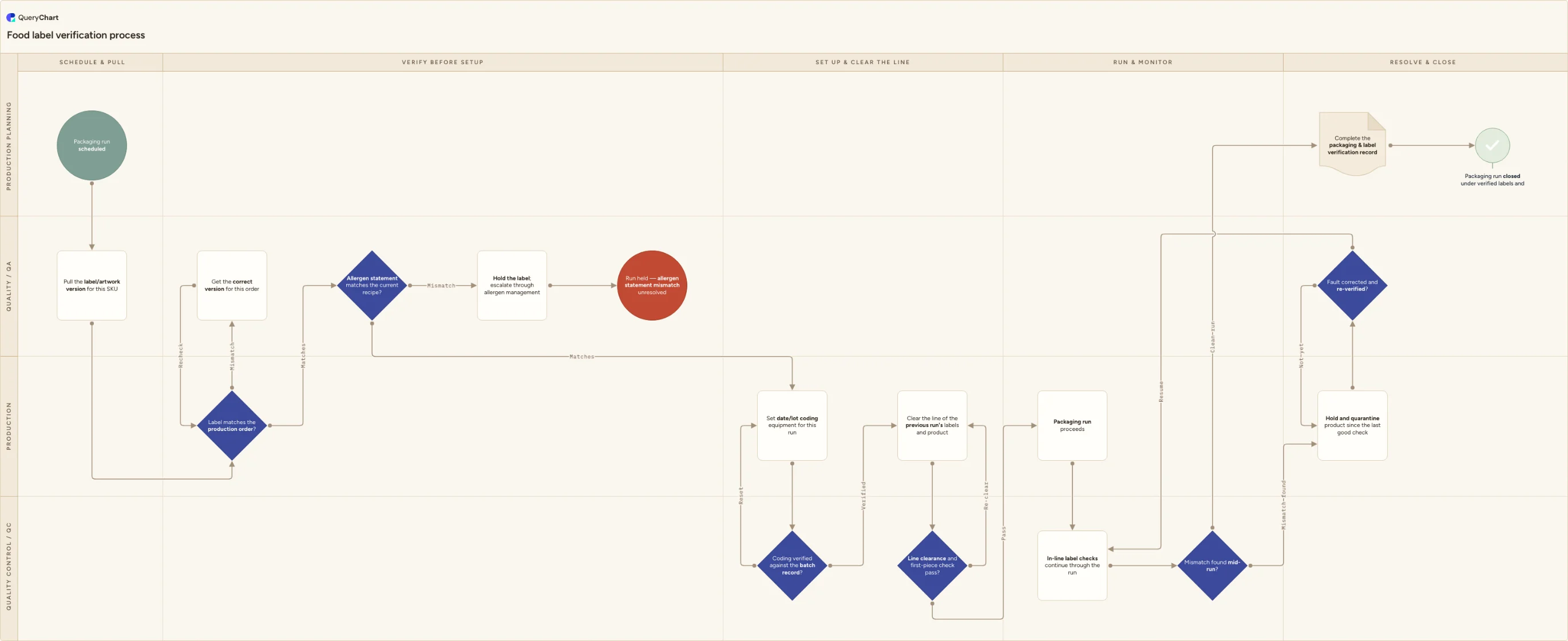
Food label verification process flowchart: label matched to recipe and allergen profile, order-checked, coding verified, with a mid-run hold-and-correct path.
What the food label verification process flowchart (pull to release) process is
This chart follows one packaging run from the moment it is scheduled to the moment the batch is closed under verified labels and coding. The correct label and artwork version is pulled from the approved label library and matched to the product, the recipe's allergen profile and this run's lot and best-before coding requirements, then cross-checked a second time against the actual production order — a step that matters because a private-label customer, an export market or a promotional pack can share the same product code as the standard run and still need different artwork. The allergen statement is verified against the current recipe, which is the highest-stakes gate on the chart, before the line moves to setup: date and lot coding equipment is set and verified against the batch record, the line is cleared of the previous run's labels and product, and a first-piece check holds a packaged unit next to the approved label proof before the run is allowed to start. The run itself is not left unattended once it starts — in-line label presence and legibility checks continue for its duration, and a mismatch caught mid-run routes to a hold, a quarantine back to the last verified good check, and a correction that has to be re-verified, by the role that can also order the line held, before the run resumes.
This chart is deliberately narrow, and it is worth being precise about where its boundary sits. It is not the allergen management process: that page owns the wider question of whether an allergen changeover is needed at all, how segregated storage and dedicated equipment are run as standing controls, and what a cleaning verification has to pass before a line is cleared for the next allergen profile — this chart picks up only at the point a label has to be verified against whatever recipe is already running, and its most serious branch, an allergen statement that no longer matches the current recipe, hands straight back to that process rather than trying to resolve a formulation problem at the packaging line. It is not label design or artwork approval either: by the time this chart opens, the label already exists in an approved library with a version and a recipe revision behind it — getting a new or changed label through proofing and sign-off is separate, upstream work. And it is not what happens after a mislabelled product has already shipped: a mismatch this chart catches is held before release, full stop; a nonconformance discovered after distribution, a customer complaint about a label, or a hazard serious enough to bring product back are the territory of a nonconforming-product process, a customer complaint process or a product recall process, not a rerun of this one.
Six decisions carry the process, and two of them are the ones worth reading closely. "Label matches the production order?" and "Allergen statement matches the current recipe?" run back to back on purpose, because they catch two different failure modes that look identical from the packaging line: the first catches the right generic label pulled for the wrong variant of an order, and the second catches a label that was correct the last time this SKU ran but has been overtaken by a recipe change nobody flagged back to label control. "Coding verified against the batch record?" and "Line clearance and first-piece check pass?" both loop back rather than pass on a caught problem, because a coding fix or a re-clear that isn't re-checked is a fix nobody confirmed. And "Mismatch found mid-run?" feeding "Fault corrected and re-verified?" is the chart's real test of discipline: the easy failure is catching a mismatch, and the harder one is resuming the run before the correction is actually confirmed, which is why release from hold sits with a role independent of the pressure to keep the line moving.
What this flowchart covers
In this template
- Four swimlanes — Production Planning, Quality / QA, Production and Quality Control / QC — across five phases from scheduling to close, so a hold, a re-clear or a correction always has a named owner instead of dissolving into 'someone on the line will catch it'
- Two verification gates run back to back before the line is ever set up: a "Label matches the production order?" check that catches an order-specific artwork variant, and an "Allergen statement matches the current recipe?" decision — the highest-stakes check on the chart — whose failure hands off to the allergen management process rather than being resolved at the packaging line
- Setup gated on two more checks that both loop back on failure rather than pass a caught problem forward: "Coding verified against the batch record?" for the date and lot code actually set on the equipment, and "Line clearance and first-piece check pass?" holding a packaged unit against the approved label proof and the order before the run is allowed to start
- The run is monitored, not just started clean: in-line label presence and legibility checks continue through the run, feeding a "Mismatch found mid-run?" decision that is the chart's only entry into its hold path
- A hold-and-correct loop scoped to what actually needs re-checking: product is quarantined back to the last verified good check, not just the flagged pack, and a "Fault corrected and re-verified?" decision — owned by Quality / QA — gates resuming the run rather than letting Production self-clear under schedule pressure
- Closure on evidence: a packaging and label verification record documents the version used, the codes issued, the line clearance result and any hold and its resolution, so the batch record shows an issue when one occurred rather than only a signature
When to use this template
- You are writing or revising a label control procedure for packaging and need one picture of who pulls the label, who verifies it against the order and the recipe, who clears the line, and who may release a held run
- Labels are being applied from whatever stock is nearest the printer rather than from a checked, current version, and a superseded artwork file with the right product name on it has gotten onto a line before
- Your allergen management process already covers changeover and cleaning verification, but the separate question of whether the label itself matches the current recipe and the actual order has never been drawn as its own gate
- In-line label checks exist but a mismatch found mid-run has no documented hold, quarantine or re-verification path, so it is unclear how far back product gets pulled or who may restart the line
- A customer, auditor or certification body has asked for a documented description of how label accuracy is verified before and during a packaging run, distinct from your general packaging and allergen procedures
How it works
Rename the lanes to your roles
Replace Production Planning, Quality / QA, Production and Quality Control / QC with the functions you actually have. A smaller facility often runs QC and QA as one role, or has a single line lead carrying both the label pull and the first-piece check; merge lanes rather than drawing a handoff that never happens.
Name the label library and the order data the two early checks compare against
"Label matches the production order?" and "Allergen statement matches the current recipe?" both need a named source of truth. Say exactly where the approved label version lives, where the current recipe revision is recorded, and which order field — customer code, pack size, market — the label is checked against, so both gates point at a real, current document rather than 'the label that was used last time.'
Set your own coding format and shelf-life rule
This chart doesn't assert a date format, a lot-code structure or a shelf-life calculation, and neither should your adaptation unless it is the one your product specification and food safety plan actually set. Name the format, the calculation basis and where it is documented, so 'coding verified against the batch record' is checked against a written rule rather than what looks right on the equipment display.
Define what line clearance and a first-piece check must confirm
Decide what 'cleared' means for your line — no previous labels, no previous packaging materials, no previous product in reach of the packaging point — and what a first-piece check has to hold the pack against: the approved label proof, the order, or both. Name who signs it off and where that record is kept.
Set your own in-line inspection method and frequency
Whether label presence and legibility are checked by a vision system on every pack or by a periodic manual pull is a decision for your own line's validated capability, not something this chart can set. Name the method, the frequency and who is responsible for acting on a failed read before you rely on 'in-line label checks continue' as a real control.
Agree the quarantine scope and the re-verification authority
Decide, before you need it, how far back a caught mismatch gets quarantined — back to the last verified good check is the convention this chart follows, but confirm it matches your own traceability capability — and name the role that verifies a correction and authorises resuming the run. Make sure that role is not the one under the most pressure to keep the line moving.
Walk it against last month's real runs
Pull a handful of recent packaging records, including one where an in-line check caught something, and trace them through the chart. Any step people describe doing that isn't drawn, or drawn but skipped when the schedule was tight, is the finding worth fixing before you publish the procedure.
Frequently asked questions
What are the steps in a food label verification process?
A packaging run is scheduled and the correct label and artwork version is pulled from the approved label library, matched to the product, the recipe's allergen profile and this run's lot and best-before coding requirements. The label is cross-checked against the actual production order, with a mismatch routed back to label control rather than corrected at the line, and the allergen statement is verified against the current recipe — the chart's highest-stakes check, since a mismatch here holds the run and escalates through the allergen management process rather than being resolved on the packaging floor. Date and lot coding equipment is set and verified against the batch record, the line is cleared of the previous run's labels and product, and a first-piece check holds a packaged unit against the approved label proof before packaging proceeds. In-line label presence and legibility checks continue through the run; a clean run moves straight to the record, while a mismatch found mid-run holds and quarantines product back to the last verified good check until the fault is corrected and re-verified. The run closes on a packaging and label verification record documenting the version used, the codes issued and any hold and its resolution.
Does this template establish HACCP or regulatory compliance for label control?
No single flowchart can, and this one does not attempt to. What counts as a required label field, an acceptable in-line inspection method or a sufficient reconciliation between the label and the recipe is specific to your products, your facility and the regulations that apply where you manufacture and sell — this chart marks the decision points and leaves the criteria to your own validated procedures. Real obligations do apply and are worth citing precisely, with the same hedge: in the United States, FDA-regulated packaged foods must declare major food allergens under the FD&C Act as amended by FALCPA and 21 CFR 101.4, while meat, poultry and egg products instead fall under USDA FSIS labeling rules in 9 CFR Parts 317 and 381 — check which regime covers your product before assuming either applies. In the EU, Regulation (EU) No 1169/2011 Annex II sets out the 14 allergens that must be declared. Certification schemes go further procedurally — BRCGS Food Safety Issue 9 includes a dedicated clause on product labelling and pack integrity — but certification depends on an audit, not on adopting a template. Treat this chart as an adaptable starting point and confirm applicability with whoever owns your facility's food safety and regulatory compliance.
How is this different from the allergen management process?
They sit at different points in the same problem and are meant to be used together, not as substitutes. The allergen management process is the master control: it decides whether a scheduled product needs a full allergen changeover based on what the line last ran, runs the cleaning and cleaning verification that changeover requires, and treats segregated storage and dedicated equipment as standing controls underneath every scheduling cycle. This chart picks up narrower ground within that same cycle — whether the label actually pulled for the run matches the order and, separately, whether the allergen statement on it still matches the current recipe — and its most serious failure, an allergen statement that no longer matches the current recipe, is designed to hand straight back to the allergen management process rather than resolve a formulation question at the packaging line. If you already run that process, treat 'Hold the label; escalate through allergen management' as the point where the two charts connect, not as a step to duplicate.
What should an in-line label check verify, and how often should it run?
There is no universal answer, and a chart that asserted one would be asserting something no facility's own line and product mix can guarantee. At minimum, an in-line check is verifying that the label present on the pack is legible, correctly applied and carries the coding and allergen statement that were verified before the run started — not re-litigating the label's correctness from scratch on every pack. Whether that check runs continuously through a vision system reading every unit, or periodically through a manual pull at an interval you set, depends on your line's speed, your product's risk profile and what your own validation of the inspection method actually supports. Whichever you choose, name it on the chart and validate it the same way you would any other in-process control, rather than leaving 'in-line label checks continue' to mean whatever the operator on shift happens to do.
Who should have authority to release a run that was held for a label or coding mismatch?
Most facilities restrict this to Quality or a named designee, and the chart follows that convention for the same reason the allergen management process does: release authority should sit with a role independent of the pressure to keep the line running, and one that can also order the line held if the correction doesn't check out. Whatever role you assign to 'Fault corrected and re-verified?', make sure it is the same role, or one with equal standing, that can call the hold in the first place — a run should never resume on the say-so of someone who could not also have kept it stopped.
Where this process fits
In most operations this process follows Allergen management process flowchart (changeover to release).
Comes before
- Allergen management process flowchart (changeover to release) — Allergen management process flowchart: goods-in declaration check, segregated storage, scheduling review, a changeover-triggering decision, cleaning verification, line clearance, label check and production release.