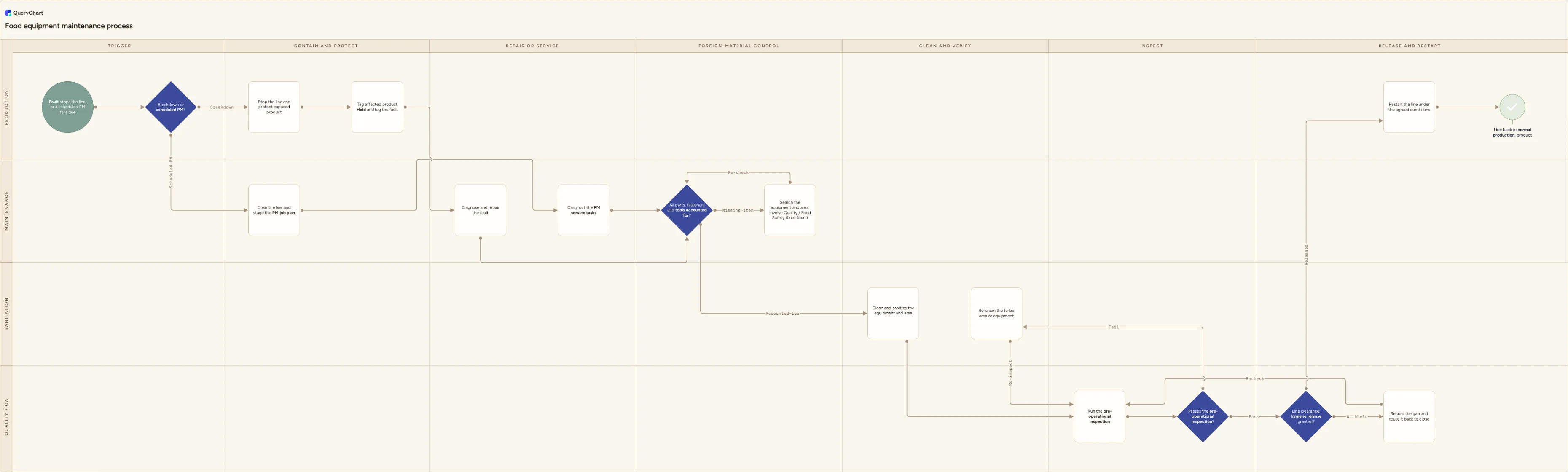
Food equipment maintenance process flowchart (breakdown to hygiene release)
Food equipment maintenance flowchart: contain a breakdown or PM, repair it, count parts and tools, clean and inspect, then a hygiene release before restart.
What the food equipment maintenance process flowchart (breakdown to hygiene release) process is
This chart follows one piece of food-contact equipment from the moment it stops to the moment it is trusted with product again. A fault takes the line down, or a scheduled PM falls due; either way the line stops, and if it was mid-run, whatever product was exposed near the fault has to be protected and, if it might be affected, tagged on hold before a technician opens anything. The technician diagnoses and repairs the fault, or works through the PM job plan, and both routes land on the same question: are every part, fastener and tool that went onto the job accounted for back off it? Only once that count clears does the equipment get cleaned, sanitized and put through a pre-operational inspection, and only once the inspection passes does Quality / QA grant hygiene release — a line clearance that has to be earned in writing before Production is allowed to restart. Four swimlanes — Production, Maintenance, Sanitation and Quality / QA — carry it, so the line only comes back into food production through one owned gate rather than on whoever happened to finish last.
This is what a stopped line does before it is allowed to touch product again, not the plant's whole maintenance function and not the two general processes it sits downstream of. It is not the general equipment maintenance process: work-order intake, priority triage across every kind of asset, spares management and permits to work are that chart's job, and this one starts from the assumption that a technician has already been dispatched. It is not the preventive maintenance process either, which owns the PM schedule, the trigger logic and the job-plan library in depth; here a scheduled PM is one of two ways into this chart, drawn only far enough to show it feeding the same back half a breakdown does. It is not routine cleaning-in-place: CIP or COP between production runs is its own cycle on its own frequency, where this chart's clean is a one-off, triggered by the fact that a repair just happened, even though it may run the same validated procedure. And it hands off in both directions rather than absorbing its neighbours — held product goes to a nonconforming-product process for disposition, and a repeat failure goes to root cause analysis — because folding either in here would bury the two steps that actually make this a food-specific chart under a general maintenance flow. Treat it as a starting point to adapt under your own HACCP plan, quality system and the regulations that apply where you manufacture.
Four decisions carry the chart, and the back two are the reason it exists as its own template. "Breakdown or scheduled PM?" is the entry split, and it matters less for what it routes than for what it converges: an urgent, unplanned stop and a planned, windowed one land on identical foreign-material, cleaning and release checks, because the asset does not know which kind of stop it just had. "All parts, fasteners and tools accounted for?" is the check a plant maintaining, say, an office building would never need to draw — a missing washer only matters here because the next thing to run through that gap is food. "Passes the pre-operational inspection?" and "Line clearance: hygiene release granted?" are two separate gates on purpose rather than one merged pass/fail: the first is Sanitation's and Quality's technical read on the equipment itself, the second is the documented authority to let Production have it back, and collapsing them into one step is how a plant ends up restarting on a clean surface with no signed record that anyone actually checked the count and the paperwork together.
What this flowchart covers
In this template
- Four swimlanes (Production, Maintenance, Sanitation and Quality / QA) across seven phases — trigger, contain and protect, repair or service, foreign-material control, clean and verify, inspect, and release and restart — so a stopped line comes back into food production through one owned gate
- A "Breakdown or scheduled PM?" decision at the top that sends an unplanned fault through product protection and a hold tag, or a scheduled job straight to a downtime window already agreed with Production, before both routes converge on the same repair-quality checks
- An "All parts, fasteners and tools accounted for?" decision in the Maintenance lane, the foreign-material control step a generic equipment maintenance chart has no reason to draw, with a search-and-escalate loop back to the same check rather than a line that restarts on trust
- A post-repair clean kept distinct from routine CIP: "Clean and sanitize the equipment and area" feeds a "Passes the pre-operational inspection?" decision owned by Quality / QA, with a re-clean loop back into it rather than one pass/fail check with no route to fix a failure
- A "Line clearance: hygiene release granted?" gate, the second thing a non-food maintenance chart would skip, that has to be granted in writing before Production is authorised to restart, with a documented, re-checked path back when it is withheld
- A brief nod to what restart actually means for food product rather than just for the machine: the line comes back under agreed conditions, with the parts-and-tools count, the clean and the inspection all standing behind it
When to use this template
- You maintain equipment that touches food or a food-contact surface, and the generic equipment maintenance process you already use doesn't cover what has to happen before the line is allowed to run product again
- A repair or a scheduled PM finishes without anyone formally accounting for the tools and parts that went onto the line, and you need that count drawn as its own gate rather than left to memory
- Sanitation cleans up after a repair but nobody owns a documented pre-operational inspection or a hygiene release before the line restarts, so restart happens on whoever finishes first
- Maintenance and Quality disagree about who has the authority to release a line back into production once the mechanical work is done, and the two gates need separate, named owners
- A customer, auditor or new food safety manager has asked how you control the risk that maintenance work itself introduces into a product, before you build the detailed foreign-material and pest-control procedures underneath it
How it works
Rename the lanes to your roles
Replace Production, Maintenance, Sanitation and Quality / QA with the functions you actually run. A smaller plant often has one shift lead covering sanitation and quality, or a technician who is also the planner; merge the lanes rather than drawing a handoff that never happens.
Write your own parts-and-tools accounting rule
State what "accounted for" means at your site: a tool tally checked out and back in against a job sheet, a shadow board with an outline for every item, or a parts-used-versus-parts-returned reconciliation. Name who signs the count, because the signature is what makes the gate real rather than a step nobody actually stops for.
Decide which checkpoints are critical control points in your own HACCP plan
Nothing on this chart declares a step a CCP, because CCP status depends on your product, your process and your own hazard analysis. Wherever a checkpoint here lines up with one in your plan, attach the monitoring frequency and critical limit your plan already sets rather than inventing one on the chart.
Set your cleaning and pre-operational inspection standard
Attach your own validated CIP or COP procedure to the clean step, and define what the pre-operational inspection actually checks: a visual standard, an ATP swab, an allergen swab where the repair touched a shared line. None of those numbers belong on a generic chart, so set them from your own environmental monitoring and sanitation programme.
Assign hygiene release authority separately from the repair sign-off
Name who may grant line clearance, and require them to check the parts-and-tools count, the cleaning record and the inspection result together rather than trusting that each one was fine because the others were. Keep this authority distinct from whoever confirmed the mechanical repair itself, so one person is not marking their own work complete on both fronts.
Define the not-found escalation
Decide how long a search runs before it escalates, who from Quality or Food Safety gets pulled in, and what happens to product or equipment when an item still can't be located: an extended hold, a magnet run, a metal-detector pass, or a decision that goes above the shift. Write the rule before the first missing bolt forces you to invent one under pressure.
Walk it against two real jobs
Take one recent breakdown and one recent PM and trace both through the chart. Check that a parts-and-tools count and a signed hygiene release actually exist for each; a repair record with a completed job but no count and no release signature is the finding worth fixing before you publish this.
Frequently asked questions
What are the steps in the food equipment maintenance process?
A fault stops the line, or a scheduled PM falls due. An unplanned stop is contained first: Production protects any exposed product near the fault and tags affected product on hold before logging it, while a scheduled PM goes straight to clearing the line and staging the job plan against a downtime window already agreed with Production. Maintenance then diagnoses and repairs the fault, or carries out the PM tasks, and both routes converge on the same check: are every part, fastener and tool that went onto the job accounted for back off it? A missing item sends Maintenance searching the equipment and area, escalating to Quality or Food Safety if it isn't found, before the count is rechecked. Once it clears, Sanitation cleans and sanitizes the equipment and area, and Quality / QA runs a pre-operational inspection; a fail sends it back for a re-clean and a re-inspection. A pass moves to line clearance, where Quality / QA either grants hygiene release or withholds it and routes the gap back to be closed. Once released, Production restarts the line under agreed conditions, with the parts-and-tools count, the clean and the inspection all standing behind it.
Why does a food plant need a hygiene release gate that a generic equipment maintenance process doesn't?
Because a generic maintenance chart correctly stops at "is the asset fixed and accepted back into service," and that question has a different answer than "is it now safe to let food touch it." An office HVAC unit, a warehouse conveyor or a piece of equipment with no product contact can restart the moment the technician's functional test passes. Equipment that contacts food carries two extra risks a repair itself can introduce: something left behind in or near the equipment (a fastener, a tool, a fragment), and a surface that was opened up and needs to be clean and verified before product runs across it again. This chart draws both as their own gates, foreign-material control and hygiene release, rather than folding them into the generic "accepted back to service" step, which is exactly the step a non-food maintenance chart has no reason to expand.
What actually counts as the parts-and-tools count, and why does it matter?
It is a reconciliation, not a tidy-up: every tool, fastener, cable tie, glove or spare part that went onto or near the job is checked back off it against what was issued, before the equipment is closed up and cleaned. Plants run this a few common ways — a tool tally sheet signed out and back in, a shadow board where a missing outline is visible at a glance, or a parts-used count matched against the requisition. The point is foreign material: a food plant's real incidents involving maintenance work usually trace back to something small left inside a hopper, a guard cavity or a product-contact surface, not to the repair itself failing. Set your own method and your own signature requirement; what matters is that the count is a discrete, owned step rather than an assumption that nothing was left behind because the job "went fine."
Does this template establish HACCP or food-safety regulatory compliance for equipment maintenance?
No. This chart is a process map of how a maintenance job clears before it touches food again, not a hazard analysis, and following it doesn't by itself satisfy any regulation or certification scheme. In the United States, FDA's current good manufacturing practice requirements under 21 CFR 117.40 require food-contact equipment and utensils to be designed and maintained to be adequately cleanable; in the EU, Regulation (EC) No 852/2004, Annex II, Chapter V sets a similar requirement that equipment be kept in good order and repair to facilitate cleaning and, where necessary, disinfection. Neither regulation, nor this chart, tells you which of these steps is a critical control point in your own HACCP or food safety plan, or what its monitoring frequency and critical limit should be — that depends on your own hazard analysis. Treat this as an adaptable starting point for documenting how maintenance work clears before it reaches product, reviewed by whoever owns your food safety plan, not as evidence of compliance on its own.
How is this different from the general equipment maintenance, preventive maintenance and cleaning-in-place processes?
Scope and altitude. The general equipment maintenance process owns the whole work-order cycle across every kind of asset — intake, triage, planning, parts, permits — and this chart picks up only once a technician is already on the job, so the two are meant to be read together rather than as alternatives. The preventive maintenance process owns the PM schedule and job-plan library in depth; here a scheduled PM is one entry point, drawn only far enough to show it converging on the same back half a breakdown does. Cleaning-in-place is a routine cycle between production runs on its own frequency, while this chart's clean is a one-off triggered by a repair, even if it runs the same validated CIP or COP procedure your sanitation programme already uses. What this chart owns that none of the other three do is the two gates in between: accounting for every part and tool that went onto the job, and a documented hygiene release before the line is trusted with food again.
Where this process fits
In most operations this process hands off to Food production workflow flowchart (shift production floor cadence).
Comes after
- Food production workflow flowchart (shift production floor cadence) — Food production workflow flowchart template: work order to line setup, pre-operational check, in-process monitoring, changeover or downtime handling, end-of-run reconciliation, line clearance and shift handover.