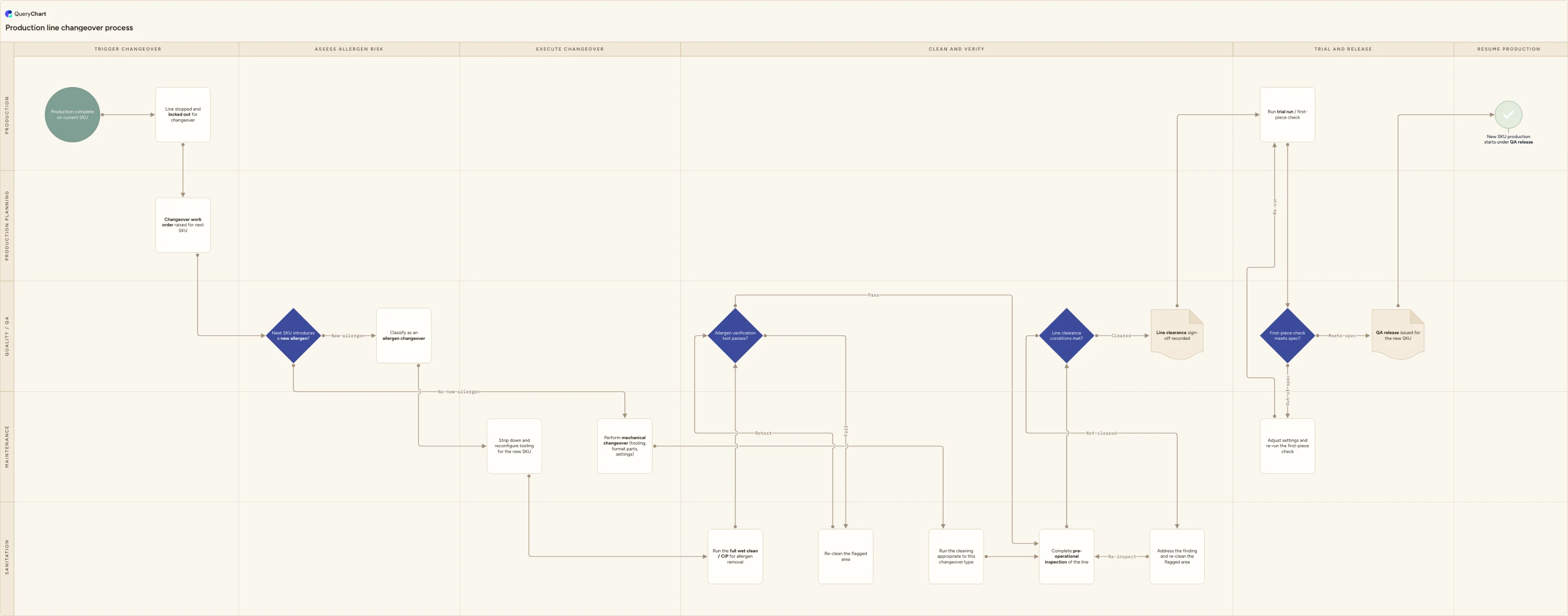
Production line changeover process flowchart (allergen check to QA release)
Production line changeover flowchart: allergen check, mechanical changeover, cleaning by type, pre-op inspection, line clearance, first-piece check, QA release.
What the production line changeover process flowchart (allergen check to QA release) process is
A changeover is the gap between two SKUs, and on most lines it is also the highest-risk window in the whole shift: tooling is off, guards are open, the line is stationary long enough that shortcuts feel cheap, and whatever cross-contact or foreign-material risk exists between the outgoing and incoming product has exactly this window to become real. The trigger is simple — production finishes on the current SKU and a changeover work order is raised for the next one — but everything downstream of that depends on one question answered early: does the next SKU introduce an allergen that was not on the line a moment ago. That single check is the fork the whole chart turns on. Get it right and a routine changeover stays routine. Get it wrong, or skip it under schedule pressure, and the pre-operational inspection and line clearance that follow are checking the wrong thing.
This chart is the backbone of a changeover, not the content of its hardest parts. It is not the allergen risk assessment itself — deciding whether a given SKU pairing counts as major-to-minor, minor-to-major or allergen-to-allergen, and what that classification requires, belongs to your allergen management procedure, and this chart only routes into it. It is not the cleaning validation either: the contact time, chemical concentration, rinse steps and verification method for the full wet clean sit in your cleaning-in-place program, referenced here rather than repeated. It is not preventive maintenance — a worn format part discovered mid-changeover becomes a maintenance work order, not a delay absorbed into this process. And it is not batch release: the batch record and disposition for the SKU that just finished are closed under your batch release process, while the QA release at the end of this chart is a decision about the line and the new run, not about stock already made. Keeping those four boundaries visible is what stops a changeover procedure from either duplicating three other SOPs badly or silently absorbing work that belongs in none of them.
Four decisions carry the process, and three of them exist because the alternative is trusting a schedule instead of a check. "Next SKU introduces a new allergen?" is the fork that decides whether the line needs a full wet clean and a verification test or a lighter changeover clean — and it has to be answered from the allergen matrix, not from what the line last ran. "Allergen verification test passes?" and "Line clearance conditions met?" both exist because a clean line and a cleared line are not the same claim: one is a physical result, the other is a documented confirmation that nothing from the previous SKU — product, label, packaging or paperwork — remains. "First-piece check meets spec?" closes the loop at the only point that actually matters to the customer: whether the first units off the new settings are within specification before the line is allowed to run at rate. Each of the three loop-backs — retest, re-inspect, re-run — is drawn because real changeovers fail a gate and go again, and a chart with no failure path teaches a team that the gate always passes.
What this flowchart covers
In this template
- Five swimlanes (Production Planning, Production, Maintenance, Sanitation and Quality / QA) across six phases: trigger the changeover, assess allergen risk, execute the changeover, clean and verify, trial and release, and resume production, so every handoff has a named owner.
- An allergen-profile fork right after the work order is raised — a "Next SKU introduces a new allergen?" decision that sends the line down a full allergen changeover and CIP route or straight to a routine mechanical changeover, rather than treating every SKU pairing the same way.
- The allergen route in full: classification under the allergen management procedure, a fuller tooling strip-down, a full wet clean or CIP run, and an "Allergen verification test passes?" gate with a re-clean-and-retest loop rather than a single pass-or-fail attempt.
- The routine route converging on the same verification: mechanical changeover of tooling, format parts and settings, followed by the cleaning appropriate to that changeover type, meeting the allergen route at one shared pre-operational inspection step.
- Two release gates before the line runs: "Line clearance conditions met?", checking nothing from the previous SKU remains on or around the line, and a first-piece check against specification that has to pass before QA release, each with its own loop back to the step it depends on.
- Closure on evidence: line clearance sign-off and the QA release are both drawn as documents, so the record a changeover is judged on — not just the fact that production resumed — is visible on the chart itself.
When to use this template
- You are writing or revising a changeover SOP and need one picture of who raises the work order, who decides whether it is an allergen changeover, and what has to be true before the next SKU is allowed to run.
- Allergen cross-contact incidents keep tracing back to changeover, and you need the allergen-profile check, the full-clean route and the verification test drawn as explicit, unavoidable steps rather than something the line lead is trusted to remember.
- Pre-operational inspection and line clearance are being signed as a formality under schedule pressure, and you need clearance to sit downstream of a real check rather than stand in for one.
- A customer, auditor or certification body has asked how you control changeovers between different products, and you need the routing — not just a policy statement — to point them to.
- You are training new supervisors or changeover leads and want the fork between an allergen changeover and a routine one, and the release gates that follow it, to be unambiguous to someone running their first shift.
How it works
Rename the lanes to your roles
Replace Production Planning, Production, Maintenance, Sanitation and Quality / QA with the functions you actually have. On a smaller site the line lead often carries the Production Planning and Maintenance steps, and the same technician may run both the mechanical changeover and the routine clean — merge lanes rather than drawing a handoff that never happens.
Put your own allergen matrix behind the fork
"Next SKU introduces a new allergen?" is only as good as what feeds it. Name the document the leader checks — an allergen matrix or changeover matrix mapping every SKU pairing to a cleaning type — and who is authorised to make the call when a pairing is not already on the matrix.
Point the allergen route at your real procedure
"Classify as an allergen changeover" and the full wet clean that follows it should name your actual allergen management procedure and cleaning validation program rather than restate them. Write the reference on the chart, not the content — duplicating a validated cleaning program on a process map is how the two quietly drift apart.
Set your own verification method and acceptance criteria
Decide how "Allergen verification test passes?" is actually checked — a swab test, an ATP check, a visual and documentation review, or a combination — and what result counts as a pass. This chart deliberately sets none of that: your validated method and your acceptance criteria are the ones that apply, not a number borrowed from a template.
Define what line clearance actually checks
Write down what "cleared" means on your line: no product, label, packaging, work-in-process or paperwork from the previous SKU remains, tooling matches the new SKU's settings, and the record names who checked it. State who has the authority to clear the line, and confirm it is not the person under pressure to restart it.
Fix the first-piece check before you need it
Name what gets measured on the first units off the new settings, how many units, and who holds them until QA has checked them. Decide what "adjust and re-run" is allowed to change without restarting the whole changeover, and where repeated adjustments on the same SKU pairing should instead trigger a maintenance investigation.
Walk it against a recent changeover log
Take a handful of completed changeovers, including one that ran over its scheduled window, and trace them through the chart. Any step people describe that is not drawn, or a re-clean or re-inspection that happened but was never recorded, is the finding worth fixing before you publish the procedure.
Frequently asked questions
What are the steps in a production line changeover process?
Production finishes on the current SKU and the line is stopped and locked out. Production Planning raises a changeover work order naming the outgoing and incoming SKU. Quality / QA checks whether the new SKU introduces an allergen the line did not just carry. If it does, the changeover is classified under the allergen management procedure, tooling is stripped down further than usual, a full wet clean or CIP run removes the allergen, and a verification test has to pass before the line moves on — failing that test sends it back for a re-clean and retest. If the new SKU introduces no new allergen, Maintenance performs the mechanical changeover and Sanitation runs the cleaning appropriate to that changeover type. Both routes converge on a pre-operational inspection and a "Line clearance conditions met?" decision; a failed clearance is addressed and re-inspected rather than waved through. Line clearance is signed off, a trial run and first-piece check confirm the new settings are within specification — adjusting and re-running if not — and QA release lets the new SKU's production start.
What makes a changeover an "allergen changeover" rather than a routine one?
It depends on whether the incoming SKU's formulation carries an allergen the outgoing SKU's did not, which is a question for your allergen matrix, not a guess based on how similar the two products look. Many allergen management programs distinguish major-to-minor, minor-to-major and allergen-to-allergen changes, and treat each differently because the risk of a trace carryover is not symmetric. A changeover that only alters flavour, colour, portion size or packaging can still be an allergen changeover if the underlying recipe changed. This chart draws the fork but not the classification rules behind it — those come from your own allergen risk assessment, adapted to what your facility actually makes and how your lines are configured, and they are not something a generic template can set correctly for every site.
What is the difference between a changeover clean and a full CIP clean?
A changeover clean is scoped to what a specific SKU pairing requires — sometimes a full wet clean, sometimes a lighter dry clean or wipe-down — and it sits inside the changeover as one step among several. Cleaning-in-place, or CIP, is usually a defined, often automated, cleaning cycle applied to enclosed processing equipment such as tanks, pipework and heat exchangers, validated for a specific set of parameters and verified on its own schedule. An allergen changeover frequently calls for a full wet clean or a CIP run as its cleaning step, but the CIP program itself — cycle design, chemical concentration, contact time, validation and routine verification — is out of scope for this chart. Treat the full wet clean box here as the handoff point into your CIP or manual cleaning procedure, not as a description of it.
Does allergen or food-safety regulation actually require a documented changeover process?
Requirements vary by jurisdiction and by what you make, so treat any specific rule as something to verify against your own regulatory obligations rather than something this chart establishes. In the United States, facilities subject to FDA's FSMA Preventive Controls for Human Food rule are required under 21 CFR 117.135(b) to have food allergen controls, including procedures to prevent allergen cross-contact — a documented changeover process is a common way facilities meet that, though the rule does not name "changeover" specifically and some facilities are exempt or covered by other frameworks, including USDA-regulated meat, poultry and egg products. In the EU and UK, Regulation (EU) No 1169/2011 requires the fourteen listed allergens to be identified when present, which puts real weight on preventing an undeclared allergen reaching a product through a changeover that was not adequately cleaned or cleared. Certification schemes such as those recognised by GFSI typically expect allergen management and changeover controls as part of their current standard — check the specific clause and edition with your certification body rather than assuming a number here. None of this makes the chart itself a compliance document; it is a starting point to adapt under whichever rules and certifications actually apply to your facility.
Who should sign off line clearance before the next SKU runs?
The chart puts the decision in the Quality / QA lane deliberately, separate from Sanitation, which performs the clean and the pre-operational inspection. The person who just cleaned the line is a poor check on whether it is genuinely clear of the previous SKU, for the same reason a talk leader is a poor judge of whether their own talk landed — proximity to the work makes it easy to see what you expect to see. Line clearance is also the record most likely to be sampled if a cross-contact issue is ever traced back to a changeover, so name, on the chart or in your SOP, exactly who holds that authority, what they check, and what happens when clearance fails rather than leaving it as an unwritten habit of whoever is on shift.
Where this process fits
In most operations this process follows Allergen management process flowchart (changeover to release) and hands off to Cleaning-in-place (CIP) process flowchart (pre-rinse to final release).
It is one step in Food production.
Step 1: Production line changeover process flowchart (allergen check to QA release) You are here
Production line changeover flowchart: allergen check, mechanical changeover, cleaning by type, pre-op inspection, line clearance, first-piece check, QA release.
Step 2: Cleaning-in-place (CIP) process flowchart (pre-rinse to final release)
Cleaning-in-Place (CIP) process flowchart: pre-rinse, wash, intermediate rinse, sanitize, final rinse, verification and release-or-reclean disposition.
Step 3: Food production workflow flowchart (shift production floor cadence)
Step 4: Batch production process flowchart (batch record to warehouse handoff)
Step 5: Food quality control process flowchart (inspection, hold and disposition)
Step 6: Food product release process flowchart (COA, disposition and dispatch)