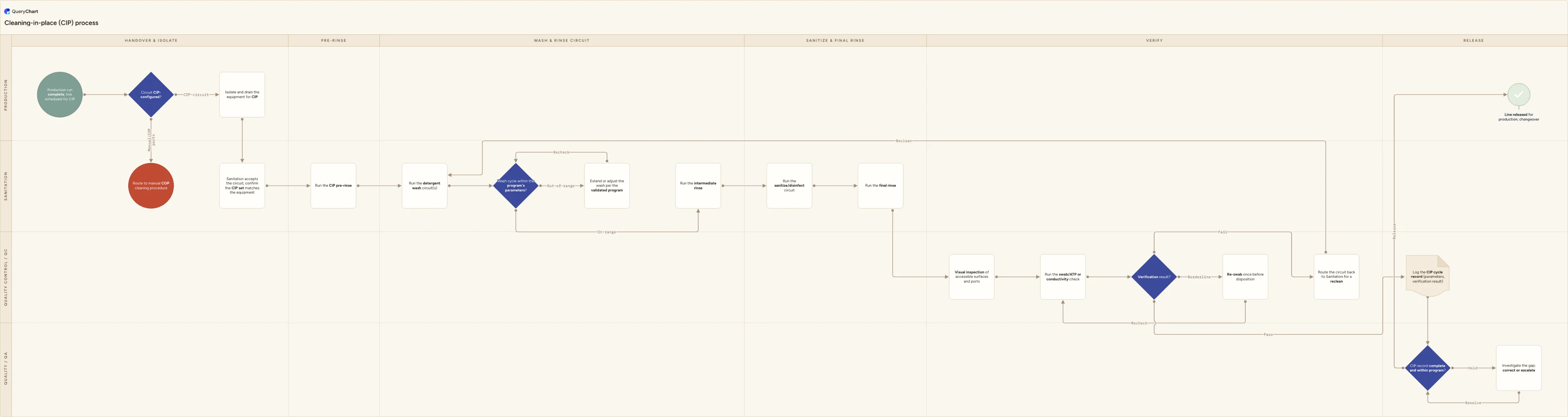
Cleaning-in-place (CIP) process flowchart (pre-rinse to final release)
Cleaning-in-Place (CIP) process flowchart: pre-rinse, wash, intermediate rinse, sanitize, final rinse, verification and release-or-reclean disposition.
What the cleaning-in-place (CIP) process flowchart (pre-rinse to final release) process is
Cleaning-in-place, CIP, is the automated cycle that cleans product-contact equipment — tanks, pipework, pasteurizers, fillers — without taking it apart, by circulating pre-rinse, detergent wash, intermediate rinse, sanitizer and final rinse through the same closed loop the product just ran through. This chart follows one CIP cycle end to end, from the moment a run ends and the circuit is confirmed as CIP-capable, through the wash and sanitize stages a program-driven skid runs largely on its own, to a verification step a person still has to perform and read, and a release decision that is recorded before the next product touches that line. Four swimlanes carry it — Production, Sanitation, Quality Control / QC and Quality / QA — so a wash that drifted, a borderline swab or a circuit that fails outright always has a named owner and a next step, not a shrug and a restart. Because a CIP cycle is frequently the specific control a facility's allergen program relies on between two products with different allergen profiles, and because the cycle record becomes part of the batch record for whatever runs on that circuit next, getting the sequence, the ownership and the paperwork right here has consequences well past the wash itself.
CIP is one specific cleaning method, not a synonym for 'cleaning.' It is closed-loop and largely automated: detergent, sanitizer and rinse water are pumped through connected, in-place equipment on a program, which is exactly what makes it fast and repeatable and exactly why it only works on equipment designed and piped for it. Anything that has to be taken apart, hand-scrubbed or manually soaked — hoses, gaskets, transfer fittings, most manual valves — is cleaned out of place, COP, under a separate procedure with its own verification, and this chart's first decision exists to route that equipment out before the rest of the process assumes a closed loop that isn't there. Nor is this a HACCP plan, an allergen control program, or a complete sanitation SOP: it names the stages and who owns each one without asserting a temperature, a contact time, a detergent concentration or a pass/fail range for any of them, because every one of those is set by the equipment's design, the soil it's cleaning and the facility's own validated cleaning program, not by a generic chart. Treat what follows as the sequence and the ownership, adapted under your own validated parameters, the food-safety regulations that apply where you manufacture, and review by whoever owns your sanitation and food-safety program.
Four decisions carry the chart. 'Circuit CIP-configured?' is the boundary decision described above, and skipping it is how a hand-cleaned fitting ends up treated as if the automated cycle covered it. 'Wash cycle within the program's parameters?' is the skid's own alarm response — most CIP systems monitor return temperature, flow and conductivity through the wash and flag a deviation themselves, and this decision is a person's response to that flag, not a manual check layered on top of it. 'Verification result?' is deliberately three-way rather than a pass/fail, because a real swab, ATP or conductivity reading has a borderline range as well as a clear pass and a clear fail, and collapsing a borderline result into an automatic pass is one of the more common ways a marginal circuit gets waved through. And 'CIP record complete and within program?' closes the loop on paperwork rather than product: a circuit can pass verification and still not be released if the record documenting that pass has a gap in it, which is what keeps the release decision auditable rather than remembered.
What this flowchart covers
In this template
- Four swimlanes (Production, Sanitation, Quality Control / QC and Quality / QA) across six phases — handover and isolate, pre-rinse, wash and rinse circuit, sanitize and final rinse, verify, and release — so a drifted wash, a borderline swab or an outright fail always lands with a named owner
- A "Circuit CIP-configured?" decision at the very start that routes equipment which can't be cleaned in place — hoses, gaskets, manual valves — to a separate clean-out-of-place procedure before the rest of the chart assumes a closed loop
- The full closed-loop sequence — pre-rinse, detergent wash circuit(s), intermediate rinse, sanitize/disinfect circuit, final rinse — with a "Wash cycle within the program's parameters?" decision and its own correction loop for the skid's own in-line monitoring
- A two-part verification stage — a visual check of what's actually visible on a closed loop, then a swab, ATP or conductivity check — feeding a three-way "Verification result?" decision with a bounded retest for a borderline reading and a reclean loop back to the wash stage for an outright fail
- A "CIP record complete and within program?" gate owned by Quality / QA, not Sanitation, so a circuit that passed verification still can't be released on a record with a gap in it
- Closure on a named production decision rather than a QA sign-off alone: the circuit's release and the line's restart are drawn as one step in the Production lane, so a passed cycle and a running line are the same fact instead of two records that can drift apart
When to use this template
- You are documenting your plant's CIP program and need one picture of who confirms the circuit is CIP-capable, who runs the cycle, who verifies it and who is authorized to release it
- Verification failures or reworked batches are being traced back to a wash or sanitize stage that nobody can say for certain ran to program, and you need the in-cycle correction and the reclean routes drawn explicitly
- You are separating cleaning verification (the swab, ATP or conductivity reading) from release authority (the disposition) for the first time and want that handoff drawn rather than assumed
- You run CIP alongside a manual COP procedure on the same line and keep finding equipment cleaned the wrong way, so the CIP-vs-COP boundary needs to sit on the chart itself, not in someone's head
- A customer, certification body or new plant manager has asked for a documented overview of your cleaning-in-place program before you attach the validated parameters, the allergen changeover rules and the sanitation SOPs underneath it
How it works
Rename the lanes to your roles
Replace Production, Sanitation, Quality Control / QC and Quality / QA with the functions you actually run. A smaller plant often has one person operating the CIP skid and reading the verification result; merge those lanes rather than drawing a handoff that never happens, and only add a Maintenance lane if this chart is meant to carry skid-fault response too.
Set your own CIP-vs-COP boundary
List which equipment on this line is actually piped and validated for CIP and which is cleaned out of place. That list, not a general rule, is what the first decision on the chart should route against — and it changes whenever the line is reconfigured, so review it alongside any equipment change.
Attach your own validated wash, sanitize and rinse parameters
This chart names the stages — pre-rinse, wash, intermediate rinse, sanitize, final rinse — without asserting a temperature, a concentration, a flow rate or a contact time for any of them. Attach those from your own validated cleaning program for this specific circuit; none of them belong on a generic chart.
Define your verification method and pass range
Decide whether verification is visual only, a chemical or ATP swab, a conductivity or rinse-water check, or some combination, and set the pass, borderline and fail ranges from your own cleaning-validation study. Name how many retests a borderline result is allowed before it's treated as a fail.
Assign who may release a circuit and who may hold one
Name a role, not a department, for who confirms the CIP record is complete, who may call a circuit released, and who may hold or reject one. The people closest to the production schedule are usually under the most pressure to wave a borderline result through, which is exactly why this call needs a named owner.
Set what the CIP cycle record must contain and where it lives
List the fields the record has to carry — circuit and program identifiers, cycle date and time, parameters the skid logged automatically, the verification method and result, and who read it — and say where it's filed and how long it's kept, especially if it needs to sit alongside the batch record of whatever runs on that circuit next.
Walk it against last month's real CIP records
Take a handful of completed cycle records, including one that triggered a reclean, and trace each through the chart. Any step people describe that isn't drawn, or is drawn but skipped when the schedule is tight, is the finding worth fixing before you publish the procedure.
Frequently asked questions
What are the steps in a CIP process?
A run ends and the circuit is confirmed as CIP-capable rather than needing manual clean-out-of-place cleaning. Production isolates and drains the equipment and hands the circuit to Sanitation, which confirms the CIP program selected actually matches this circuit before starting. The cycle runs pre-rinse, detergent wash, intermediate rinse, sanitize/disinfect and final rinse in sequence, with an in-line parameter check that can trigger a correction and rerun of the wash stage. Quality Control then runs a visual inspection and a swab, ATP or conductivity check, which passes, comes back borderline and is retested once, or fails and sends the circuit back to Sanitation for a reclean from the wash stage. A passed cycle is logged as a CIP record with its parameters and verification result, Quality / QA confirms the record is complete before releasing the circuit, and Production restarts the line under the released circuit.
What's the difference between CIP and COP cleaning?
CIP, cleaning-in-place, cleans equipment without taking it apart: detergent, sanitizer and rinse water circulate through connected, in-place piping and vessels on an automated program, which is fast and repeatable but only works on equipment that's actually designed and piped for it. COP, cleaning-out-of-place, is the opposite: parts that can't be cleaned in a closed loop — hoses, gaskets, transfer fittings, most manual valves and small parts — are disassembled, taken to a wash area or sink, and cleaned and verified by hand under a separate procedure. Most food and beverage plants run both, on different equipment on the same line, which is exactly why this chart's first decision routes non-CIP-capable equipment out before the rest of the process assumes a closed loop. Confusing the two, or assuming CIP covers everything downstream of the isolation valve, is one of the more common ways a piece of equipment goes uncleaned without anyone noticing.
Does this template establish a validated CIP program or regulatory compliance?
No. This chart is a process map of the sequence and the ownership, not a validated cleaning program, and using it does not by itself satisfy any regulation or certification scheme. In the United States, 21 CFR 117.35 requires that food-contact surfaces be cleaned as frequently as necessary and, where required, sanitized before use, but it does not specify a CIP method or set the parameters for one — those come from your own equipment design and validation. Equipment intended for CIP is commonly built to 3-A Sanitary Standards, which set hygienic-design requirements so a circuit can actually be cleaned in place, but conformance to a design standard is not the same as a validated cleaning cycle for your specific product and soil. If you hold or are pursuing a GFSI-recognised certification — FSSC 22000, SQF, BRCGS or similar — each sets its own expectations for cleaning validation and verification, so check the specific scheme and version that applies to you rather than assuming this chart, or any generic one, satisfies it.
What records should a CIP cycle produce for an audit or a recall?
At minimum, enough to show which circuit ran which program, when, with what parameters, and what the verification result was and who read it — the pieces this chart generates at the cycle-record step. Many CIP skids log time, temperature and flow automatically, but the verification result and the release decision still have to be entered and reviewed by hand, and a record with that field blank is what turns a routine release into an investigation. If a product recall or a customer complaint ever traces back to a specific run, the CIP record for the circuit that cleaned it beforehand is one of the first things a reviewer asks for, so file it somewhere it can be pulled against a batch record, not just against a maintenance log.
Who should verify and release a CIP cycle — Sanitation, QC or QA?
This chart splits the roles on purpose. Sanitation runs the cycle and owns the in-line correction if a wash parameter drifts, because they're the ones actually operating the skid. Quality Control performs the verification — the visual check and the swab, ATP or conductivity reading — because a fresh, independent read is more reliable than the person who ran the cycle checking their own work. Quality / QA holds the release decision, confirming the record is complete and authorizing the circuit before Production restarts the line. That three-way split is a common convention in food and beverage plants precisely because it keeps the person under the most schedule pressure — usually Sanitation or Production — from being the same person who signs off that the wash actually worked; exactly how you title and assign those roles is a decision for your own quality system, not something this chart can set for you.
Where this process fits
In most operations this process follows Allergen management process flowchart (changeover to release) and hands off to Food production workflow flowchart (shift production floor cadence).
It is one step in Food production.
Step 1: Production line changeover process flowchart (allergen check to QA release)
Production line changeover flowchart: allergen check, mechanical changeover, cleaning by type, pre-op inspection, line clearance, first-piece check, QA release.
Step 2: Cleaning-in-place (CIP) process flowchart (pre-rinse to final release) You are here
Cleaning-in-Place (CIP) process flowchart: pre-rinse, wash, intermediate rinse, sanitize, final rinse, verification and release-or-reclean disposition.
Step 3: Food production workflow flowchart (shift production floor cadence)
Food production workflow flowchart template: work order to line setup, pre-operational check, in-process monitoring, changeover or downtime handling, end-of-run reconciliation, line clearance and shift handover.
Step 4: Batch production process flowchart (batch record to warehouse handoff)
Step 5: Food quality control process flowchart (inspection, hold and disposition)
Step 6: Food product release process flowchart (COA, disposition and dispatch)