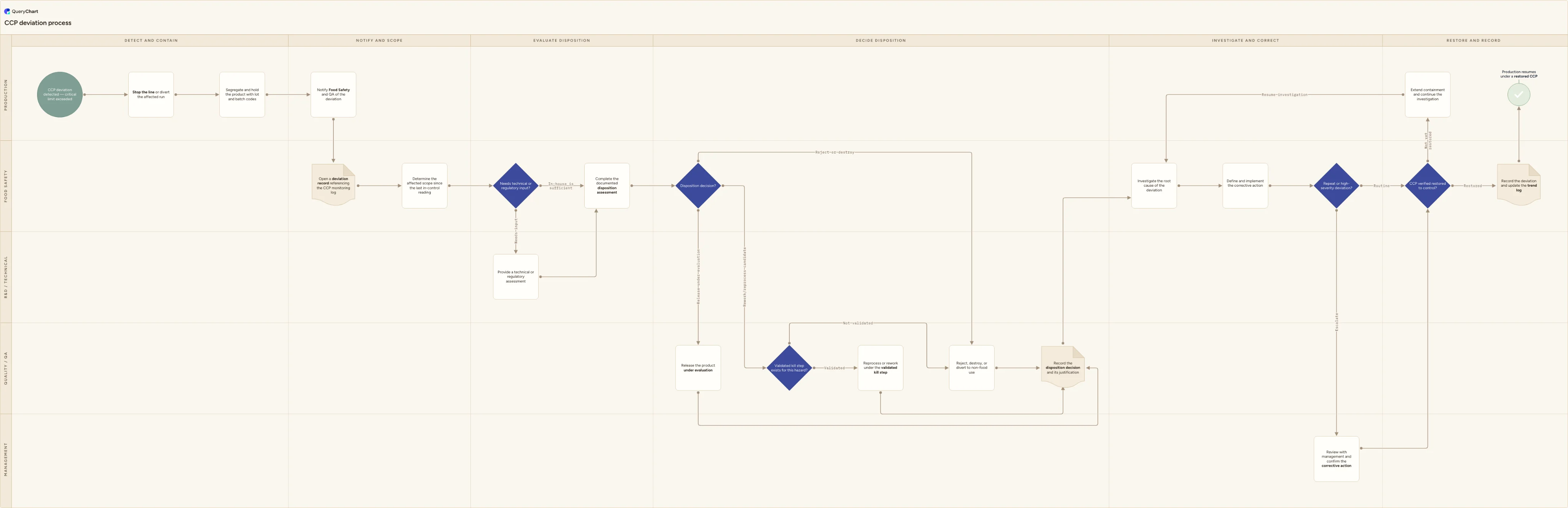
CCP deviation process flowchart (critical limit exceedance response)
CCP deviation process template: contain and hold product after a critical limit exceedance, scope it, evaluate and decide disposition, run root cause and corrective action, then verify the CCP before resuming.
What the CCP deviation process flowchart (critical limit exceedance response) process is
A CCP deviation is what monitoring is watching for: a reading at a critical control point that falls outside the critical limit set for it. The trigger for this chart is that single moment, handed off from the day-to-day monitoring process at /templates/ccp-monitoring-process, and the chart follows the response end to end from there. Production contains the affected product first, before anyone has worked out why the limit was exceeded, because the size of the problem keeps growing for as long as the line keeps running and the product keeps moving. Food Safety scopes what's actually affected, evaluates it against a documented assessment — pulling in R&D or regulatory input where the question calls for it — and the deviation is disposed of one of three ways, each requiring its own justification on the record. Root cause and corrective action follow, and the process does not close until the CCP itself is verified back in control, with the deviation and its outcome recorded and trended against the ones before it.
This chart handles one event at one CCP; it is not the systems around it. It doesn't run the monitoring itself — taking the scheduled reading and comparing it to the critical limit is CCP monitoring, a separate day-to-day process this one only starts from. It doesn't set the critical limit, the monitoring frequency or the predetermined corrective action either; those are decided when the HACCP plan is built, at /templates/haccp-process-flowchart, and this chart executes against a plan that already exists rather than authoring one. It is narrower than nonconforming product handling in general: a shipment with the wrong label or a can with a dented seam is a nonconforming product with its own process at /templates/nonconforming-food-product-process, and only becomes a CCP deviation if it also involves a critical limit being exceeded at a control point. And it stops short of a recall: if the investigation or the scope-determination step finds that affected product already left the site, that is a different process, at /templates/food-product-recall-process, which traces the affected lots through batch records and the facility's HACCP plan and carries its own notification and regulatory obligations. Root cause investigation and corrective action here run on the same general apparatus as /templates/root-cause-analysis-process and /templates/capa-workflow — this chart is what routes a specific kind of event into that apparatus, not a replacement for it.
Four decisions carry the process. "Needs technical or regulatory input?" keeps the food safety team from making a call alone that genuinely needs R&D or regulatory affairs — a novel hazard or an export market's own rules, not every deviation. The three-way "Disposition decision?" is the one that matters most, because it is where a documented, product-specific assessment either becomes real or gets skipped in favor of habit; the chart deliberately gives it three outcomes rather than a single default. "Validated kill step exists for this hazard?" gates the rework branch specifically, because reprocessing under a step that was never validated for this hazard — or was validated for a different one — turns a control into an assumption. And "CCP verified restored to control?" is what keeps the record from closing on the strength of the same reading, or the same instrument, that caused the deviation in the first place; a "no" here sends the process back into the investigation rather than out the door.
What this flowchart covers
In this template
- Five swimlanes (Production, Food Safety, Quality / QA, R&D / Technical and Management) across six phases — detect and contain, notify and scope, evaluate disposition, decide disposition, investigate and correct, restore and record — so a deviation has a named owner at every stage rather than sitting with whoever noticed it first
- Containment and hold ahead of any investigation: "Segregate and hold the product with lot and batch codes" so a hold travels with the pallet rather than living only in a log entry
- A "Needs technical or regulatory input?" decision that routes to R&D / Technical only when the disposition question genuinely calls for it, rather than making every deviation wait on a specialist or every specialist review get skipped
- A three-way "Disposition decision?" — release under evaluation, rework or reprocess, or reject and destroy — with rework specifically gated behind "Validated kill step exists for this hazard?" so reprocessing never runs on an unvalidated assumption
- Root cause investigation and corrective action with a "Repeat or high-severity deviation?" check that escalates a recurring pattern to Management review instead of closing it the same way as a first occurrence
- A "CCP verified restored to control?" gate before the line resumes, with a documented restart only once that's confirmed, plus a record-and-trend step that closes the loop against the CCP's own deviation history rather than treating each event in isolation
When to use this template
- You're documenting how your site responds when a CCP monitoring reading falls outside its critical limit, and want containment, evaluation, disposition and correction on one chart with a named owner at each step
- Disposition decisions for deviated product are being made inconsistently — sometimes released, sometimes destroyed, with no documented reasoning behind either choice — and you need the assessment step to actually happen before the outcome does
- Rework or reprocessing is being used as a default fix for a deviation without anyone confirming a validated kill step actually applies to the hazard involved
- An auditor or certification body has asked to see how a critical limit exceedance is contained, evaluated, corrected and verified as restored, distinct from the day-to-day monitoring records
- Deviations on the same CCP keep recurring and nobody has a structured escalation point that sends a repeat finding to management instead of closing it out the same way as the last one
How it works
Rename the lanes to your own roles
Replace Production, Food Safety, Quality / QA, R&D / Technical and Management with whoever genuinely holds these responsibilities at your site. A smaller facility often merges Food Safety and Quality / QA into one role, or has no in-house R&D and instead calls a co-packer's technical contact or an outside consultant for the rare deviation that needs that input — move the step into whichever lane that call actually lands in.
Point containment at your own hold and segregation procedure
Name the physical mechanism your site actually uses — a hold cooler, a quarantine cage, a locked pallet, a status field in your inventory system — and the tag or label format that travels with the product. State who is authorized to place a hold and who is authorized to release one; those should rarely be the same person for a significant deviation.
Point scope determination at your own monitoring records
Name where the last-known-in-control reading is recorded and how someone traces forward from it to everything potentially affected — a time window, a quantity, a run of code dates. This chart cannot do that arithmetic for you; it only asserts that the scope is set from the record, not from a guess at how bad the deviation looks.
Write your own disposition-assessment criteria, never a fixed answer
State what your documented disposition assessment actually weighs — the specific hazard, the affected product's shelf life and intended use, any prior validation for a kill step, and applicable regulatory requirements — and who signs it. This chart names three possible outcomes on purpose; it does not, and cannot, tell you which one is correct for a given deviation.
Name what counts as a validated kill step at your facility
List the process steps your facility has actually validated to control specific hazards, what that validation covered, and who confirms a candidate deviation's hazard is actually within scope of an existing validation before rework is approved. A step nobody has validated, or one validated for a different hazard, does not qualify — write that rule down rather than leaving it to judgment under time pressure.
Set your recurrence threshold and your restoration-verification method
Define what counts as a repeat or high-severity deviation for your escalation step, and separately, how CCP restoration is actually verified — a second reading, a calibration check, a run of readings meeting the limit — before production resumes. Restoration verification should not rely on the same instrument or the same person's judgment that produced the original deviation.
Walk it against a real past deviation
Take a closed deviation record, including one where the disposition decision was disputed at the time, and trace it through the chart. Any step people describe from memory that isn't drawn here, or any decision that was actually made by habit rather than assessment, is the finding worth fixing before the next deviation runs through the same gap.
Frequently asked questions
What are the steps in a CCP deviation process?
Monitoring shows a critical limit exceeded at a CCP, and the affected line or run is stopped or diverted while the product is segregated and put on hold with its lot and batch codes. Food Safety and QA are notified, a deviation record is opened against the monitoring log, and the affected scope is traced back to the last reading that met the critical limit. A documented disposition assessment follows, pulling in technical or regulatory input where the question calls for it, and the deviation is disposed of one of three ways: released under evaluation, reprocessed under a validated kill step, or rejected and destroyed — each with its reasoning recorded. Root cause investigation and a corrective action follow, with a repeat or high-severity deviation escalated to management rather than closed the same way as a routine one. The process ends only once the CCP itself is verified restored to control and the deviation is recorded and trended against its own history.
Is deviated product automatically rejected or destroyed?
No, and treating rejection as the safe default is itself a mistake this process is built to prevent. Disposition of product involved in a CCP deviation is a documented, evaluated, product- and process-specific decision, not a fixed rule — it depends on the specific hazard, whether it's controlled by any step downstream, the product's intended use and shelf life, and whether a kill step validated for that exact hazard exists and can be applied. Some deviations are released once the evaluation shows no safety impact for that particular product; some are reprocessed, but only under a step already validated for that hazard; and some genuinely are rejected or destroyed. What the process actually requires is that whichever outcome is chosen, the reasoning is written down and the decision is made by someone with the authority and the food safety expertise to make it — never that one outcome is automatically correct.
How is a CCP deviation different from a nonconforming product?
Every CCP deviation produces a nonconforming product, but not every nonconforming product is a CCP deviation, and the distinction matters because a CCP deviation carries an obligation this chart's generic sibling doesn't: verifying the control point itself is restored before production resumes. A dented can, a mislabeled case or a short-weight pack is a nonconforming product handled through a broader process — see /templates/nonconforming-food-product-process — because none of those, on their own, involve a critical limit being exceeded at a control point identified in a HACCP plan. A CCP deviation is narrower and more specific: it only happens at a designated CCP, against a documented critical limit, and it triggers this chart's disposition, root-cause and restoration-verification requirements in addition to whatever nonconformance handling would otherwise apply.
What do food safety regulations actually require when a critical limit is exceeded?
It depends heavily on which regulatory system governs your facility and product, so check the current text of whichever actually applies rather than treat any one of these as universal. In the US, most food facilities under FDA's Preventive Controls for Human Food rule follow the corrective-action and corrective-action-plan requirements at 21 CFR 117.150, while meat, poultry and egg establishments under USDA's mandatory HACCP systems follow the corrective-actions requirement at 9 CFR 417.3 — both require identifying and correcting the cause, and evaluating whether affected product can safely enter commerce. Internationally, Codex Alimentarius's HACCP framework (CXC 1-1969) sets out corrective action as Principle 5 of the seven HACCP principles, and most GFSI-recognised certification schemes build their nonconformity and corrective-action clauses on top of it. None of these name this chart's specific decision points — they set the underlying duty; your own procedure, reviewed against whichever rule actually governs you, is what should set the rest.
Who has the authority to release product held for a CCP deviation?
This chart doesn't answer that for you, and shouldn't — release authority is a role your own food safety management system assigns, usually to Food Safety or QA leadership rather than to whoever placed the hold, and often requiring a second signature for a significant deviation. What the chart does assert is a structural rule: release, however it's authorized at your site, is a documented decision made after the disposition assessment, not something that happens by a hold simply expiring or by product moving before the paperwork catches up. Name the actual role, and the conditions under which it can act alone versus needs a second reviewer, in your own procedure rather than leaving it implicit.
Where this process fits
In most operations this process follows Batch production process flowchart (batch record to warehouse handoff) and hands off to CAPA process flowchart (corrective and preventive action).
It is one step in HACCP food safety.
Step 1: HACCP process flowchart (7-principle food safety plan)
Step 2: CCP monitoring process flowchart (reading, recording and deviation handoff)
CCP monitoring process flowchart: take the scheduled reading, record it, judge it against the critical limit, then continue, deviate or verify calibration.
Step 3: CCP deviation process flowchart (critical limit exceedance response) You are here
CCP deviation process template: contain and hold product after a critical limit exceedance, scope it, evaluate and decide disposition, run root cause and corrective action, then verify the CCP before resuming.
Step 4: Nonconforming food product process flowchart (food-safety disposition and CAPA)
Nonconforming food product flowchart: contain and quarantine, log the finding, assess food-safety impact, disposition as rework, regrade, use-as-is or reject, then root cause and CAPA.