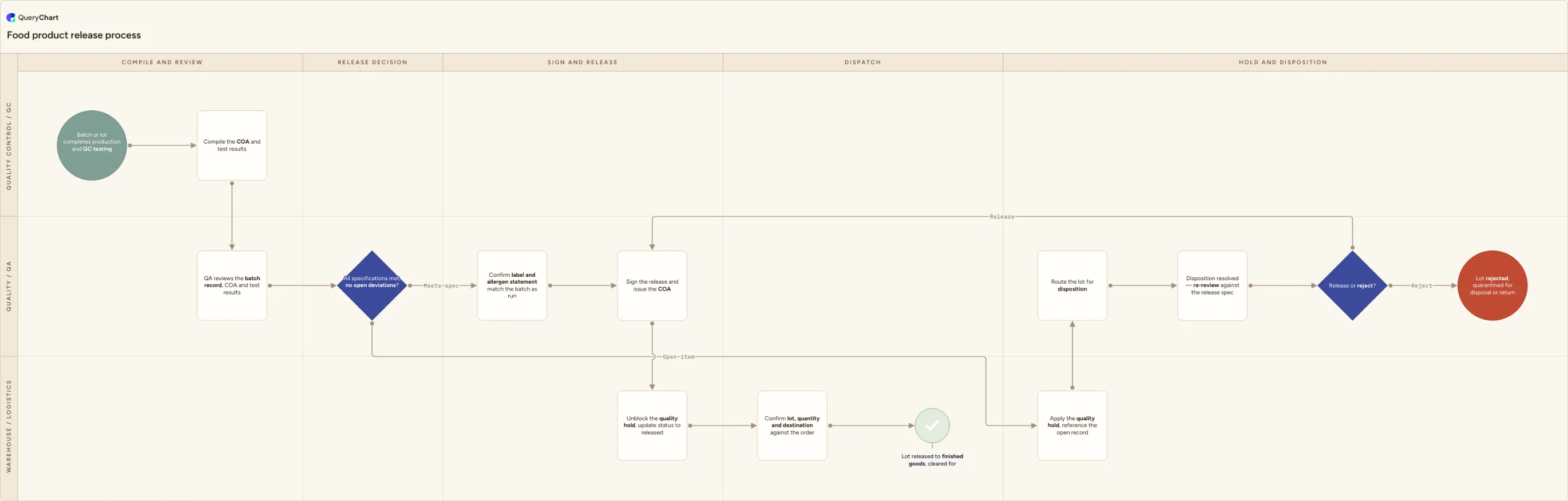
Food product release process flowchart (COA, disposition and dispatch)
Food product release process flowchart: QA checks the COA and batch record, routes an open deviation to disposition, then signs off and dispatches a clean lot.
What the food product release process flowchart (COA, disposition and dispatch) process is
The food product release process is the last gate a batch or lot passes through before it becomes stock a customer can actually receive: the certificate of analysis and test results are compiled, QA checks them against the batch record and the release specification, and a lot with no open finding is signed off, has its quality hold removed, and moves to the warehouse cleared for dispatch. Three swimlanes carry it — Quality Control / QC, Quality / QA and Warehouse / Logistics — across five phases, so a lot released today, or one that comes back weeks later once a hold has been resolved, moves through the same documented gate rather than a version of it improvised at the loading dock. The trigger is deliberately broad: a lot arrives here already dispositioned 'Release' at the end of batch production, cleared through a plant's own QC checkpoint system, or returning from a hold whose nonconforming-product or deviation investigation has since closed. What this chart adds is the same in every case: confirm the paperwork, confirm the label, confirm the physical lot matches what the paperwork says, and only then let it leave quarantine.
This chart is not where a batch's own record is reviewed line by line against its formula, and it is not where a batch is first dispositioned as released, held or rejected — that decision, and the batch-record review behind it, belongs to the batch production process; this chart begins once that call, or an equivalent one from a plant's own QC checkpoint system, has already been made. It is not the nonconforming food product process either: when this gate finds an open item, it hands the lot to that process for the actual containment, root-cause work and disposition rather than doing any of that inline, and only picks the lot back up once a disposition already exists. Nor is it a recall procedure — everything drawn here happens to stock still inside the facility and under quarantine, before anything has shipped, and a lot that has already reached a customer is a different process with its own authority. Keeping this chart narrow is what lets it stay the same short gate for every lot, whatever route brought it here, rather than re-deriving the batch-record review or the disposition logic each of those other processes already owns. Treat it, like every template on this site, as a starting point to adapt against your own quality system, your own product's hazard analysis, and the regulations and certification schemes that apply to your facility.
Two decisions carry the chart, and each is a real gate rather than a formality. 'All specifications met, no open deviations?' is worded to catch more than this lot's own numbers: a deviation or a CCP exceedance still under investigation elsewhere keeps a lot from release even when its own certificate reads clean, because the finding, not the paperwork in front of you, is what has to close first. 'Release or reject?', asked only after a held lot's disposition has actually resolved, exists because a resolved disposition is not automatically a release — a downgrade, a use-as-is concession or a rework still has to be re-checked against the specification the lot originally failed, and even then may ship only against a different order, or with a customer's own documented acceptance, rather than sliding back into the original one unnoticed.
What this flowchart covers
In this template
- Three swimlanes (Quality Control / QC, Quality / QA and Warehouse / Logistics) across five phases — compile and review, release decision, sign and release, hold and disposition, and dispatch — so a lot always has a named owner between a completed batch and a shipment that actually leaves the building
- An "All specifications met, no open deviations?" decision that checks the certificate of analysis and batch record against the release specification, written to catch a deviation or CCP exceedance still under investigation elsewhere too, not just this lot's own numbers
- A "Confirm label and allergen statement match the batch as run" step, so the release gate catches a late ingredient substitution or a label mismatch before it leaves quarantine, not after
- A hold-and-disposition branch — "Apply the quality hold, reference the open record" into "Route the lot for disposition" — that hands an open item to the nonconforming food product process or a CCP deviation and deviation management process rather than dispositioning it inline
- A "Disposition resolved — re-review against the release spec" step feeding a two-way "Release or reject?" decision, so a resolved hold is checked against the specification the lot originally failed rather than assumed to be an automatic release
- An "Unblock the quality hold, update status to released" step kept separate from the paperwork sign-off, plus a "Confirm lot, quantity and destination against the order" check immediately before dispatch
When to use this template
- You are writing or revising a food product release SOP and need one picture of who compiles the COA, who reviews it against the batch record, and who actually removes a quality hold before stock ships
- Lots are being released informally from the warehouse floor, and you need the COA review, the label and allergen check, and the sign-off drawn as separate, named steps rather than a verbal 'it's fine, ship it'
- A held or rejected lot's eventual release keeps stalling because nobody owns the moment it comes back from the nonconforming-product or deviation process, and you need the re-review and release-or-reject decision written down rather than left to whoever remembers the lot
- You are configuring a WMS or ERP release workflow and need the agreed sequence — paperwork sign-off, physical and system hold removal, and the final lot, quantity and destination check — before anyone builds screens or permissions around it
- A customer, auditor or certification body has asked how a released lot is actually authorized to leave the facility, and you need a documented answer that connects the COA, the batch record and the disposition history rather than three separate files
How it works
Rename the lanes to your own roles
Replace Quality Control / QC, Quality / QA and Warehouse / Logistics with the functions you actually run. On a smaller site QC and QA are often the same person at different points of the same shift, and warehouse release authority may sit with a shift lead rather than a dedicated logistics function — merge lanes rather than drawing a handoff that never happens.
Define what belongs on the COA and where it comes from
State which lab and in-process results the certificate of analysis actually carries for your products, whether it's generated automatically from your LIMS or compiled by hand, and who checks it against the batch record before it's treated as final. A COA nobody re-derives from the raw data is a document, not a check.
Name your own 'open item' triggers
This chart names no specific deviation type or CCP of its own — list what counts as open on your own products: an unresolved deviation, an unclosed CAPA, a pending environmental or allergen swab result, or a customer complaint still under investigation on the same lot or line. Write the rule down before the first disputed release, not during it.
Assign release-signing authority
Decide who may actually sign a release, whether that person may also be who ran or supervised the batch, and what happens when they're unavailable. A release signed by whoever is nearest the terminal under a ship-date deadline is the finding an auditor samples first.
Write your own label and allergen re-check rule
Decide what 'matches the batch as run' means in practice: checking the printed label and any allergen statement against the formula and any approved substitution actually used, not the formula as originally planned. Name who does this check and whether it has to be independent of whoever signs the release itself.
Set the re-review and release-or-reject rule for a resolved disposition
State what a lot has to clear before a resolved hold becomes a release: re-verification against the original specification, any concession sign-off your disposition required, and whether a downgrade or rework can still go to the original order or only to a different one. Name who makes the final release-or-reject call once disposition is resolved.
Walk it against last month's real releases and holds
Take a handful of recently released lots, including one that came back from a hold, and trace each through the chart. Any step people describe doing that isn't drawn, or a COA that was never actually checked against the batch record, is the finding worth fixing before you publish the procedure.
Frequently asked questions
What are the steps in a food product release process?
A lot arrives at this gate already dispositioned 'Release' during batch production, cleared through a plant's QC checkpoint system, or returning with a resolved disposition from a hold. QC compiles the certificate of analysis and test results, and QA reviews them against the batch record and the release specification, checking for anything still open elsewhere as well as this lot's own numbers. A lot with no open finding has its label and allergen statement confirmed against the formula as actually run, is signed for release, and has its COA issued; the warehouse then removes the quality hold, updates the lot's status, and confirms the lot code, quantity and destination against the shipping order before it's cleared for dispatch. A lot with an open item is held, physically and in the system, and handed to the nonconforming product or deviation process for disposition; once that resolves, the lot is re-reviewed against the specification it originally failed and either released through the same sign-off path or rejected and quarantined for disposal or return.
How is this different from a batch production process or a food quality control process flowchart?
Both of those make the first call on a lot's status; this chart is what turns that call into an actual, documented release. The batch production process reviews one batch's own record line by line and reaches its own release, hold or reject disposition at the end of that run — this chart starts once that decision, or an equivalent from a plant's QC checkpoint system, already exists, and its job is the certificate of analysis, the label check, the sign-off and the physical unblocking of stock, not re-deriving the batch-record review. A food quality control process flowchart sits a level above both: it shows how incoming, in-process and finished-product inspection all feed one shared hold and disposition path, without carrying either the batch-record detail or the release-documentation detail those other two pages own. Folding all three into one chart would bury the release-specific paperwork this page exists to make explicit.
When a lot comes back from a hold, does it automatically get released?
No, and treating it that way is the gap this chart is built to close. A disposition resolving — a rework completed, a downgrade agreed, a use-as-is concession granted — is not the same claim as the lot meeting its original release specification; it has to be re-reviewed against the specification it originally failed, not a relaxed one written to pass it. Even a lot that clears re-review may only be eligible to ship against a different order than the one it was originally made for, or may need the customer's own documented acceptance where the deviated requirement was theirs to begin with. Name who makes the final release-or-reject call after a disposition resolves, and don't let a lot slide back into normal stock just because its hold has been lifted somewhere else in the system.
Does releasing a lot through this process mean it's HACCP-compliant or safe to ship?
No template can make that claim, and this one doesn't try to. This chart checks that a lot's documentation is complete and consistent and that nothing is still open against it — it doesn't perform a hazard analysis, and CCP status, critical limits and what counts as an 'open' finding are all decisions specific to your own product, process and HACCP plan. Under Codex Alimentarius's HACCP principles (CXC 1-1969), verifying that a product meets its intended specification is part of what a food safety system is expected to demonstrate, and in the United States, FDA's Preventive Controls for Human Food rule (21 CFR Part 117) sets its own requirements for finished-product testing and records where it applies — but whether either governs your facility, and whether your own plan and this chart actually satisfy it, is something only your food safety and regulatory affairs function can confirm. Treat this chart as an adaptable starting point for your own release procedure, not evidence of compliance in itself.
What records does a release decision need for an audit?
At minimum: the lot code, the certificate of analysis and the test results it's based on, confirmation the batch record was reviewed and matches, who signed the release and when, the label and allergen check, and — for a lot that was held — the disposition, the re-review result, and who made the final release-or-reject call. What a reviewer typically checks is not whether these fields exist but whether they're consistent with each other: a COA dated before the batch record it certifies was actually completed, or a released lot with no re-verification on file after a documented hold, are both the kind of gap an audit is built to find. Exactly what you're required to keep and for how long depends on your product and jurisdiction — confirm it against your own regulatory affairs function rather than this template.
Where this process fits
In most operations this process follows Certificate of Analysis (CoA) process flowchart and hands off to Nonconforming food product process flowchart (food-safety disposition and CAPA).
It is one step in Food production.
Step 1: Production line changeover process flowchart (allergen check to QA release)
Step 2: Cleaning-in-place (CIP) process flowchart (pre-rinse to final release)
Step 3: Food production workflow flowchart (shift production floor cadence)
Step 4: Batch production process flowchart (batch record to warehouse handoff)
Step 5: Food quality control process flowchart (inspection, hold and disposition)
Food quality control process flowchart: incoming, in-process and finished-product inspection routed into one shared hold and disposition path before release.
Step 6: Food product release process flowchart (COA, disposition and dispatch) You are here
Food product release process flowchart: QA checks the COA and batch record, routes an open deviation to disposition, then signs off and dispatches a clean lot.