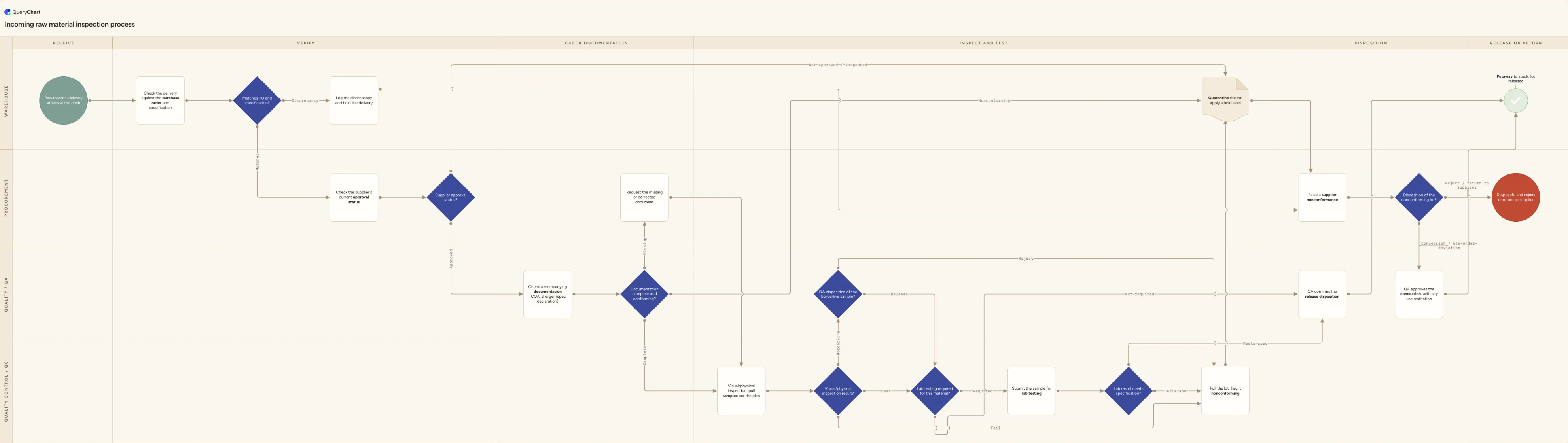
Incoming raw material inspection flowchart (receiving to release or hold)
Incoming raw material inspection flowchart: PO/spec check, supplier approval status, COA/allergen review, sampling and lab testing, then release, hold or concession.
What the incoming raw material inspection flowchart (receiving to release or hold) process is
This chart follows one delivery of raw material from the moment it hits the dock to the moment it becomes usable stock or leaves as a rejection. The delivery is checked against the purchase order and the material's own specification; the supplier's current approval status is checked before anything is inspected, because a delivery from a supplier who isn't approved for this item needs a decision of its own regardless of how the material looks; the accompanying documentation — certificate of analysis, allergen and spec declaration — is checked against the release specification and the product's own allergen matrix; the material itself is visually and physically inspected and sampled; and, where the material's own specification calls for it, a lab result is checked before anything moves further. A pass releases the lot to stock. A discrepancy, a supplier not currently approved, missing or nonconforming documentation, a failed inspection or a failed lab result all converge on the same hold: the lot is quarantined, a supplier nonconformance is raised, and the lot itself is either rejected and returned to the supplier or released under a documented concession. Four swimlanes carry it — Warehouse, Quality Control / QC, Quality / QA and Procurement — so a hold, a nonconformance or a concession always has a named owner instead of dissolving into 'someone should look at this.'
This is the receiving-dock gate, not the process that decided this supplier could ship to you in the first place. Whether a source is qualified at all — risk-categorized, certified, audited or trialled onto the approved supplier list — is the food supplier approval process, at /templates/food-supplier-approval-process; what this chart does with that status is check it at the moment a delivery arrives, not set it. A supplier risk assessment, at /templates/supplier-risk-assessment, is the broader, product-agnostic version of the same judgement for any third party, not just a food ingredient source, and this chart assumes that upstream judgement already exists rather than repeating it. It is not a HACCP plan either: nothing on this chart names a critical control point, a monitoring frequency or a critical limit, because which step is a CCP, and what its limit is, depends on your product, your process and your own hazard analysis — this chart marks where a real HACCP plan would attach to receiving, not what it says. And it is not the supplier corrective action process, at /templates/supplier-corrective-action-process: once a nonconformance is raised here, the investigation, the containment at the supplier's own site and the verification that follow run there, and a pattern of incoming failures from the same supplier is a case for a full supplier audit, at /templates/supplier-audit-process, not a rule this receiving-dock chart can enforce on its own. Treat this chart as an adaptable starting point for your own procedures, the food-safety regulations that apply where you manufacture and sell, and review by whoever owns your HACCP plan and supplier quality program — not as a document that by itself establishes compliance with any of them.
Five decisions carry the chart. 'Matches PO and specification?' catches the substitution or short-ship before the supplier's paperwork or the material's condition is even considered. 'Supplier approval status?' sits right after it and before documentation is checked, on purpose — a delivery from a supplier who isn't currently approved needs a decision made about it regardless of how clean the paperwork or the material turns out to be. 'Documentation complete and conforming?' is three-way rather than a pass/fail gate, because a missing certificate can be chased while a nonconforming allergen declaration cannot — one is a paperwork gap, the other is a reason to hold the lot outright. 'Visual/physical inspection result?' keeps a borderline call with QA rather than with whoever pulled the sample, through a dedicated 'QA disposition of the borderline sample?' step, for the same reason a receiving inspector shouldn't be the one to clear their own reject. And 'Disposition of the nonconforming lot?' closes the loop: reject and return to the supplier, or release under a documented concession that has to be recorded against the lot, not waved through to keep a production schedule moving.
What this flowchart covers
In this template
- Four swimlanes (Warehouse, Quality Control / QC, Quality / QA and Procurement) across six phases — receive, verify, check documentation, inspect and test, disposition, and release or return — so a hold, a nonconformance or a concession always has a named owner
- A "Matches PO and specification?" decision right after the delivery is checked against the purchase order, with a discrepancy holding the delivery rather than letting it continue to supplier and documentation checks unresolved
- A "Supplier approval status?" check ahead of documentation review, so a delivery from a supplier who isn't currently approved is routed to the same hold as a failed inspection instead of proceeding on the strength of clean paperwork
- A three-way "Documentation complete and conforming?" decision that sends a missing certificate back out on a "Request the missing or corrected document" loop, while a nonconforming allergen or spec declaration goes straight to the hold
- A "Visual/physical inspection result?" decision with its own "QA disposition of the borderline sample?" step, and a "Lab testing required for this material?" branch that is gated on the material's own specification rather than a fixed rule for every raw material
- A closing "Disposition of the nonconforming lot?" decision that follows "Quarantine the lot; apply a hold label" and "Raise a supplier nonconformance" — the lot is either rejected and returned to the supplier, or released under a documented concession recorded against the lot rather than waved through
When to use this template
- You are writing or revising a receiving and incoming-inspection procedure and need one picture of who checks the PO, who checks the supplier's status and paperwork, who inspects and samples the material, and who has authority to hold, reject or approve a concession.
- Nonconforming raw material keeps reaching production instead of being caught at the dock, and you need to see whether the gap sits at the PO/specification check, the supplier-status check, the documentation review, or the physical inspection itself.
- You are separating the inspection and testing role from the disposition and release authority for the first time, and want that handoff — QC finds it, QA decides it — drawn explicitly rather than assumed.
- You want the supplier-facing steps — checking approval status at the point of delivery, raising a nonconformance, choosing reject-and-return over a documented concession — visible as part of receiving rather than left as a side conversation with the buyer.
- A customer, auditor or certification body has asked for a documented description of how incoming raw materials are inspected, tested where required, and released or held, before you build the detailed sampling plan, specification and HACCP documentation underneath it.
How it works
Rename the lanes to your own functions
Replace Warehouse, Quality Control / QC, Quality / QA and Procurement with the roles you actually have. A smaller site often runs QC and QA as one role or one shift lead, so merge those lanes rather than drawing a handoff that never happens; add a separate Food Safety lane only if this chart is meant to carry a step your food safety team, not quality, actually owns.
Write your own PO-match and specification tolerances
"Matches PO and specification?" is inert until you decide what counts as a match. State what triggers the discrepancy branch — quantity outside a stated tolerance, the wrong pack size, a specification revision you didn't order — and who at the dock is authorised to accept a minor variance versus who has to be called for anything else.
Name your approved-supplier source and what 'not approved' means at your dock
Point "Check the supplier's current approval status" at your own approved supplier list or vendor approval system rather than a memory of who's reliable. Decide what happens to a delivery from a supplier who is mid-qualification or on conditional status — a named exception with QA sign-off, or a hold with no exceptions — before a driver is waiting on it.
Set your documentation checklist and what's negotiable
List exactly what "Check accompanying documentation" requires for each material category — a COA against your own acceptance range, an allergen and spec declaration against your product's own allergen matrix — and decide which gaps can be chased on the "Request the missing or corrected document" loop and which are a nonconformity from the moment they're found, with no loop available.
Decide which raw materials need lab testing, and against what
"Lab testing required for this material?" is deliberately generic. Tie it to your own material specification and hazard analysis, material by material — an allergen swab, a microbiological panel, water activity, whatever applies — name the lab, in-house or accredited, and state what "meets specification" means for each test you actually run.
Assign who may hold, reject and approve a concession
Name a specific role, not a department, for each of the three calls this chart makes: who may put a delivery on hold, who may sign the reject-and-return decision, and who may approve a concession or use-under-deviation. State plainly which categories of nonconformity — an allergen mismatch is the obvious one — a concession may never cover, whoever is asking.
Walk it against last month's real receiving log
Take a handful of completed receiving records, including one that was held, rejected or released under concession, and trace each through the chart. Any step people describe that isn't drawn, or drawn but skipped when the truck is waiting, is the finding worth fixing before you publish the procedure.
Frequently asked questions
What are the steps in an incoming raw material inspection process?
A delivery arrives at the dock and is checked against the purchase order and the material's own specification; a discrepancy holds it right there rather than letting it continue. The supplier's current approval status is checked next, and a supplier who isn't currently approved is routed to the same hold as a failed inspection, whatever the delivery looks like. The accompanying documentation — certificate of analysis, allergen and spec declaration — is checked for completeness and conformance; a missing document can be chased from the supplier, but a nonconforming declaration holds the lot outright. The material is then visually and physically inspected and sampled against the plant's own sampling plan, with a borderline result routed to QA for a disposition call rather than left to whoever pulled the sample. Where the material's own specification calls for it, a sample goes for lab testing and the lot stays in quarantine until the result is back. A pass on every check releases the lot to stock. A discrepancy, an unapproved supplier, nonconforming documentation, a failed inspection or a failed lab result all converge on quarantine, a supplier nonconformance raised against the delivery, and a final decision to reject and return the lot to the supplier or release it under a documented concession.
Does this template establish HACCP or food-safety compliance?
No. This chart is a process map for one control point — the receiving dock — not a food-safety management system, and using it does not by itself satisfy any regulation or standard. In the United States, FDA's current good manufacturing practice requirements for human food (21 CFR Part 117, Subpart B, specifically 21 CFR 117.80) require that raw materials and other ingredients be inspected and, where necessary, handled to protect against contamination before they are used — receiving inspection is one of the standard ways a facility meets that general requirement, but the regulation does not prescribe this chart's specific steps, decisions or hold labels. Internationally, the Codex Alimentarius General Principles of Food Hygiene (CXC 1-1969) set out the same broad expectation that incoming materials are controlled, again without prescribing a procedure. Whether a critical control point sits anywhere in this chart at all — and, if one does, what its critical limit and monitoring frequency are — depends on your product and your own hazard analysis, not on anything asserted here. Treat this chart as an adaptable starting point, reviewed by whoever owns your HACCP plan and quality system, not as evidence of compliance in itself.
How is incoming inspection different from food supplier approval?
They run at different times and answer different questions. Food supplier approval decides whether a source should be trusted with an ingredient, packaging or co-packing relationship at all — risk category, certification, an audit or questionnaire, a trial order — before the first commercial delivery ever arrives; that process is covered at /templates/food-supplier-approval-process. Incoming inspection assumes that judgement is already made and checks one delivery against it: is this the material the PO and specification describe, is the supplier's approval status still current, does the paperwork on this shipment match what the file promised, and does the material itself pass on inspection and, where required, on test. A supplier can be fully approved and still deliver a nonconforming lot — a mis-picked pallet, an expired certificate that slipped past renewal, a genuine quality slip — which is exactly the gap this chart exists to catch. The two processes meet at the 'Supplier approval status?' decision, which is this chart's only check of the other one's output, not a repeat of the work.
What is a concession or use-under-deviation, and who should approve one?
A concession, sometimes called use-under-deviation, means using or releasing a specific lot against a documented deviation approval rather than against the original specification — the material didn't meet spec, and someone with the authority to accept that risk decided the deviation was acceptable for this use, this once, with the reason recorded. It is not a way to clear a hold under schedule pressure, and it should never be available for a defect that touches food safety directly, such as an allergen declaration that doesn't match what's on your label or a failed pathogen test — those belong on the reject-and-return branch, not this one. Decide in advance, in your own procedure rather than on the day, who may grant a concession, which categories of defect are eligible at all, and what has to be recorded against the lot — the deviation, the approver, and any restriction on how the material may be used. This chart's 'Disposition of the nonconforming lot?' decision assumes that rule already exists; it doesn't set it.
What records does incoming inspection need to produce for traceability or a recall?
At minimum, enough to link the lot code you assign at receiving back to the supplier's own lot or batch number, and forward to whatever it becomes in your process — the same one-up, one-back logic that makes a mock recall possible. This chart generates the pieces as the delivery moves: the PO and specification match, the supplier approval status at the time of delivery, the COA and allergen declaration on file, the sample and any lab result, and the final disposition, including who approved a hold, a reject or a concession and why. In the United States, FDA's Food Traceability Rule (21 CFR Part 1, Subpart S, sometimes called Rule 204) adds specific recordkeeping requirements — including receiving records — for foods on its Food Traceability List, with its own scope, exemptions and compliance date that you should check directly rather than assume apply to you. If you hold or are pursuing a GFSI-recognized certification such as BRCGS, FSSC 22000 or SQF, each scheme layers its own traceability and record-retention expectations on top of whatever your regulator requires, so check the specific scheme and version you operate under.
Where this process fits
In most operations this process follows Food supplier approval process flowchart (documentation to approved list) and hands off to Supplier corrective action process flowchart (SCAR, issue to closure).
It is one step in Food supply and traceability.
Step 1: Food supplier approval process flowchart (documentation to approved list)
Food supplier approval flowchart template: risk category, documentation request (specs, food-safety certification, insurance, allergen statement), review, risk-based audit or questionnaire, trial order and approved supplier list.
Step 2: Incoming raw material inspection flowchart (receiving to release or hold) You are here
Incoming raw material inspection flowchart: PO/spec check, supplier approval status, COA/allergen review, sampling and lab testing, then release, hold or concession.
Step 3: Food traceability process flowchart (lot receipt to trace record)
Food traceability process flowchart template: raw material lot receipt, formula/BOM linkage to a batch, packaging and shipment lot codes, one-up-one-back trace lookup, and physical stock reconciliation.
Step 4: Food product recall process flowchart (safety-driven recall, not withdrawal)