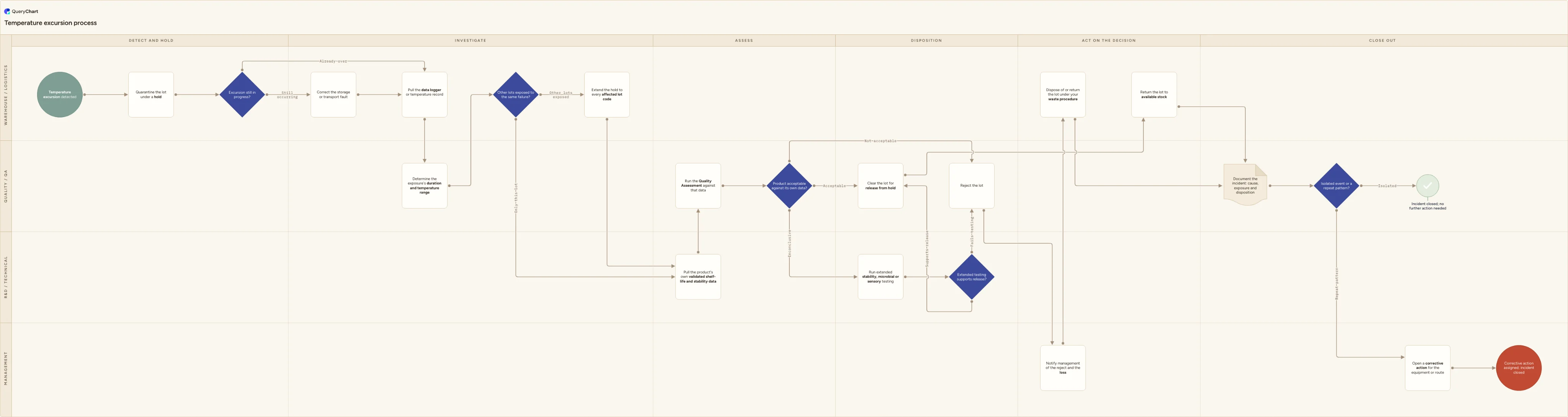
Temperature excursion process flowchart (hold, assessment and disposition)
Temperature excursion flowchart: hold the lot, size the exposure, assess it against the product's shelf-life data, then release, retest, reject and document.
What the temperature excursion process flowchart (hold, assessment and disposition) process is
A temperature excursion is any point where a product sits outside the storage or transport temperature it was supposed to hold — a warehouse cooler that loses power overnight, a delivery vehicle's reefer unit that cuts out for part of a route, a dock door left open through a shift change. The trigger is usually a continuous data logger alarm, a receiving check against a carrier's own temperature record, or a routine walk that happens to catch it. Whichever it is, the chart below runs the same way from there: the affected lot is quarantined under a hold before anything else happens, and if the fault causing the excursion is still active it gets corrected first, because sizing an exposure that is still happening just measures a number that keeps changing. Once the fault is stopped, the actual duration and temperature range is pulled from the record, and a second check asks whether any other lot shared the same room, truck or dock door during the window — a cold-chain failure is rarely a single-pallet event. From there the lot's own validated shelf-life and stability data, not a number this chart invents, is weighed against what actually happened, and Quality reaches one of three outcomes: the lot is cleared for release, sent for extended stability, microbial or sensory testing when the reading is genuinely inconclusive, or rejected. Whatever the outcome, it is documented, and a closing check asks whether the incident is isolated or part of a repeat pattern worth fixing at the equipment or the route rather than at the pallet. Four swimlanes — Warehouse / Logistics, Quality / QA, R&D / Technical and Management — carry it, so a held lot always has a named owner at every stage instead of drifting between whoever noticed it and whoever eventually has to sign it off.
This chart covers a temperature excursion caught while the product is still in the company's own custody — in a warehouse, a cold room, or on a vehicle the company runs or has visibility into. It is not a HACCP plan, and it does not decide whether any given storage or transport step is a critical control point: CCP status, the monitoring frequency that goes with it, and the critical limit that defines a deviation are findings your own hazard analysis makes for your own product and process, not something a generic chart can assert. Where a step is already defined as a CCP with its own critical limit, a breach of that limit is a CCP deviation with its own dedicated procedure; this chart is the wider net that also catches an excursion nobody had classified as a CCP in the first place — the warehouse door left open overnight, the delivery vehicle that ran warm for an hour. It is not a recall procedure either. Recall begins once product has left the company's control and reached distribution or a customer, with its own notification, public-communication and effectiveness-check obligations; this chart assumes the affected lot is still sitting in front of the people who can hold it, and most excursions resolve here without ever becoming one. And the 'Quality Assessment' step is deliberately a decision, not a formula: the same duration and temperature reading is a straightforward release for one product and a clear reject for another, so the assessment routes against that product's own validated data rather than a fixed number this chart would otherwise have to invent.
Five decisions carry the chart, and two of them are the ones a bare temperature log usually skips. "Excursion still in progress?" matters because correcting the fault has to come before sizing it — a compressor still failing or a door still open makes the duration and temperature range a moving target. "Other lots exposed to the same failure?" exists because a lost power feed to a room, or a reefer unit that failed for the length of a route, touches everything that shared that space or that vehicle, and a hold that stops at the flagged lot leaves the rest sitting on the shelf as if nothing happened. "Product acceptable against its own data?" is three-way rather than a pass/fail, because a genuine assessment against real stability data produces more than a binary outcome: some readings clearly clear the product, some clearly do not, and a real middle case deserves extended testing rather than being forced onto whichever side is easier to defend that afternoon. And "Isolated event or a repeat pattern?" is what turns one held pallet into a fixed compressor or a retrained driver, closing the loop on the equipment or the route rather than on the paperwork alone.
What this flowchart covers
In this template
- Four swimlanes (Warehouse / Logistics, Quality / QA, R&D / Technical and Management) across six phases — detect and hold, investigate, assess, disposition, act on the decision, and close out — so a held lot always has a named owner from the moment it is flagged to the moment the incident is closed
- An "Excursion still in progress?" check ahead of everything else, so an active storage or transport fault is corrected before the duration and temperature range is measured against a condition that has not stopped changing
- An "Other lots exposed to the same failure?" decision that extends the hold to every lot code that shared the same room, truck or dock door, rather than quarantining only the pallet that happened to be checked first
- A Quality Assessment step that pulls the product's own validated shelf-life and stability data and weighs the actual exposure against that, never against a fixed hours-and-degrees rule this chart would otherwise have to invent
- A three-way "Product acceptable against its own data?" decision — release, extended testing, or reject — with an "Extended testing supports release?" loop that routes a genuinely inconclusive result to stability, microbial or sensory testing rather than forcing an early call
- A shared Document the incident step reached from every disposition, followed by an "Isolated event or a repeat pattern?" check that routes a recurring cause to a corrective action on the equipment or the route instead of closing the file on the pallet alone
When to use this template
- You are writing a cold-chain or temperature-control procedure and need one picture of who holds a lot, who sizes the exposure, who assesses it and who is authorised to release, retest or reject it
- Excursions are being noticed and logged but not consistently held, and you need the quarantine step to sit ahead of any judgement call rather than after one
- A reefer failure or a warehouse power loss has previously been treated as a single-pallet problem when it actually touched a whole truck or a whole cold room, and you need the "other lots exposed" check drawn into the process rather than left to memory
- You want the disposition call routed against each product's own shelf-life and stability data instead of a rule of thumb carried over from a different SKU, so the same reading is not released for one product and rejected for another by accident
- A customer, auditor or new quality manager has asked for a documented picture of how your facility actually responds to a temperature deviation, from detection through disposition to the corrective action a repeat pattern should trigger
How it works
Rename the lanes to your roles
Replace Warehouse / Logistics, Quality / QA, R&D / Technical and Management with the functions you actually run. A smaller operation often has one person covering quality and technical review, or has no separate R&D function at all and instead calls a co-packer or a supplier's technical contact for the stability question — merge the lanes to match, rather than drawing a handoff that never happens.
Name your own monitoring points and trigger
State which storage areas, vehicles and process steps carry continuous monitoring, what device raises the alert, and who is notified. A data logger with an audible alarm, a receiving check against a carrier's printout, and a manual walk that happens to catch an open door are three different reliability levels — say which ones you actually have before you assume every excursion gets caught the same way.
Attach the product's own shelf-life and stability data to the Quality Assessment step
This chart asserts no acceptable time or temperature threshold on purpose. For each product family, name the document Quality Assessment pulls from — a stability study, challenge-testing data, or a supplier's own technical data sheet — and who is authorised to interpret it. A threshold copied from a different product is how a sound lot gets scrapped and a compromised one gets released.
Set the rule for extending a hold to other lots
Decide how you trace what else shared a room, a truck or a dock door during an excursion window — by storage location log, by loading manifest, or by whatever traceability record you already keep — and who is responsible for pulling it. Agree this before the first real event, not while a truck is already unloading.
Define the extended-testing scope and who can authorise it
List what an inconclusive result can trigger — a hold-and-test microbial count, a sensory panel, an accelerated stability pull — and who signs off on running it. Scoping the extra testing to what the specific result leaves open, rather than defaulting to a full release panel every time, keeps the loop useful instead of becoming its own bottleneck.
Name disposition and reject authority
State who may clear a lot for release, who may call a reject, and at what estimated loss or exposure Management is notified rather than only informed after the fact. Name where a rejected lot's disposal or return is recorded, and whether it ever needs a witness or a manifest under your own waste or returns procedure.
Walk it against last quarter's real excursions
Take a handful of completed incident records, including one that was released and one that was rejected, and trace each through the chart. Any step people describe that is not drawn, or drawn but skipped under schedule pressure, is the finding worth fixing before you publish the procedure — and check whether any of them should have flagged a repeat pattern that never reached a corrective action.
Frequently asked questions
What are the steps in a temperature excursion process?
An excursion is detected — by a data logger alarm, a receiving check, or a routine walk — and the affected lot is quarantined under a hold immediately. If the storage or transport fault causing it is still active, it is corrected first, because sizing an exposure that is still happening measures a moving target. Once it has stopped, the actual duration and temperature range is pulled from the record, and a check asks whether any other lot shared the same room, truck or dock door during the window; if so, the hold is extended to every affected lot code. Quality then pulls the product's own validated shelf-life and stability data and runs the assessment against it. A clearly acceptable result is released from hold; a genuinely inconclusive one goes to extended stability, microbial or sensory testing, which itself resolves to release or reject; a clearly unacceptable one is rejected outright, with Management notified of the loss before the lot is disposed of or returned. Whichever path it took, the incident is documented — cause, exposure, disposition and any action taken — and a closing check asks whether it was an isolated event or part of a repeat pattern that should trigger a corrective action on the equipment or the route.
Does every temperature excursion mean the product has to be destroyed?
No. This chart routes to three outcomes, not one, and reject is only one of them. Whether a given exposure is acceptable, borderline or unacceptable depends entirely on the specific product's own validated shelf-life and stability data — the same duration and temperature range that a sturdy, low-moisture product tolerates without issue can be a clear reject for a product that requires tight, continuous refrigeration. Treat any duration-and-degrees rule you have not validated for the specific product in front of you as a placeholder, not a decision.
Is a temperature excursion always a CCP deviation?
Not necessarily, and this chart deliberately doesn't assume it is. Whether a given storage or transport step is a critical control point, and what its critical limit is, is a finding your own hazard analysis makes under Codex Alimentarius's HACCP principles (CXC 1-1969) or, in the United States, FDA's Preventive Controls for Human Food rule (21 CFR Part 117) — not something a generic process chart can assert. Where a step already carries a defined CCP and critical limit, a breach of that limit is handled as a CCP deviation under your own HACCP plan's deviation procedure. This chart is the wider net for everything else: an excursion in a location or a leg of transport nobody had classified as a CCP, which still needs a hold, an assessment against the product's own data, and a documented disposition.
What regulations govern temperature control during food storage and transport?
It depends heavily on where you operate, what you handle and who you sell to, so treat any specific citation as a starting point to check against your own regulatory counsel or compliance function. In the United States, the FSMA Sanitary Transportation of Human and Animal Food rule (21 CFR Part 1, Subpart O) requires shippers, carriers, loaders and receivers engaged in transportation to use vehicles and equipment that are adequate to prevent food from becoming unsafe, including maintaining necessary temperature conditions, though it carries exemptions by business size and shipment type. FDA's Food Code — a model code that only has legal force once a state or local jurisdiction adopts it, and jurisdictions adopt different editions — recommends holding time/temperature-control-for-safety food at 41°F (5°C) or below or 135°F (57°C) or above; that figure is a retail-level reference point, not a number this chart asserts for your own manufactured product, which should instead be validated against its own formulation and packaging. In the European Union, Regulation (EC) No 852/2004 sets general hygiene requirements including temperature control obligations that member states implement and enforce nationally. Name the rules that actually bind your facility and your lanes rather than relying on any one of these as universal.
How does a temperature excursion relate to a product recall?
They sit at different points in the product's journey and most excursions never become the other. A temperature excursion, as this chart draws it, is caught while the lot is still in the company's own custody — in a warehouse, a cold room, or a vehicle it controls — so it is held, assessed and resolved before it ever reaches a customer. A recall begins once product has already left that custody and reached distribution or the end customer, and carries its own notification, public-communication and effectiveness-check obligations that this chart does not cover. The connection between them is real but narrow: if a rejected lot from this process turns out to have already shipped elsewhere under the same conditions — the same truck, the same cold-room failure, the same time window — that discovery is what escalates the incident into a recall decision, handled under a dedicated recall procedure rather than folded into this one.