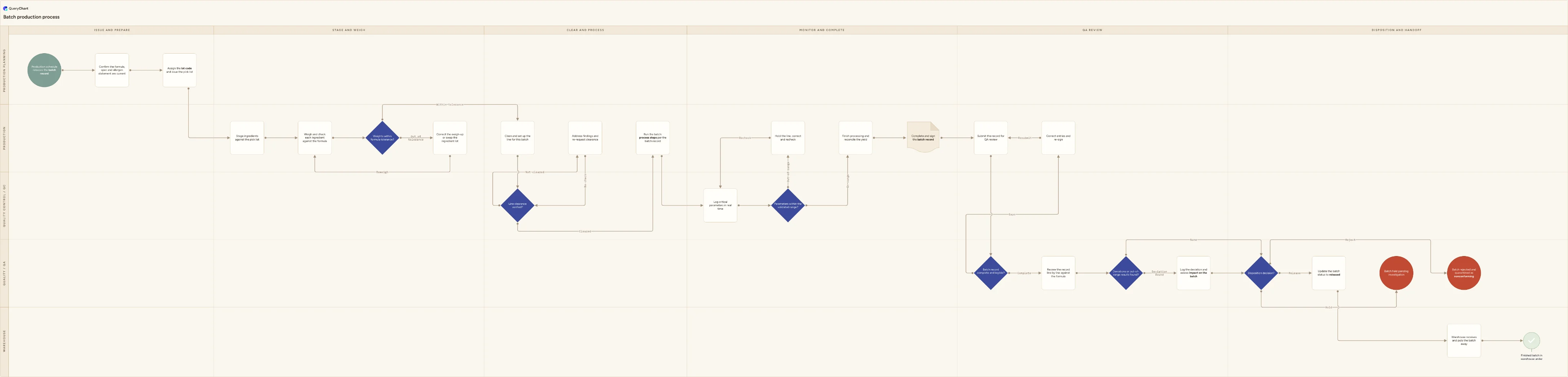
Batch production process flowchart (batch record to warehouse handoff)
Batch production process flowchart: ingredients weighed against the formula, line clearance, parameters logged, QA review, then released, held or rejected.
What the batch production process flowchart (batch record to warehouse handoff) process is
A batch record is the working proof that one specific lot was made the way its formula and process specification say it should be, and this chart follows that record from the moment it is issued to the moment the finished batch reaches the warehouse under a released status. The trigger is the production schedule releasing a batch record against a work order; from there ingredients are staged and weighed against the formula, the line is cleared for this product before anything runs, the batch is processed through its written steps, and whatever the process defines as critical is logged in real time rather than reconstructed afterward. The record is completed and signed, QA reviews it against the formula and against whatever was logged along the way, and the batch is released, held or rejected. What separates a documented batch from an undocumented one is not that the paperwork exists — it is that every entry on it was made by the person who did the thing, at the time they did it, against a record that already existed before the batch started.
This chart is one execution against one batch record, and it sits inside a larger set of processes it deliberately does not repeat. It is not the food manufacturing process page, which follows the whole chain from raw material receipt through production to shipping and treats this entire chart as a single link; that is where procurement, goods-in and distribution belong. It is not the food production workflow either, which runs at the level of a shift — staffing, line scheduling, changeovers between products — rather than at the level of one lot's record. It is not document control: the formula, the specification and the batch record template this process reads from are version-controlled on their own track at /templates/document-control-process, and this chart only ever pulls the current revision, never edits it. A parameter excursion or a formula error logged here is handed to /templates/deviation-management-process for classification and investigation the moment it is found to matter, rather than worked out inline. Where a batch ends up rejected, what happens to the physical product next — rework, destroy, or return to a supplier if a raw material is the traced cause — is /templates/nonconforming-food-product-process, not this chart. Most deliberately, the disposition decision at the end of this chart is kept light on purpose: the certificate of analysis, the customer-facing release paperwork and the stock-unblocking mechanics belong to /templates/food-product-release-process, and duplicating that page's release-gate detail here would just give two charts two different answers to the same question. Treat this chart, like every template on this site, as a starting point to adapt against your own procedures, your own product's hazard analysis and whatever regulations and certification schemes apply to your facility.
Four decisions carry the chart. "Weights within formula tolerance?" sits before the line even starts, because a weigh-up error caught at the scale costs a re-weigh and one caught after mixing costs the batch. "Line clearance verified?" is answered by Quality Control rather than by the operator who just cleaned the line, on the same logic that puts a second signature on a cheque: the person who did the work is the wrong person to be the only one confirming it was done, and on a shared line that is also where allergen carryover gets caught before it becomes someone else's reaction. "Parameters within the validated range?" names no number of its own — what counts as in range is whatever your own validated process specification says for this product, and if one of those parameters is a critical limit under your HACCP plan, an excursion there is a critical-limit deviation with its own procedure, not a line-level recheck. And "Disposition decision?" is drawn three ways rather than two, because a batch with an open question is held, not released to protect a ship date and not rejected before anyone has actually investigated — the same reasoning that gives held stock an owner rather than letting it sit in the warehouse with a status nobody chose on purpose.
What this flowchart covers
In this template
- Five swimlanes (Production Planning, Production, Quality Control / QC, Quality / QA and Warehouse) across six phases — Issue and prepare, Stage and weigh, Clear and process, Monitor and complete, QA review, and Disposition and handoff — so the batch record has a named owner at every step from issue to warehouse
- A "Weights within formula tolerance?" gate right after ingredients are staged, with an out-of-tolerance branch that loops back to the scale rather than letting a corrected weigh-up travel forward unverified
- "Line clearance verified?" owned by Quality Control rather than by whoever just cleaned the line, so the same segregation of duties that governs the batch record itself also governs the changeover into it
- "Run the batch: process steps per the batch record" executed exactly as written, followed by critical parameters logged in real time and a "Parameters within the validated range?" decision that routes an excursion to a hold-and-recheck loop rather than a note in the margin
- "Batch record complete and legible?" gates the record into QA review before "Deviations or out-of-range results found?" decides whether the batch carries anything QA has to weigh at disposition
- A three-way "Disposition decision?" — Release, Hold or Reject — that hands a released batch to the Warehouse lane and a held or rejected one off to the deviation, nonconforming food product and food product release processes rather than resolving their detail here
When to use this template
- You are writing or revising a batch production SOP and need one picture of who issues the record, who weighs and processes, who verifies the line and the parameters, and who decides the batch's disposition
- Batch records are being completed but not really checked — QA review is a formality — and you want the record-completeness gate and the line-by-line review drawn as separate, named steps
- In-process parameter logs are being filled in after the run rather than during it, and you need the real-time logging step and its own decision gate written into the process rather than left to whoever is on the line that day
- You run a shared line across multiple products or allergen profiles and want line clearance verified by someone other than the operator who cleaned it, rather than left to a self-check
- You are building or configuring an MES or batch-record system and need the agreed sequence — including the hold and reject outcomes most procedures leave implicit — before anyone builds screens or permissions around it
How it works
Rename the lanes to your own roles
Replace Production Planning, Production, Quality Control / QC, Quality / QA and Warehouse with the functions you actually have. On a smaller site QC and QA are often the same person wearing two hats at different points in the day; keep the two decision points distinct even if one person owns both, because the point of separating them is the moment the check happens, not the org chart.
Set your own formula tolerance and second-check rule
"Weights within formula tolerance?" needs a real tolerance band, not an implied one — state it as a percentage or an absolute weight range per ingredient, and decide whether a second person verifies the weigh-up or a check-weigher does. Write down what happens when an approved substitute ingredient or lot is used, since a substitution is a formula change even when the finished weight matches.
Write your own line clearance checklist
Decide what 'cleared' actually means for your lines: prior product and its allergens removed, labels and packaging from the last run cleared from the area, the correct pick list staged, and any changeover cleaning verified against your sanitation procedure rather than assumed. Name who signs it off, and whether that person may be the same one who ran the previous batch.
Name your own critical parameters and their limits
This chart deliberately names no temperature, time, weight or concentration of its own — pull the actual parameters and their limits from your own validated process specification and, where a parameter is a critical limit under your HACCP plan, from that plan specifically. State whether logging is manual, on a chart recorder or through an automated data logger, and what 'in real time' means for your process: continuous, or checked at a defined interval.
Decide what QA weighs at the deviation gate
"Deviations or out-of-range results found?" should point QA at a real question: does anything logged on this batch — an out-of-tolerance weigh-up, a parameter excursion, an incomplete signature — change what can be said about the finished batch? Anything that does gets classified and investigated on your deviation management process; this chart only needs to know whether the answer changes the disposition decision downstream.
Write the hold and reject rules, and where they hand off
State who may place a batch on hold, what its status becomes in your inventory or ERP system, and how it is labelled so nobody in the warehouse mistakes a quarantined lot for released stock. Name the process a held or rejected batch moves to next — your deviation management, nonconforming food product and release processes — rather than leaving 'held' as a dead end nobody owns.
Walk it against last week's batches
Take a handful of recently closed batch records, including one that was held or had a query at QA review, and trace them through the chart. Any step people describe doing that is not drawn, or drawn but skipped under time pressure, is the finding worth fixing before you publish the revision.
Frequently asked questions
What are the steps in a batch production process?
The production schedule releases a batch record against a work order, and the formula, specification and allergen statement are confirmed current before the lot code is assigned and the pick list issued. Ingredients are staged and weighed against the formula, with an out-of-tolerance weigh-up looping back to the scale rather than travelling forward. The line is cleaned and its clearance verified before anything runs, and the batch is then processed through its written steps while critical parameters are logged in real time; a parameter outside its validated range holds the line for a correction and a recheck rather than a note added later. Processing finishes, the yield is reconciled, and the batch record is completed and signed. QA checks the record for completeness, reviews it line by line against the formula, and asks whether any deviation or out-of-range result was logged. The batch is then released, held pending investigation, or rejected and quarantined as nonconforming, and a released batch moves to the warehouse under that status.
How is this different from a food manufacturing process flowchart or a food production workflow?
They sit at different altitudes of the same operation. The food manufacturing process at /templates/food-manufacturing-process is the whole chain — raw material receipt, formulation, production, quality release and shipping — and this chart is a single link inside it: what happens to one batch once its record is issued. The food production workflow at /templates/food-production-workflow runs at the level of a shift: staffing the line, sequencing which products run when, and managing changeovers across a day, none of which this chart addresses because it starts once a specific batch record has already been issued for a specific run. This page is narrower than both on purpose, because "how does the plant run" and "how does one lot get executed and documented" are different questions with different owners, and folding them into one chart tends to produce a diagram nobody can actually follow.
Why is line clearance verified by Quality Control instead of the operator who cleaned the line?
Because the person who just did the cleaning is not a reliable judge of whether it is complete — not from dishonesty, but because it is hard to spot your own miss on a task you just finished. Verifying line clearance is a common way food and beverage plants build a second, independent check into a changeover: confirming the previous product, its labels and its allergens are actually gone, the correct pick list and packaging are staged for the new run, and any changeover cleaning matches what the sanitation procedure calls for. Exactly how rigorous that check needs to be, and who is qualified to perform it, depends on your own allergen and cross-contact risk assessment for the specific products sharing the line — this chart draws the checkpoint, not the checklist behind it.
Does this chart identify Critical Control Points (CCPs)?
No, and it should not be read that way. Under the Codex Alimentarius HACCP framework, a Critical Control Point is a step where control can be applied to prevent, eliminate or reduce a food safety hazard to an acceptable level, and which steps qualify is determined by a documented hazard analysis specific to a given product, process and facility, typically worked through a CCP decision tree. The "Log critical parameters in real time" step in this chart is a generic in-process monitoring point that may or may not coincide with a CCP in your own HACCP plan — some of what it logs could be a CCP, some could be an operational prerequisite programme control, and that split is yours to determine, not something a generic template can assert. Map this chart's monitoring step onto your own hazard analysis rather than assuming it names one.
What should a batch record capture, and what will an auditor or regulator look for?
At minimum: the ingredients and their lots as actually used, the weights and process parameters as actually observed against what the formula and specification called for, who performed and who verified each step and when, any deviation from the written record and how it was resolved, the reconciled yield, and the final disposition. What a reviewer looks for is usually not whether the fields are present but whether the entries are contemporaneous and internally consistent — a signature dated before the parameter it verifies, or a yield that never varies batch to batch, both read as records completed after the fact rather than during the run. Exactly what a facility must keep and for how long depends on where it operates and what it makes: in the United States, FDA's Preventive Controls for Human Food rule at 21 CFR Part 117, Subpart F sets record requirements for facilities the rule covers; in the EU, Regulation (EC) No 852/2004 requires food business operators to maintain documentation supporting their HACCP-based procedures without prescribing one universal record format; and certification schemes such as FSSC 22000, BRCGS or SQF each layer their own specific documentation requirements on top. None of that is settled by this template — treat it as an adaptable starting point for your own batch record, not a compliance deliverable, and confirm the actual requirements with whoever owns your food safety and regulatory affairs function.
Where this process fits
In most operations this process follows Food production workflow flowchart (shift production floor cadence) and hands off to Nonconforming food product process flowchart (food-safety disposition and CAPA).
It is one step in Food production.
Step 1: Production line changeover process flowchart (allergen check to QA release)
Step 2: Cleaning-in-place (CIP) process flowchart (pre-rinse to final release)
Step 3: Food production workflow flowchart (shift production floor cadence)
Food production workflow flowchart template: work order to line setup, pre-operational check, in-process monitoring, changeover or downtime handling, end-of-run reconciliation, line clearance and shift handover.
Step 4: Batch production process flowchart (batch record to warehouse handoff) You are here
Batch production process flowchart: ingredients weighed against the formula, line clearance, parameters logged, QA review, then released, held or rejected.
Step 5: Food quality control process flowchart (inspection, hold and disposition)
Food quality control process flowchart: incoming, in-process and finished-product inspection routed into one shared hold and disposition path before release.
Step 6: Food product release process flowchart (COA, disposition and dispatch)