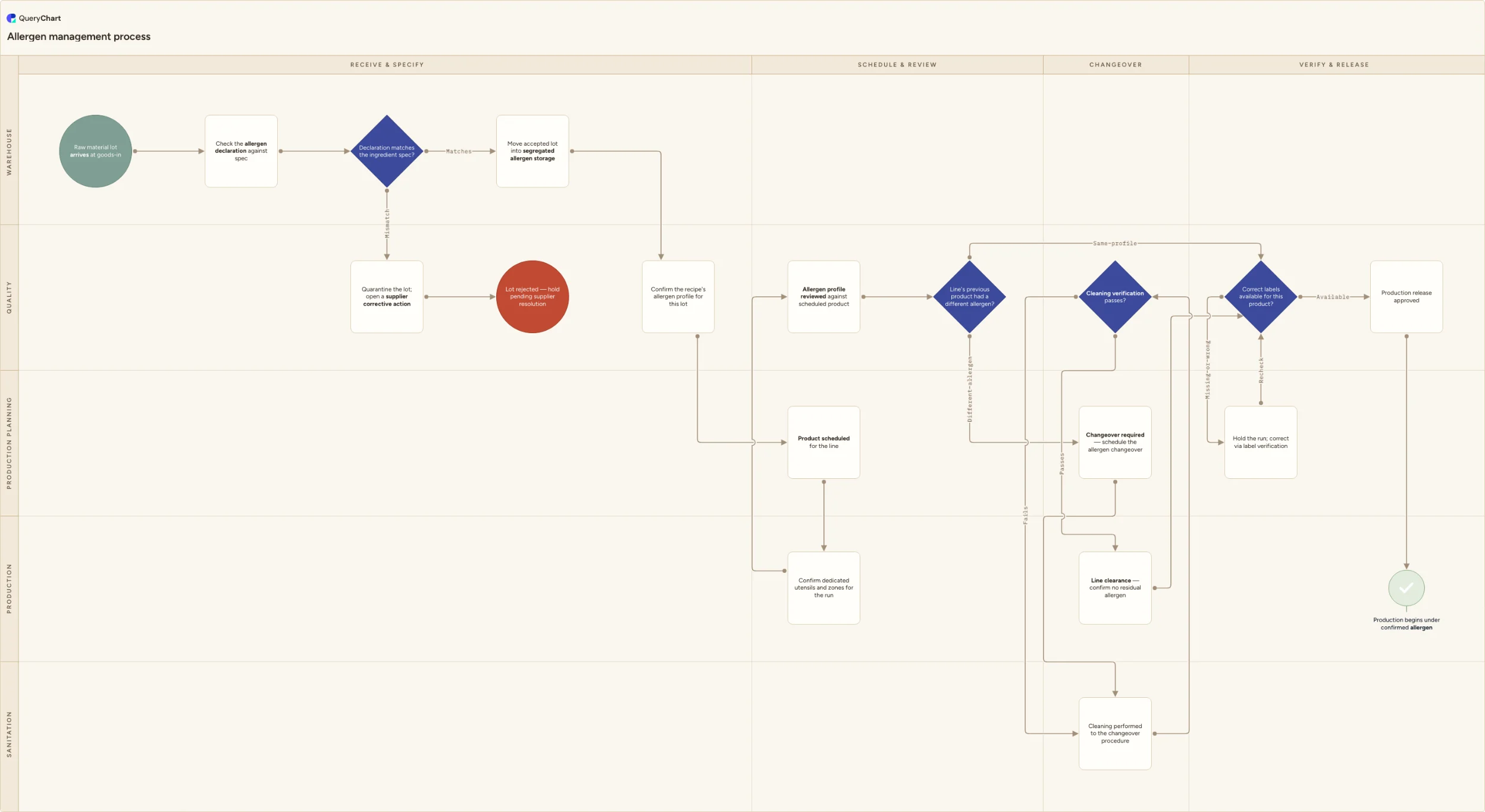
Allergen management process flowchart (changeover to release)
Allergen management process flowchart: goods-in declaration check, segregated storage, scheduling review, a changeover-triggering decision, cleaning verification, line clearance, label check and production release.
What the allergen management process flowchart (changeover to release) process is
Allergen management is not one event — it is the standing process that decides, every time a product is scheduled, whether this run needs a full allergen changeover or can proceed under the controls already in place, and whether the line and the label are actually ready before product moves. The chart below follows one scheduling cycle end to end. A raw material lot arrives and its allergen declaration is checked against the ingredient specification on file before it ever reaches a rack; an accepted lot goes into segregated storage keyed to its declared allergen profile, and the recipe's own allergen profile is confirmed current for that lot. Production Planning schedules the product, Production confirms whatever dedicated utensils or zones the run needs, and Quality reviews the scheduled product's allergen profile against what the line last ran. That review is the hinge: if the previous product carried a different allergen, the line goes through changeover, cleaning and a cleaning verification before line clearance; if not, the chart skips straight to the same label check both paths converge on. Either way, production is released only once the labels on hand match the profile that was reviewed.
This chart is broader than any single changeover event, and it is worth being precise about where its boundary sits. When 'Changeover required' fires, the mechanics of the changeover itself — the cleaning method, the sequencing, the equipment teardown — belong to a production line changeover process; this chart only carries the decision to trigger one and the checks that bracket it. Likewise, 'Cleaning performed to the changeover procedure' names the action but not the method: a CIP-cleaned line runs its own clean-in-place process underneath this step, with its own circuit parameters and its own verification. And 'Hold the run; correct via label verification' hands off to a food label verification process rather than re-litigating label proofing here. Keeping those three boundaries visible is what stops this page from either duplicating three other processes or quietly absorbing content that belongs to a validated method someone else owns. This chart also does not itself constitute an allergen risk assessment, a HACCP plan or a recall procedure — it assumes those exist and consumes their outputs, most visibly at the ingredient specification the goods-in check runs against and the changeover trigger the review decision applies.
Four decisions carry the process, and none of them names a fixed number. 'Declaration matches the ingredient spec?' is the gate that keeps an undeclared allergen from ever reaching a rack, let alone a formula. 'Line's previous product had a different allergen?' is the decision that actually controls cost and risk together — it is what stops every scheduled run from triggering a full changeover regardless of need, while still catching every run that does need one. 'Cleaning verification passes?' deliberately does not say what passing means: the method, whether that is a visual check, an ATP swab or an allergen-specific test, and the limit it is read against both belong to the cleaning validation behind your own changeover procedure, not to this chart. 'Correct labels available for this product?' is the last gate before release, because a clean line and a wrong label produce exactly the same undeclared-allergen failure this whole process exists to prevent. Treat the chart as a starting point to adapt under your own allergen risk assessment, your own validated cleaning and verification methods, and the food safety regulations that apply where you manufacture.
What this flowchart covers
In this template
- Five swimlanes — Production Planning, Warehouse, Production, Sanitation and Quality — across four phases from receipt to release, so the master allergen-control process has a named owner at every handoff rather than living in one department's head
- A "Declaration matches the ingredient spec?" decision at goods-in, checking a supplier's allergen statement against the ingredient specification on file before the lot is put away, with a mismatch routed to quarantine and a supplier corrective action rather than resolved at the dock
- The standing cross-contact controls this chart treats as background, not a one-off event: "Move accepted lot into segregated allergen storage" keyed to declared profile, and "Confirm dedicated utensils and zones for the run" before that run's review
- A "Line's previous product had a different allergen?" decision that is the hinge of the whole chart — it sends the line through changeover, cleaning and cleaning verification, or skips straight to the label check when the profile hasn't changed
- The changeover branch itself — "Cleaning performed to the changeover procedure" checked by a "Cleaning verification passes?" decision, then "Line clearance — confirm no residual allergen" before the line rejoins the other path
- A "Correct labels available for this product?" gate that both paths rejoin, holding the run for label verification rather than releasing under the wrong allergen statement, before "Production release approved" closes the run under Quality sign-off
When to use this template
- You are writing or revising an allergen control procedure and need one picture of who checks the incoming declaration, who decides a changeover is needed, who verifies the line, and who releases
- Changeovers are being run on a fixed schedule regardless of what the line actually ran last, and you need the decision that triggers one to be explicit rather than assumed
- Cleaning is being verified with no documented method, or verified and then not checked against the label before release, so the two gates need to be drawn as separate, sequential decisions
- You run shared lines across multiple allergen-declared products and want segregated storage and dedicated equipment shown as standing controls that feed every review, not as a note in a training slide
- A customer, auditor or certification body has asked for a documented description of how allergen changeovers are triggered, verified and released, distinct from your general production line changeover procedure
How it works
Rename the lanes to your roles
Replace Production Planning, Warehouse, Production, Sanitation and Quality with the titles that actually exist on your site. A smaller facility often merges Sanitation into Production or has one person carry both the changeover decision and the release sign-off — merge lanes rather than drawing a handoff that never happens.
Name the record the goods-in check runs against
State exactly what 'Check the allergen declaration against spec' compares: the supplier's certificate of analysis, an allergen statement on the delivery note, or a pre-approved supplier declaration on file. Say who may accept a discrepancy and under what condition, if any — and if none, say so on the chart.
Define your own changeover trigger rule
Write the rule 'Line's previous product had a different allergen?' is actually answering. Most sites work from an allergen matrix that says which pairs of products can run back to back without a full changeover and which cannot — name that matrix here rather than leaving the decision to whoever is running the line that day.
Set your own cleaning verification method and limit
This chart does not assert a method or a pass/fail limit, and neither should your adaptation unless it is validated for your equipment and your allergens. Name the method — visual, ATP, allergen-specific test strip or laboratory analysis — and the limit it is read against, sourced from your own cleaning validation study.
Decide who may release without full changeover evidence
'Cleaning verification passes?' failing sends the line back through cleaning, not around it. Decide whether any role may accept a marginal result with additional controls, and if the answer is no, make sure the chart's authority to release sits only with the role that can also order the line held.
Tie the label check to your label verification process
'Correct labels available for this product?' should point at a real, named check — pre-printed label reconciliation, a barcode scan against the batch record, or a manual proof against the approved artwork — rather than a general instruction to 'check the label.' If you already run a separate food label verification process, reference it here instead of duplicating it.
Walk it against last month's changeovers
Pull a handful of recent changeover records, including one where cleaning verification failed on the first attempt, and trace them through the chart. Any step people describe doing that isn't drawn, or drawn but skipped under schedule pressure, is the finding worth fixing before you publish the procedure.
Frequently asked questions
What are the steps in an allergen management process?
A raw material lot arrives and its allergen declaration is checked against the ingredient specification on file; a mismatch is quarantined and routed to a supplier corrective action rather than resolved at goods-in. An accepted lot moves into segregated allergen storage, and the recipe's own allergen profile is confirmed current for that lot. Production Planning schedules the product, Production confirms any dedicated utensils or zones the run needs, and Quality reviews the scheduled product's allergen profile against what the line last ran. If the previous product carried a different allergen, the line goes through a changeover, cleaning to the changeover procedure, a cleaning verification decision, and line clearance before it rejoins the process; if the profile hasn't changed, the chart skips straight there. Either path ends at a label check — production is released only once the labels on hand match the reviewed profile.
Does this template establish HACCP or regulatory compliance for allergen control?
No single flowchart can, and this one does not attempt to. Allergen management sits inside a facility's own hazard analysis, and what counts as a required control point, a critical limit or an acceptable cleaning verification result is specific to your products, your equipment and the regulations that apply where you manufacture — this chart names none of those and instead marks every place your own validated plan supplies one. Real obligations do apply and are worth citing precisely, with the same hedge: in the United States, 21 CFR Part 117 requires food allergens to be identified and controlled as part of a facility's hazard analysis and risk-based preventive controls, including allergen cross-contact and label controls, but the specific measures a facility adopts are its own. In the EU, Regulation (EU) No 1169/2011 Annex II sets out the 14 allergens that must be declared on a label, which is a labelling duty rather than a manufacturing-process standard. GFSI-benchmarked schemes such as BRCGS Food Safety go further procedurally — Issue 9 includes a dedicated allergen management clause — but certification against any scheme depends on an audit, not on adopting a template. Use this chart as an adaptable starting point and confirm applicability with whoever owns your facility's food safety and regulatory compliance.
How is an allergen changeover different from a production line changeover?
They overlap but answer different questions. A production line changeover covers everything that changes between two runs — format, recipe, speed, tooling — and an allergen difference is one possible reason for it. This chart isolates just the allergen half: the decision to trigger a changeover because the previous product carried a different allergen, and the verification and label checks that specifically guard against allergen carryover. If your changeover always needs a full teardown and reset regardless of allergen status, or if allergen status is only one of several triggers you track, model the changeover mechanics in a dedicated production line changeover process and treat this chart's 'Changeover required' step as the point where that process is invoked, not duplicated.
What counts as sufficient cleaning verification before an allergen changeover?
There is no single sufficient method, and a chart that asserted one would be asserting something no regulator, auditor or facility's own validation study can guarantee for every allergen and every soil type. Visual inspection alone is a reasonable step for gross soil but is not validated to detect allergenic protein at trace levels; ATP bioluminescence tests general cleanliness but does not test for a specific allergen; only an allergen-specific lateral flow test or a laboratory ELISA test for the allergen itself, and even those depend on the sampling plan and the limit the result is compared against. Whichever method you use, it needs to be validated for your equipment, your allergens and your soil types before it goes on the chart as 'Cleaning verification passes?' — and the limit that decision applies belongs to that validation, not to this template.
Who should have authority to approve production release after a changeover?
Most facilities restrict this to Quality or a named designee, and the chart follows that convention, but the underlying principle matters more than the title: release authority should sit with a role that is independent of the pressure to keep the line running, and that can also order the line held if cleaning verification or the label check fails. Whatever role you assign, make sure it is the same role — or one with equal standing — on both sides of the decision, so 'Production release approved' is never signed by someone who could not also have said no.
Where this process fits
In most operations this process hands off to Production line changeover process flowchart (allergen check to QA release).
Comes after
- Production line changeover process flowchart (allergen check to QA release) — Production line changeover flowchart: allergen check, mechanical changeover, cleaning by type, pre-op inspection, line clearance, first-piece check, QA release.
- Cleaning-in-place (CIP) process flowchart (pre-rinse to final release) — Cleaning-in-Place (CIP) process flowchart: pre-rinse, wash, intermediate rinse, sanitize, final rinse, verification and release-or-reclean disposition.
- Food label verification process flowchart (pull to release) — Food label verification process flowchart: label matched to recipe and allergen profile, order-checked, coding verified, with a mid-run hold-and-correct path.
- Supplier corrective action process flowchart (SCAR, issue to closure) — Supplier corrective action process flowchart (SCAR): screen the failure, issue with deadlines, contain stock on both sides, prove root cause and escape point, verify effectiveness over agreed lots, then close or escalate.