Accounts receivable process flowchart (invoice to cash)
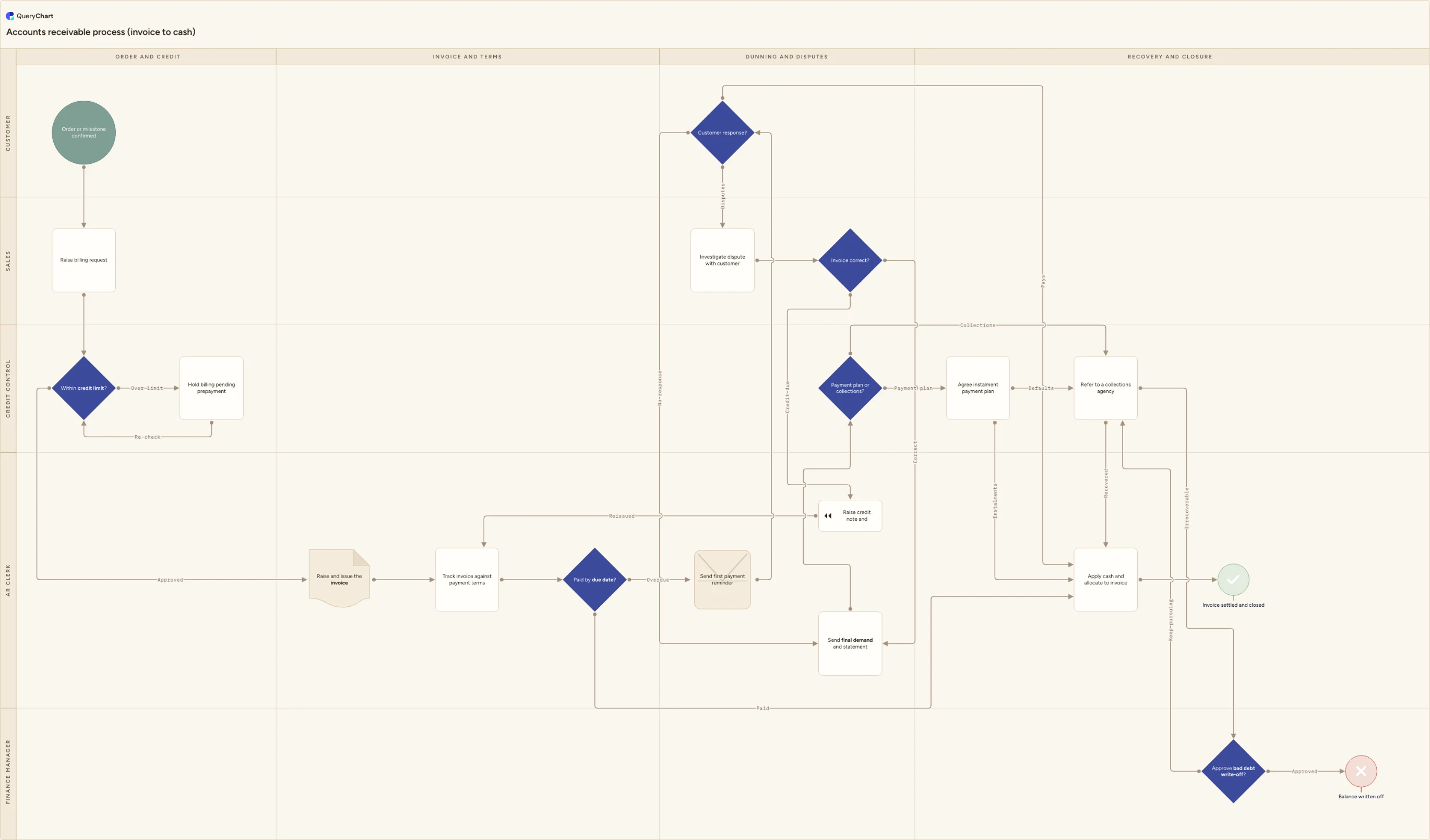
A five-lane accounts receivable process flowchart: credit check, invoice issue, payment terms, dunning, disputes, payment plans, cash application, write-off.
What the accounts receivable process flowchart (invoice to cash) process is
Accounts receivable is the collection half of order-to-cash: everything between an invoice leaving your ledger and the money arriving and being matched to the right invoice. Written as a list it is three steps, raise, send, get paid, which is why so many AR procedures are three steps long and useless the moment something goes overdue. The real process is defined by its exceptions: a customer already at their credit limit, an invoice sent to the wrong contact so the payment clock never starts, a disputed line that sales has to settle before finance can chase, a debtor who can only pay in instalments, and a balance that eventually has to be written off by someone with the authority to do it.
Two neighbouring processes stop where this one starts. Order fulfilment covers order capture, picking, dispatch and delivery and ends when the invoice is raised, so if the problem is short shipments or missed delivery dates, that is the map you want. Invoice approval is the mirror image on the supplier side: it is accounts payable, validating and approving invoices you receive before money leaves. This chart is the customer-facing side only. It begins at the billing trigger and ends at cash applied or the balance written off, and it does not cover customer credit application and onboarding, revenue recognition, or month-end ledger reporting.
The template maps the collection cycle across five lanes, Customer, Sales, Credit control, AR clerk and Finance manager, over four phases from the billing trigger to closure. It is deliberately explicit about the branches most AR procedures leave to habit: a credit gate before anything is billed, a dunning ladder whose response decision separates silence from a genuine dispute, a dispute route owned by sales that ends in either a final demand or a credit note, an escalation to credit control that chooses between an instalment plan and collections, and a write-off a finance manager has to authorise. Replace the reminder timings, credit limits and authority levels with your own policy; the shape of the flow is the part that transfers.
What this flowchart covers
In this template
- Five swimlanes, Customer, Sales, Credit control, AR clerk and Finance manager, across four phases: Order and credit, Invoice and terms, Dunning and disputes, and Recovery and closure.
- A credit gate before anything is billed. The confirmed order or milestone becomes a billing request in the Sales lane, then a "Within credit limit?" decision either releases it or holds billing pending prepayment, and the hold loops back for a re-check rather than dying on the account.
- Invoice raised and issued, then tracked against payment terms up to a "Paid by due date?" decision, the point where an invoice either leaves the process as cash or enters the dunning sequence.
- An escalating dunning ladder with a real response decision. After the first reminder, "Customer response?" splits three ways into Pays, Disputes and No response, so silence goes to a final demand and statement while disagreement goes to sales, instead of both receiving another copy of the invoice.
- A disputed-invoice branch owned by Sales: investigate with the customer, then "Invoice correct?" either sends the account on to final demand or raises a credit note and reissues, which re-enters the flow at payment-terms tracking so the reissued invoice gets its own due date.
- Escalation to credit control at "Payment plan or collections?", an instalment plan that either feeds cash application or defaults into collections, cash applied and allocated against the invoice, and a Finance manager "Approve bad debt write-off?" decision ending in either a written-off balance or continued pursuit.
When to use this template
- You are writing or refreshing a credit control or accounts receivable procedure and need the sales, AR and credit control handoffs on one page rather than in three separate habits.
- Days sales outstanding is drifting and you need to establish whether invoices stall at issue, at the first reminder, in unresolved disputes or in unapplied cash before changing anything.
- You are configuring dunning or an AR module in an ERP or billing system and want the reminder ladder, escalation points and write-off authority agreed before they are encoded as automation.
- Disputes are being handled informally between a salesperson and a customer, with no record of who agreed the credit note or when the invoice re-entered the chase.
- A new AR clerk or credit controller needs to know what happens to an overdue account next, and at what point it stops being theirs.
How it works
Rename the lanes to your real roles
Replace Customer, Sales, Credit control, AR clerk and Finance manager with the roles you actually have. Smaller organisations often merge credit control into the AR clerk lane; larger ones split billing from collections. If a shared service centre issues invoices while a local controller chases them, keep both lanes so the handoff stays visible.
Write your credit policy into the credit gate
State how exposure is measured on the "Within credit limit?" step: posted balance plus open orders plus delivered but unbilled work, not just today's ledger. Record who can release a held order, up to what value, and whether a new customer is billed on prepayment until a payment history exists.
Set a dunning calendar with real dates
Decide how many days after the due date each reminder goes, what each one says, and who signs it. Keep the escalation qualitatively different at each rung: a reminder, then a statement and final demand, then credit control. If you intend to charge statutory late-payment interest or compensation, note where that is triggered and who authorises it.
Define the dispute route and credit note authority
Agree what counts as a dispute rather than a delay, how quickly sales must respond, and who may approve a credit note and at what value. Decide explicitly whether reminders pause while a dispute is open, and for how long, so a dispute cannot be used to park a balance indefinitely.
Fix the escalation and write-off thresholds
Put your own rules on "Payment plan or collections?" and "Approve bad debt write-off?": the age or value at which an account leaves the AR clerk, who may agree instalments and on what terms, and the authority level required to write a balance off. Keep the person chasing the debt separate from the person approving the write-off.
Walk it through, then keep the approved version
Follow two or three live accounts through the chart, including one dispute and one that reached collections, and correct the map to what people do rather than what the procedure says. Then keep the agreed version under version control so the current authorised diagram is unambiguous and later edits are tracked.
Frequently asked questions
What are the steps in the accounts receivable process?
A typical sequence is: an order or milestone is confirmed, sales raises a billing request, credit control checks the customer against their credit limit and either releases or holds it, the invoice is raised and issued to the customer, the invoice is tracked against its payment terms, and a due-date check decides what happens next. Paid invoices go to cash application and allocation and the invoice is closed. Overdue invoices enter a dunning sequence: a first reminder, then a response decision that separates payment, dispute and silence, a final demand and statement, escalation to credit control, and either an instalment payment plan or referral to collections. Anything still unrecovered ends at a bad-debt write-off decision.
What is the difference between accounts receivable and order-to-cash?
Order-to-cash is the whole cycle from a customer order through fulfilment, invoicing, collection and cash application. Accounts receivable is the collection half of it: the invoice, the payment terms, the chase and the cash. This chart covers that half, so it starts at the billing trigger rather than at order capture and it says nothing about picking, packing or delivery. It is also the opposite side of the ledger from accounts payable, where you are the one receiving supplier invoices and approving them for payment; the roles, controls and risks are different even though the paperwork looks similar.
What should a dunning sequence look like?
A dunning sequence is the ordered set of reminders sent after an invoice passes its due date, escalating in tone and in who sends it: a short reminder from the AR clerk, then a statement of account and a final demand, then contact from credit control with the account on stop. The useful design point is not the wording but the branching. Build in a response decision so a customer who disputes the invoice goes to the person who can settle it, while silence continues up the ladder. Set the intervals to your own terms and customer base and write them into the chart, and note that late-payment legislation such as the UK Late Payment of Commercial Debts (Interest) Act 1998 and the EU Late Payment Directive gives suppliers a right to statutory interest and compensation on overdue commercial debts, subject to conditions you should confirm for your jurisdiction and contract.
When should an invoice be written off as bad debt, and who approves it?
A write-off is an accounting judgement that a balance is no longer recoverable, made after the collection routes have been exhausted: reminders, credit control, a payment plan, and referral to collections or legal action where that is proportionate. It is distinct from a provision or allowance for doubtful debts, which reduces the carrying value of receivables you still expect to pursue. Approval should sit with someone independent of the collection effort, at an authority level set by your delegation of authority, and the decision, reason and amount should be recorded. If you have accounted for VAT or sales tax on the invoice, check the specific relief conditions in your jurisdiction, which usually include a minimum period after the due date, the debt being written off in the accounts, and a time limit on claiming.
Where this process fits
In most operations this process follows 3PL Billing Process and hands off to Month-end close process flowchart (calendar to sign-off).
It is one step in Order-to-cash.
Step 1: Customer credit approval process flowchart (limit and terms)
Step 3: Proof of delivery process flowchart (ePOD capture to invoice)
Step 4: Invoice-to-cash process flowchart
Invoice-to-cash process flowchart for invoice issue, due-date monitoring, customer disputes, collections, cash application and receivables reconciliation.
Step 5: Accounts receivable process flowchart (invoice to cash) You are here
A five-lane accounts receivable process flowchart: credit check, invoice issue, payment terms, dunning, disputes, payment plans, cash application, write-off.
Step 6: Bank reconciliation process flowchart
Bank reconciliation process flowchart for matching bank statements to the general ledger, resolving timing and error differences, and independent sign-off.