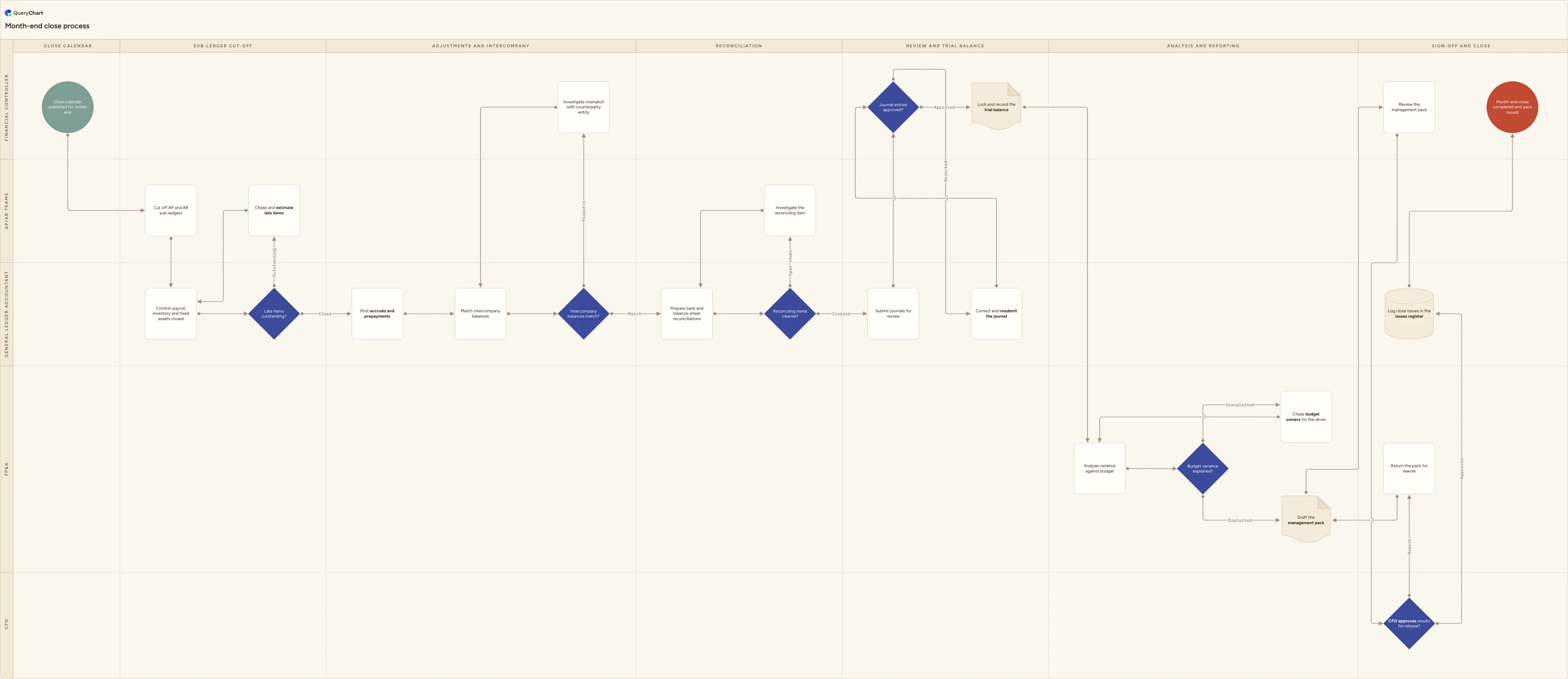
Month-end close process flowchart (calendar to sign-off)
Month-end close process flowchart template: close calendar, sub-ledger cut-off, accruals, intercompany matching, reconciliations, journal approval, trial balance, variance analysis and CFO sign-off.
What the month-end close process flowchart (calendar to sign-off) process is
Month-end close is the monthly discipline that record to report describes as a whole cycle: the calendar published on day one, the sub-ledgers cut off, the adjustments posted, the balances reconciled, the journals reviewed, and a management pack signed off before the calendar resets for next month. The chart below follows one close from the calendar going out to the AP/AR teams, the general ledger accountant, the controller, FP&A and the CFO, through to the issues log that feeds next month's calendar. It is written for the single entity running its own monthly cycle: one set of sub-ledgers, one trial balance, one pack, not a group consolidating several of them.
This chart stops at the internal management pack. It does not carry consolidation, elimination and currency translation across multiple entities, or the statutory disclosures and external audit that turn a management close into filed financial statements; that broader, group-level cycle is mapped separately as the record-to-report process, and this page's calendar, cut-off and reconciliation steps are one entity's contribution to it. It also stops before the figures leave finance: drafting the statutory financial statements themselves, with their disclosure notes and external auditor sign-off, is a distinct financial reporting process this chart hands off to rather than performs. Keeping that boundary visible matters because a controller who tries to run consolidation and disclosure inside the monthly close calendar is usually the reason the calendar slips.
Four decisions carry the process. 'Late items outstanding?' decides whether a missing invoice or timesheet is worth holding the whole close for, and the answer is normally no: estimate and true up later. 'Intercompany balances match?' and 'Reconciling items cleared?' are the two loops that consume most of a close's actual days, because an open item does not resolve itself between one review and the next. 'Journal entries approved?' sits with the controller rather than the preparer on purpose, so nobody reviews their own posting. The variance and sign-off steps close the loop the other way: a budget variance nobody can explain is a finding, not a formality, and the CFO's approval is a real gate that can send the pack back, which is why the chart ends in rework as well as in a closed period.
What this flowchart covers
In this template
- Five swimlanes (Financial controller, General ledger accountant, AP/AR teams, FP&A and CFO) across seven phases: close calendar, sub-ledger cut-off, adjustments and intercompany, reconciliation, review and trial balance, analysis and reporting, and sign-off and close
- A 'Late items outstanding?' decision right after cut-off, so a late invoice or timesheet gets chased and estimated rather than holding the whole close open for one missing sub-ledger entry
- The intercompany loop: 'Match intercompany balances' feeding an 'Intercompany balances match?' decision, whose mismatch branch runs through the controller's own investigation with the counterparty entity before matching is attempted again
- The reconciliation-exception loop in the AP/AR teams' lane: 'Prepare bank and balance-sheet reconciliations' feeding 'Reconciling items cleared?', where open items go back to be investigated and the reconciliation is prepared again before it can clear
- A journal review gate owned by the controller rather than the preparer, 'Journal entries approved?' with a correct-and-resubmit loop, followed by locking and recording the trial balance as its own document step
- Analysis and sign-off with a real consequence: a 'Budget variance explained?' loop back to FP&A when the driver is not yet known, a management pack the CFO can approve or send back for rework, and a close issues register that closes the loop into next month's calendar
When to use this template
- You are documenting the monthly close for the first time and today's version is a spreadsheet checklist with no owners or review points on it
- The close keeps slipping past its target day and you need to see whether it stalls at sub-ledger cut-off, at an intercompany or reconciliation loop, or in journal review
- You are configuring close tasks in a new ERP or close-management tool and need the roles, handoffs and decisions agreed before task owners and due dates are set up
- The controller and FP&A disagree about how variance explanations get produced, so the analysis step and its loop back need to be explicit and owned
- An auditor or the CFO has asked for a documented description of how the monthly close is run, reviewed and signed off, distinct from the broader group reporting cycle
How it works
Rename the lanes to your finance team
Replace Financial controller, General ledger accountant, AP/AR teams, FP&A and CFO with the roles you actually have. In a small business the controller often is the general ledger accountant and there may be no separate FP&A function: merge those lanes rather than drawing a handoff that never happens. Whatever else you merge, keep the person who posts journals and the person who approves them in different lanes.
Publish the calendar with a day and a time on every task
Attach your own calendar to the opening step. The chart's comment uses day numbers as a placeholder pattern, for example day one cut-off, day three reconciliations reviewed, day five pack issued; replace them with your real close timetable and give every task an owner and a time of day, not just a day, so day three at 9am reads as a deadline and day three on its own reads as a hope.
Write your late-item and estimate rule
State what happens when AP, AR, payroll, inventory or fixed assets has an item outstanding at cut-off: who may estimate and accrue it, what the reversal rule is next period, and how many days a sub-ledger can run late before the whole calendar is affected. A close that waits for every last invoice before moving on is a close with no cut-off at all.
Set your intercompany and reconciliation tolerances
Put real numbers on the two loops that consume most of a close: a value below which an intercompany difference is written off centrally rather than chased with the counterparty entity, and an ageing limit past which an open reconciling item is escalated rather than carried forward untouched into next month.
Set the journal approval and second-approver rule
Decide the value above which a journal needs a second approver, and name the entry types that always get extra scrutiny regardless of value, such as manual entries to cash, revenue, provisions or reserves. State who may approve their own general ledger accountant's postings, and confirm the honest answer is nobody.
Define the variance threshold and sign-off rule
Set the percentage or value against budget that makes an explanation mandatory rather than optional, and agree what the CFO's sign-off actually blocks: does a rejected pack go back to FP&A for analysis only, or can it reopen journals and the trial balance lock. Write both rules onto the chart before anyone treats the sign-off decision as a formality.
Walk it against last month's close, then log the gaps
Take last month's actual close and trace it through the chart with the controller, the general ledger accountant and FP&A, marking every point where the real sequence differed from the drawn one or where a step was skipped under time pressure. Feed what you find into the issues register step so the same slippage becomes a calendar change rather than a repeat finding next month.
Frequently asked questions
What are the steps in the month-end close process?
The close calendar is published for the period. AP and AR sub-ledgers are cut off, and payroll, inventory and fixed assets are confirmed closed; anything outstanding is chased and estimated rather than left open. The general ledger accountant posts accruals and prepayments, then matches intercompany balances, resolving any mismatch with the counterparty entity. Bank and balance-sheet reconciliations are prepared, with any reconciling item investigated and the reconciliation redone until it clears. Journals go to the controller for approval or correction, then the trial balance is locked and recorded. FP&A analyses variance against budget, chasing an explanation for anything unexplained, then drafts the management pack. The CFO approves it for release or returns it for rework, and the close issues found along the way are logged before the period is called closed.
How is month-end close different from record to report?
They are the same discipline at two different scopes. Month-end close, as this chart draws it, is what one entity does every month: publish the calendar, cut off its own sub-ledgers, post its own accruals, match its own intercompany balances, reconcile, get journals approved, and produce a management pack its own CFO signs off. Record to report is the broader cycle above that, adding consolidation of multiple entities, elimination of intercompany balances across the group, currency translation, a group-level flux review and the statutory disclosures that go into filed financial statements. In a single-entity business the two are close to the same thing. In a group, this chart's steps are what each entity contributes before record to report's controller-level review folds them together, which is why an out-of-balance intercompany pair here becomes a group elimination problem there.
How long should a month-end close take?
There is no universal target, and the number that matters is where the days actually go rather than the total. A close that finishes quickly by skipping reconciliation or rushing sign-off has not really finished. Track how many calendar days are lost waiting for a sub-ledger to cut off cleanly, how many are lost inside the intercompany or reconciliation loops, and how many are lost because journal review or the variance explanation only starts after the figures have already been circulated informally. Agree your own target day for the calendar and measure against it consistently, and treat a slipping target as a reason to look at which step in this chart is absorbing the delay rather than as a reason to compress the review at the end.
Who should approve journal entries and reconciliations at month end?
Someone other than the person who prepared them, looking at the supporting schedule rather than the total alone. The usual pattern is that the general ledger accountant prepares and posts routine entries, the controller reviews and approves them, and a named second approver signs off anything above an agreed value or of a sensitive type, such as a manual entry to cash, revenue, provisions or reserves. The same separation applies to reconciliations: the preparer is not the reviewer. This matters both for catching genuine errors and because it is what an internal or external auditor checks for first when they sample the close, so the approval needs to be recorded somewhere retrievable alongside the entry, not left in an email thread nobody archives.
What does an auditor look for in a month-end close?
Evidence that the process on paper is the process that actually ran: a published calendar with real dates rather than a template nobody follows, sub-ledgers genuinely cut off on the stated day rather than adjusted after the fact, reconciling items actually cleared or explained rather than the same balance rolled forward month after month, journals with a visible preparer and a different approver, and a variance analysis that explains the movement rather than restating it. The issues register matters too: an auditor who sees the same finding recur unaddressed reads it as a control that exists on paper, not in practice. None of this makes a close compliant on its own; specific requirements depend on your own procedures and, for a public company, its statutory and internal-control obligations, so treat this chart as a starting point to adapt under those, not a substitute for them.
Where this process fits
In most operations this process follows Accounts payable process flowchart (full AP cycle) and hands off to Financial reporting process flowchart.
It is one step in Financial close.
Step 1: Journal entry approval workflow
Step 2: Account reconciliation process flowchart
Account reconciliation process flowchart for supporting-balance preparation, reconciling-item resolution, correction approval and independent account certification.
Step 3: Month-end close process flowchart (calendar to sign-off) You are here
Month-end close process flowchart template: close calendar, sub-ledger cut-off, accruals, intercompany matching, reconciliations, journal approval, trial balance, variance analysis and CFO sign-off.
Step 4: Financial reporting process flowchart
Financial reporting process flowchart for reconciled reporting inputs, consolidation, variance analysis, controller review, CFO approval and management-pack issue.