3PL Customer Onboarding Process
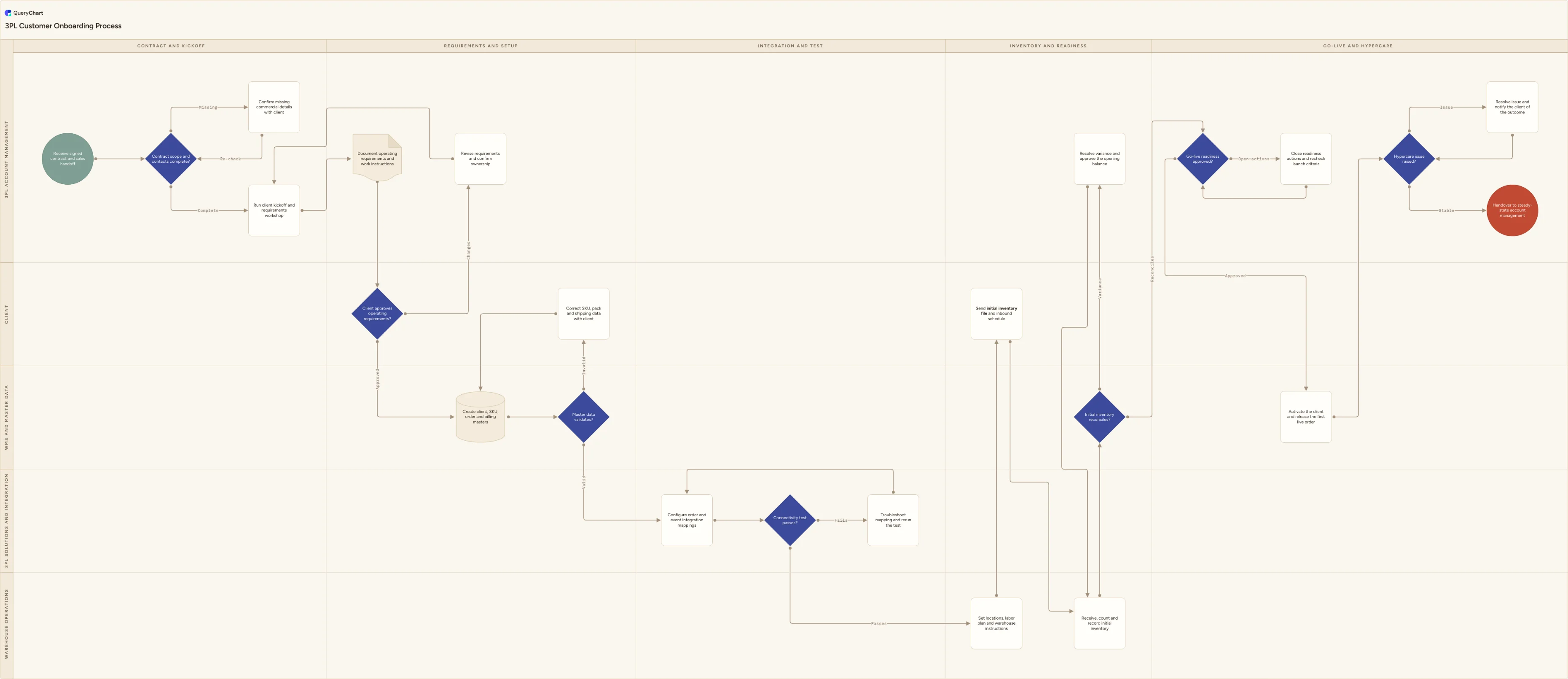
3PL customer onboarding process template: turn a signed contract into approved operating requirements, configured data and integrations, reconciled inventory, go-live readiness and hypercare.
What the 3PL customer onboarding process is
3PL onboarding is the controlled transition from a commercial promise to an operation a warehouse can execute repeatedly. It starts with the signed contract and a sales handoff, then gives account management a kickoff with the client to turn scope, contacts, order cutoffs, returns, packaging, service levels and reporting into owned operating requirements. The WMS team creates the client, SKU, order and billing masters; solutions configures the order and event mappings; warehouse operations set locations, labor and work instructions. The client supplies the initial inventory file and inbound plan, and the warehouse receives and counts that stock before anyone releases a live customer order.
The chart keeps readiness and hypercare as real gates, not a calendar date on a project plan. Data must validate, connectivity tests must pass, opening inventory must reconcile, and the client and 3PL must agree that launch criteria are met. Only then does the WMS activate the account and release the first order. A hypercare issue loops through resolution and client notification until the service is stable enough to hand over to steady-state account management. Use the five swimlanes to assign the work to the Client, 3PL account management, 3PL solutions and integration, WMS and master data, and Warehouse operations rather than treating onboarding as an IT implementation alone.
What this flowchart covers
In this template
- Five swimlanes across contract and kickoff, requirements and setup, integration and test, inventory and readiness, and go-live and hypercare, with a named owner for every client and 3PL handoff
- A contract-scope check and a client requirements approval loop, so operating work does not begin on missing contacts, unagreed service rules or an instruction that has not been accepted
- Creation and validation of client, SKU, order and billing masters, with invalid pack, shipping or product data returned to the client for correction before configuration continues
- Integration mapping and connectivity testing, followed by a warehouse-led initial-inventory count and reconciliation loop that establishes an approved opening balance
- A go-live readiness decision, first-order activation and hypercare loop that resolves and communicates launch issues before the account moves to normal management
When to use this template
- You have signed a new 3PL client and need a shared operational path from commercial handoff to the first live order
- Client masters, SKU attributes or integration mappings are repeatedly discovered after the warehouse has already started setup work
- Initial inventory arrives with a file that does not agree with the physical count, and there is no clear owner for approving the opening stock position
- Go-live dates are set before readiness is tested, creating launches that rely on manual workarounds and hypercare issues nobody has formally closed
How it works
Turn the contract into an operating requirements checklist
List the service commitments that change warehouse behavior: order cutoff, carrier services, packaging, serial or lot control, returns, hazardous goods, value-added work, reporting and escalation contacts. Give each requirement one owner and one client approval point. The signed contract is an input, not an instruction a shift can execute without interpretation.
Define the master-data acceptance rule
Specify the fields that must be complete before setup can pass: SKU dimensions, weights, pack hierarchy, labeling, storage conditions, order types, shipping methods and billing codes. Include the source of truth and who may correct it. A validated but wrong pack quantity can make an integration test look successful while the first shipment fails physically.
Test transactions, not just connectivity
Run representative orders, cancellations, shipment confirmations, inventory adjustments and the client reports that consume the events. Check both directions of each interface and preserve the expected result. A successful connection proves only that systems can talk, not that the order, inventory and billing data mean the same thing on both sides.
Reconcile and approve the opening inventory balance
Agree the count method, variance tolerance, treatment of damaged or unlabelled stock and the person who can approve the final opening balance. Do not activate available-to-promise stock until physical quantity, status and location agree with the WMS and the client's record. This is the baseline every later inventory investigation will use.
Set launch and hypercare exit criteria
Write the readiness evidence required for go-live, the first-order monitoring cadence, the issue severity levels and the condition for exiting hypercare. Include who tells the client an issue is resolved. A fixed hypercare end date rewards closing the project while the operation is still depending on people who happen to be watching it.
Frequently asked questions
What are the stages of 3PL customer onboarding?
The process begins with a signed contract and a sales-to-operations handoff. Account management runs kickoff and obtains approval for operating requirements, then the 3PL creates and validates client, SKU, order and billing masters. Solutions configures and tests integrations, while warehouse operations prepare locations and work instructions. The client sends an inventory file and inbound schedule, the warehouse counts and reconciles the opening stock, and the team reviews go-live readiness. After activation, the first orders run under hypercare until issues are resolved and the account can move to steady-state management.
Why must initial inventory be reconciled before 3PL go-live?
The opening balance is the point from which the client, WMS and warehouse will measure every future receipt, shipment, adjustment and cycle count. If quantity, status, lot, location or ownership is wrong at launch, later discrepancies have no trustworthy baseline and orders can promise stock that cannot be picked. The reconciliation loop makes variances visible, gives the client and 3PL a chance to agree their treatment, and records an approved balance before inventory becomes available to orders.
What is hypercare in a 3PL onboarding process?
Hypercare is the monitored period immediately after go-live when the new account runs real orders under closer-than-normal operational attention. It is not simply extra support. The team watches the first transactions, compares outputs to the agreed requirements, resolves defects across the client, integration, WMS and warehouse teams, and tells the client what changed. It ends when defined launch criteria are stable, not when a project calendar reaches a date.
Where this process fits
In most operations this process hands off to 3PL Order Fulfillment Process.
It is one step in 3PL client lifecycle.
Step 1: 3PL Customer Onboarding Process You are here
3PL customer onboarding process template: turn a signed contract into approved operating requirements, configured data and integrations, reconciled inventory, go-live readiness and hypercare.
Step 2: 3PL Order Fulfillment Process
3PL order fulfillment process template: validate the client order, allocate and pick stock, resolve shortages and shipping risks with client approval, then ship, confirm and close.
Step 3: 3PL Billing Process