3PL Order Fulfillment Process
3PL order fulfillment process template: validate the client order, allocate and pick stock, resolve shortages and shipping risks with client approval, then ship, confirm and close.
What the 3PL order fulfillment process is
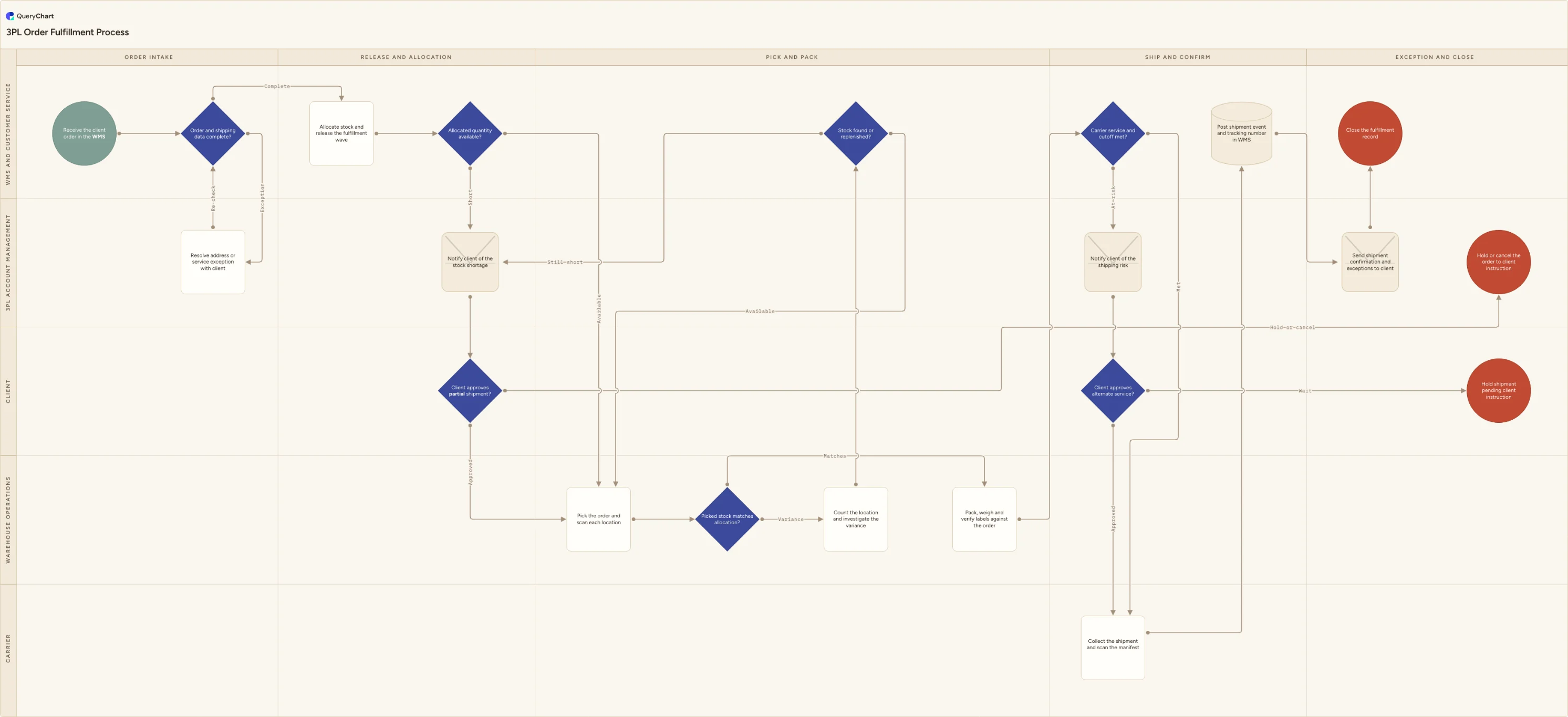
A 3PL order fulfillment process is more than a pick-pack-ship sequence. It is the operating agreement between a client that owns the customer promise and a warehouse that executes it. The order arrives in the WMS, where the service, address and order data are checked before stock is allocated and a fulfillment wave is released. Warehouse operations then pick by scan, investigate any pick variance, pack and verify the order, and hand it to the carrier. The 3PL posts the shipment event and tracking number, while account management sends the client the confirmation and the exceptions that matter to its customer service team. Five swimlanes make those ownership changes visible: Client, 3PL account management, WMS and customer service, Warehouse operations and Carrier.
This chart is deliberately a 3PL process rather than a generic warehouse fulfillment diagram. A stock shortage does not automatically become a partial shipment, and a missed cutoff does not automatically become an upgraded service: both affect the client's customer commitment, so account management notifies the client and obtains an instruction. It also keeps the WMS, warehouse and carrier responsibilities separate. The WMS allocates and records events; the warehouse proves the physical pick and pack; the carrier owns collection and manifest scan. Adapt the approval limits, carrier services, hold rules and escalation times to the contract and operating model you actually run.
What this flowchart covers
In this template
- Five swimlanes across order intake, release and allocation, pick and pack, ship and confirm, and exception and close, separating the client decision from 3PL account management, WMS, warehouse and carrier execution
- An order-data gate before work starts, with address or requested-service exceptions routed to account management and back through the same check once the client response is recorded
- A stock-allocation decision that notifies the client of a shortage and asks for approval before a partial shipment proceeds, rather than letting warehouse staff choose the commercial outcome
- A scanned pick variance loop that counts the location, investigates the stock record and either returns to the pick or sends the shortage back to the client-notification path
- A carrier-cutoff risk check with client approval for an alternate service, followed by manifest scan, WMS tracking update, shipment confirmation and record closure
When to use this template
- You are documenting a new client account before launch and need to distinguish its service decisions from the 3PL's physical warehouse work
- Partial shipments, substitutions or carrier upgrades are being made informally on the floor, and the client approval and notification path needs to be explicit
- Order exceptions disappear between customer service, the WMS and the pick team, leaving nobody able to explain why an order shipped late or short
- You are configuring WMS order holds, fulfillment waves, event messages or carrier cutoffs and need the operational handoffs agreed before building the rules
How it works
Name the client instructions that require approval
Set the decisions the warehouse may make under standing instructions and the ones account management must take back to the client. Partial shipment, substitution, split shipment, delayed dispatch and premium freight often have different limits. Record the client contact, response channel and response-time rule beside the chart so an order does not sit in an unowned hold.
Map your order-status vocabulary
Replace the labels with the WMS statuses your operators actually see, including held, allocated, picked, packed, manifested and shipped. Define the event that moves an order between each status. A physical parcel at the dock with an order still marked allocated is a reporting and billing problem as well as an execution problem.
Set allocation and shortage rules by client
Decide whether allocation is first-come, priority based, order complete or governed by a client-owned allocation file. State when the WMS may release a partial quantity and when it must stop. The client approval branch should cite those rules rather than ask a vague question after the shortage has already reached the pack bench.
Make scan exceptions recoverable
Define who counts a short pick location, who can adjust stock and when a variance needs a cycle count or an inventory-control investigation. Keep the re-pick loop; a picker who cannot see the route back to a corrected allocation often creates an off-system workaround that no later report can explain.
Test the chart against one late and one short order
Walk a normal order, a stock-short order and an order that misses its carrier cutoff through the chart. Check that each team can identify the next owner, the client receives the right message and the WMS captures the final outcome. Amend the contract-specific timing and service rules before using the chart as an SOP.
Frequently asked questions
What are the main steps in a 3PL order fulfillment process?
The order enters the WMS and its shipping data is checked before inventory is allocated and released to the warehouse. Warehouse operations pick by scan, resolve any location or stock variance, pack and verify the labels, and check whether the requested carrier service can meet the cutoff. A shortage or service risk goes to 3PL account management, which notifies the client and obtains an instruction before the order changes. The carrier collects and manifests the shipment, the WMS posts the shipment event and tracking number, and account management sends the client confirmation before the fulfillment record closes.
Who should approve a partial shipment in a 3PL operation?
The client should set the authority in its operating instructions, because a partial shipment changes its promise to its own customer and can create extra freight, backorder or marketplace consequences. The 3PL can execute a standing rule, such as ship available stock for a named sales channel, but should not improvise where no rule exists. The chart routes the shortage through account management so the decision, the client contact and the outcome are visible rather than buried in a picker note.
How is a 3PL fulfillment process different from a warehouse picking process?
A warehouse picking process starts when work is released to the floor and concentrates on location scans, quantities, packing and dispatch. A 3PL fulfillment process begins earlier and closes later: it validates client order data, routes client-owned commercial decisions, records WMS events and sends the client the operational result. The physical pick is essential, but it is only one handoff in a service the 3PL delivers on the client's behalf.
Where this process fits
In most operations this process follows 3PL Customer Onboarding Process and hands off to 3PL Billing Process.
It is one step in 3PL client lifecycle.
Step 1: 3PL Customer Onboarding Process
3PL customer onboarding process template: turn a signed contract into approved operating requirements, configured data and integrations, reconciled inventory, go-live readiness and hypercare.
Step 2: 3PL Order Fulfillment Process You are here
3PL order fulfillment process template: validate the client order, allocate and pick stock, resolve shortages and shipping risks with client approval, then ship, confirm and close.
Step 3: 3PL Billing Process
3PL billing process template: validate warehouse events and client rates, review and issue invoices, resolve disputes with corrections or credits, then report and close the period.