Recruitment process flowchart: vacancy to offer accepted
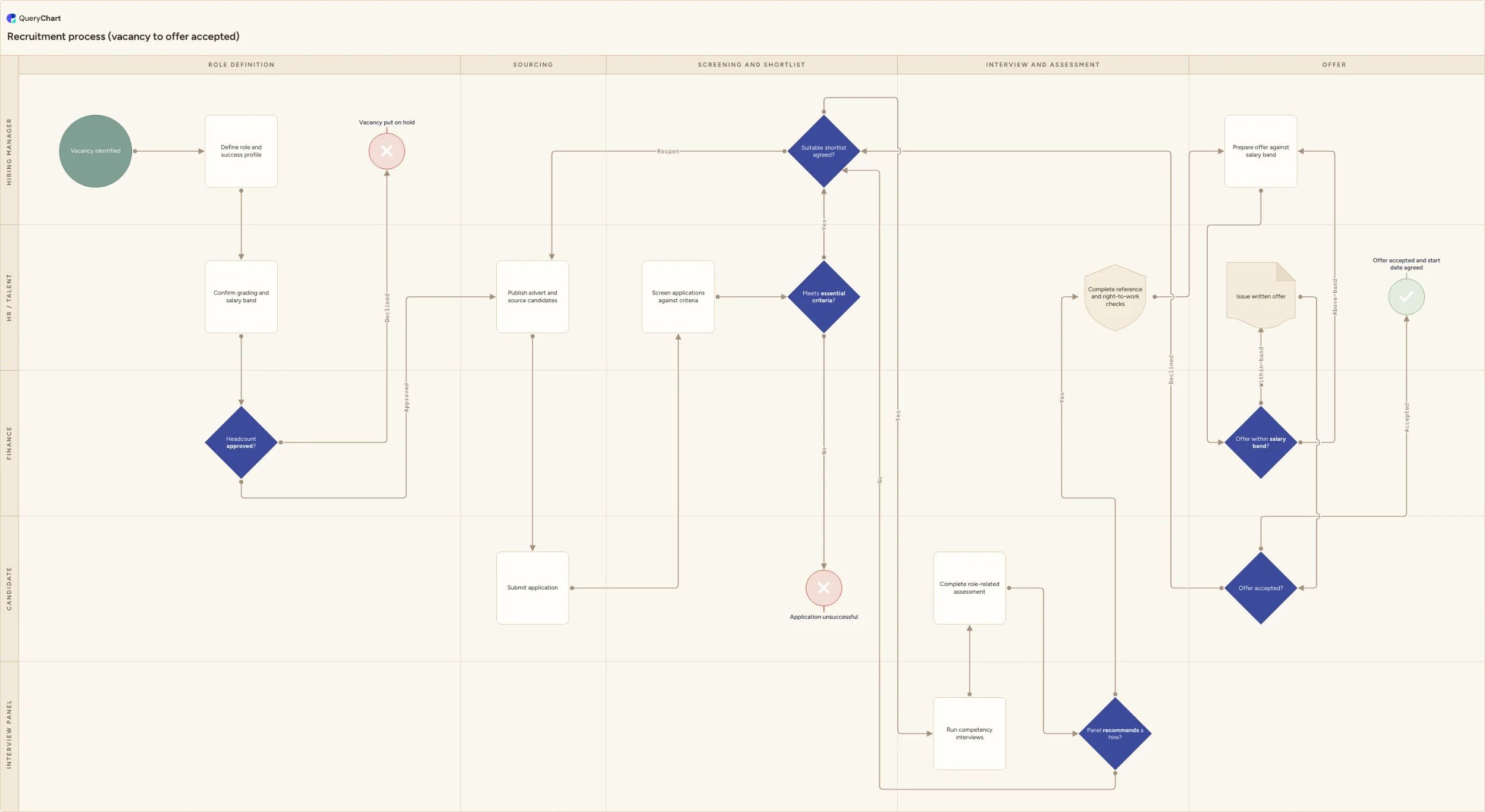
A swimlane recruitment process flowchart from approved headcount to accepted offer, covering screening, shortlisting, interviews, checks and offer approval.
What the recruitment process flowchart: vacancy to offer accepted process is
A recruitment process turns approved headcount into a hired person. Most of the delay in hiring is not in the interviews themselves, it is in the gaps between them: a vacancy waiting on finance, a shortlist nobody has formally agreed, an offer stuck because it sits above the salary band. Drawing the process makes those handovers visible and gives each one an owner.
This template runs from vacancy identified to offer accepted across five swimlanes: hiring manager, HR/talent, finance, candidate and interview panel. Read left to right it moves through role definition, sourcing, screening and shortlist, interview and assessment, and the offer. Six decision points mark where it can branch: headcount approval, essential criteria at screening, shortlist agreement, the panel's recommendation, the salary band check and the candidate's answer.
It also shows the paths that usually go undocumented. Applicants who fail screening end at 'Application unsuccessful' rather than quietly disappearing. If the shortlist is not strong enough, or the panel will not recommend anyone, the flow loops back to sourcing so the role is re-advertised instead of filled reluctantly. A declined offer returns to the shortlist decision, so the next candidate is considered before the vacancy is reopened.
What this flowchart covers
In this template
- Five swimlanes (hiring manager, HR/talent, finance, candidate, interview panel) across five phases: role definition, sourcing, screening and shortlist, interview and assessment, and offer.
- Headcount approval before any advert goes out: finance answers 'Headcount approved?', and a declined vacancy terminates at 'Vacancy put on hold' rather than drifting.
- Screening against the agreed essential criteria, with an explicit 'Application unsuccessful' end point so rejected applicants are closed out rather than left waiting.
- A 'Suitable shortlist agreed?' decision that owns the reopen loop: no suitable candidates sends the vacancy back to 'Publish advert and source candidates'.
- Competency interviews plus a role-related assessment, followed by 'Panel recommends a hire?' which returns to the shortlist decision when nobody is appointable.
- Reference and right-to-work checks before the offer, and an 'Offer within salary band?' check by finance that sends above-band offers back to be re-priced or escalated.
When to use this template
- You are writing down a hiring process that currently lives in people's heads, and want one picture the hiring manager, HR and the panel can all agree on.
- Time-to-hire is slipping and you need to see where it goes, which is usually headcount approval, shortlist agreement or offer sign-off rather than the interviews.
- You are configuring or replacing an applicant tracking system and need the target process agreed before mapping it to system statuses.
- You are inducting a new recruiter or a first-time hiring manager and need a one-page map of who does what at each stage.
- You need to show an internal auditor or works council that hiring decisions follow a defined route with named approvers.
How it works
Rename the swimlanes to your real roles
Replace 'HR / Talent' with your recruiter, agency partner or shared service, and split 'Interview panel' into first and second panel if your rounds have different membership. Delete the finance lane only if headcount and salary band are genuinely signed off elsewhere, and move those two decisions into whichever lane owns them.
Set the approval points and thresholds
State who answers 'Headcount approved?' and against what, for example an approved establishment or a budgeted vacancy. Add the salary band owner and the escalation route for an above-band offer, so 'Offer within salary band?' has a real answer rather than a habit.
Match the interview and assessment stages to yours
Expand 'Run competency interviews' into the rounds you actually hold (screening call, technical, panel, final) and change 'Complete role-related assessment' to your work sample, presentation or test. Remove the assessment step entirely if you do not use one, rather than leaving it aspirational.
Decide what triggers the reopen loop
The 'Reopen' branch back to sourcing is the honest answer to no suitable candidates. Write down what has to change before re-advertising, such as the band, the essential criteria, the channels or the advert itself, so the loop does not just repeat the same search.
Fix the timing of checks
Confirm whether your written offer is conditional on references and when right-to-work evidence is verified. Move 'Complete reference and right-to-work checks' after 'Issue written offer' if that matches your practice, but keep right-to-work verification before the start date.
Add owners, service levels and keep it current
Put a named owner and a target turnaround on each step, particularly screening and offer approval. Then share the chart with the hiring managers who follow it and keep one version, so a process change is visible in the chart's history rather than announced in an email.
Frequently asked questions
What are the main stages of a recruitment process?
Six, in this order: define the role and get headcount approved; advertise and source; screen applications against the essential criteria; agree a shortlist; interview and assess; then check, approve and make the offer. The stages that get skipped in practice are the first and the fourth, which is why vacancies stall at approval or drift with a shortlist nobody has signed off. Each stage should have one owner and a decision that ends it.
Who approves a new vacancy, and when?
Approval usually splits in two. Headcount approval, whether the organisation will fund another person at all, sits with finance or the budget holder and belongs before the advert is written, not after a candidate is found. Pay approval, whether the specific offer sits inside the salary band for the grade, sits with finance or reward and belongs at the offer stage. This chart shows them as separate decisions because they are answered by different evidence at different times.
What should happen when there are no suitable candidates?
The process should reopen, not lower its standards silently. In this template both the 'Suitable shortlist agreed?' and 'Panel recommends a hire?' decisions can route back to sourcing. Before re-advertising, change one input: the salary band, the essential criteria, the sourcing channels or the advert. Reposting an unchanged role through the same channels produces the same shortlist, and the second search is the one that damages time-to-hire figures.
When should right-to-work and reference checks happen?
Right-to-work evidence must be verified before employment begins; in the UK the Home Office guidance is that the check is completed before the first day for the employer to have a statutory excuse, so do not leave it to induction. References are commonly taken after a verbal or conditional written offer, which is why many organisations make the written offer explicitly conditional on satisfactory references. This template places the checks before the offer decision, but the sequence is a policy choice worth stating in the chart rather than assuming.
Where this process fits
In most operations this process follows Employee promotion process flowchart (nomination to effective date) and hands off to Employee onboarding process flowchart.
It is one step in Employee lifecycle.
Step 1: Recruitment process flowchart: vacancy to offer accepted You are here
A swimlane recruitment process flowchart from approved headcount to accepted offer, covering screening, shortlisting, interviews, checks and offer approval.
Step 2: Employee onboarding process flowchart
A cross-functional employee onboarding process template covering pre-boarding checks, IT provisioning, day one, first week and the day-90 probation review.
Step 3: Employee performance review process flowchart template