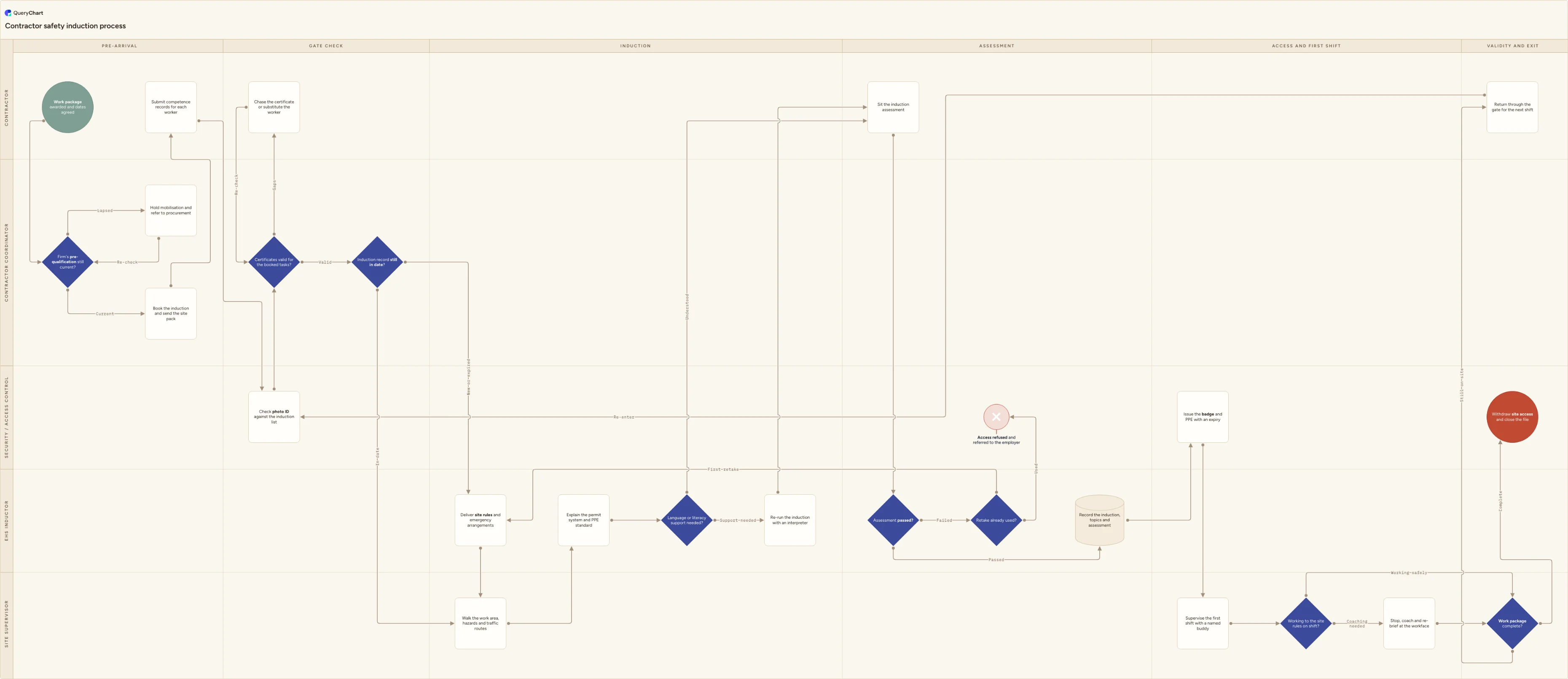
Contractor safety induction process flowchart (site access)
Contractor safety induction flowchart template: pre-qualification check, ID and certificate checks at the gate, site rules and emergency briefing, work area walk, assessment, badge issue with an expiry and supervised first shift.
What the contractor safety induction process flowchart (site access) process is
A contractor safety induction is the point at which a site takes responsibility for someone it does not employ. The trigger is ordinary: a work package has been awarded, the dates are agreed, and a crew is due at the gate on Monday morning. What happens between those two facts decides whether the people who arrive know where the muster point is, which vehicles use the road they are walking down, what the site's permit rules are, and who to tell when something is not as they were told it would be. The chart below follows one worker from the awarded package to the withdrawn pass: the firm's pre-qualification confirmed, the induction booked and a site pack sent out, photo identity and competence certificates checked at the gate, site rules and emergency arrangements briefed, the work area walked, permit and PPE requirements explained, understanding checked and assessed, a time-limited badge issued, a supervised first shift, and the re-entry check on every later shift that catches an induction quietly going out of date.
This chart starts after the firm has been selected and ends when its pass is handed back, which keeps two neighbouring processes off it. Contractor pre-qualification, the checks on a company's insurance, safety record, method statements and financial standing, happens before the first box and appears here only as the decision confirming that clearance is still current; if that decision fails routinely the problem sits in vendor onboarding rather than at the gate. The work itself is out of scope too: hot work, confined space entry, working at height and energy isolation are authorised through the permit-to-work system, and this chart only ensures the worker knows that system exists and who issues under it. Employee onboarding is a third process again, because a contractor never joins the payroll, the appraisal cycle or the internal training matrix. Treat the diagram as a starting point to be adapted under your own procedures, the regulations that apply where you operate and a competent person's review; an induction chart makes nobody compliant and does not replace site-specific arrangements.
Four decisions carry the process. 'Induction record still in date?' sits in the coordinator's lane at the gate rather than in the inductor's, because it is a records question asked on every entry and not once: a returning worker with a current record joins at the work area walk, while an expired record goes back through the full briefing. 'Language or literacy support needed?' sits with the EHS inductor and exists to stop the induction becoming a signature exercise, since information nobody understood was not information that was given. 'Assessment passed?' is what separates an induction from an attendance register, and its failure path runs into 'Retake already used?' so the retake rule is a written decision rather than an argument at the desk. 'Working to the site rules on shift?' sits with the site supervisor because a classroom is not where an induction is tested; the first shift is, and coaching at the workface is drawn as a normal outcome rather than a discipline step.
What this flowchart covers
In this template
- Five swimlanes (Contractor, Contractor coordinator, EHS inductor, Site supervisor and Security / access control) across six phases: pre-arrival, gate check, induction, assessment, access and first shift, and validity and exit
- A gate that can turn people away rather than a sign-in sheet: "Check photo ID against the induction list" comes before anything else, and "Certificates valid for the booked tasks?" routes a gap to "Chase the certificate or substitute the worker" instead of into the induction room
- "Induction record still in date?" splits new and returning workers: an expired or missing record runs the full briefing from "Deliver site rules and emergency arrangements", while a record still in date joins at "Walk the work area, hazards and traffic routes" so nobody skips the area brief
- A comprehension check rather than a signature: "Language or literacy support needed?" sends a worker to "Re-run the induction with an interpreter" before "Sit the induction assessment", because information nobody understood was never information that was given
- An assessment with a bounded retake: "Assessment passed?" fails into "Retake already used?", which either re-briefs the worker from the start of the induction or ends the chart at "Access refused and referred to the employer"
- Access treated as time-limited: "Issue the badge and PPE with an expiry" follows the induction record, "Supervise the first shift with a named buddy" leads into "Working to the site rules on shift?", and every later shift re-enters through the same gate check
When to use this template
- You are writing a contractor induction procedure and need one picture of who checks identity, who briefs, who assesses and who issues the pass
- Contractors are reaching the work area before anyone has walked it with them, and you want the area brief drawn as a step the process cannot skip
- Your access passes and your induction records carry different expiry dates, so people are on site on inductions that ran out months ago
- An incident involving a contractor has raised the question of what they were actually told, and the induction record cannot answer it
- A client, auditor or insurer has asked how you assure yourself that people you do not employ are competent and briefed before they start work
How it works
Rename the lanes to your roles
Replace Contractor, Contractor coordinator, EHS inductor, Site supervisor and Security / access control with the roles that genuinely exist on your site. On a small site the coordinator and the inductor are usually the same person, and security may be a receptionist with a visitor book, so merge those lanes rather than drawing a handoff nobody performs. Keep the contractor's own lane whatever else you merge: several steps are theirs to complete.
Write down what the gate actually checks
The gate check is only as good as the list behind it. Name the documents your site demands before anyone walks in: photo identity, the qualifications a task needs, medical or fitness declarations, and any scheme card your clients require. Say who verifies each one and against what, because a photograph of a card on a phone proves the card existed, not that it is still valid.
List the induction content and who owns each part
Split the induction into the parts a central briefing covers and the parts only the receiving area can. Emergency arrangements, site rules, permit types and PPE standards belong to the inductor; live hazards, traffic routes, adjacent operations and the people working nearby belong to the supervisor who owns the area. Writing that split down is what stops the area walk being dropped when the schedule is tight.
Set the assessment and the retake rule
Decide what the assessment tests and what a pass means. Emergency arrangements, stop-work authority and the permit rules are the usual core, and a spoken check often tells you more than a multiple-choice paper. Then write the retake rule onto the chart: how many attempts, what has to be re-briefed before the next one, and who may waive it. Left unwritten, the answer changes with whoever is at the desk.
Tie the badge expiry to the induction expiry
Set your own validity period and give the pass the same date as the induction behind it, not the end date of the contract. Then list the events that force a re-induction regardless of the date: a change to site rules or emergency arrangements, a new hazard or a new area, a long absence, or a serious incident. Say where both dates are held so the gate can see them.
Decide what the first shift is supervised against
Name what the supervisor is watching for on the first shift, such as PPE use, staying inside the assigned area, permit conditions and stop-work behaviour. Agree that coaching at the workface is the normal response and record what turns a repeat into a formal step. Then say when supervision drops back to routine, because a buddy arrangement nobody ends is one nobody keeps.
Walk it against a real contractor visit
Take two recent visits, one routine and one where somebody was turned away or sent back, and trace them through the chart with the coordinator, the inductor and the supervisor in the room. Steps people describe that the chart does not draw, and steps the chart draws that nobody performs, are the findings worth acting on before you publish it as your procedure.
Frequently asked questions
What are the steps in a contractor safety induction process?
A work package is awarded and the coordinator confirms the firm's pre-qualification is current, holding mobilisation and referring it back to procurement if it is not. The induction is booked, a site pack is sent, and the contractor submits competence records. At the gate, security checks photo identity against the induction list and the coordinator checks the certificates against the tasks booked, chasing a missing one or substituting the worker. A worker with no record, or an expired one, takes the full briefing: site rules and emergency arrangements, a walk of the work area and its traffic routes, then the permit system and PPE standard, re-run with an interpreter where support is needed. The worker sits an assessment; a fail runs through a retake rule that either re-briefs them or refuses access and refers them back to their employer. A pass is recorded with the topics covered, a badge and PPE are issued with an expiry, the first shift is supervised with a named buddy, and the pass is withdrawn when the work package is complete.
What is the difference between contractor pre-qualification and contractor induction?
Pre-qualification is about the company and induction is about the person. Pre-qualification happens once, before any work is awarded, and asks whether the firm is capable and insured: safety performance, competent management, method statements, references and financial standing. Induction happens for each individual before they set foot on the site, and asks whether this worker knows this site: its rules, its hazards, its emergency arrangements and the permits their task will need. The two fail in different ways, which is why they belong in different processes. A well pre-qualified firm can still send a worker who has never seen your site, and a thoroughly inducted worker can still belong to a firm whose insurance lapsed last month. This chart carries pre-qualification only as a decision at the top, confirming the clearance is still current before the induction is booked.
What should a contractor site induction cover, and is it a legal requirement?
The content is site-specific, but the recurring core is emergency arrangements, site rules and prohibitions, the hazards of the area the person will work in, traffic and pedestrian routes, welfare facilities, PPE standards, the permit-to-work system and how to stop work or raise a concern. The legal position depends on where you operate. In Great Britain, regulation 13(4) of the Construction (Design and Management) Regulations 2015 requires the principal contractor to ensure a suitable site induction is provided and that steps are taken to prevent access by unauthorised persons to the construction site. Outside construction, regulation 12 of the Management of Health and Safety at Work Regulations 1999 requires a host employer to give the employer of visiting workers comprehensible information on the risks arising from its undertaking and the measures taken. In the United States, 29 CFR 1926.21(b)(2) requires each employee to be instructed in the recognition and avoidance of unsafe conditions and the regulations applicable to their work environment. Have a competent person confirm what applies to you.
How long is a site induction valid and when is a re-induction needed?
There is no universal statutory validity period, so any duration you see quoted is a site rule rather than a legal one. Set your own, write it on the chart and give the access pass the same expiry, because a pass that outlives the induction behind it turns a controlled gate into a turnstile. Time is only one of the triggers. A re-induction or a targeted re-brief is normally warranted when the site rules or emergency arrangements change, when a new hazard or phase of work is introduced, when the worker moves to a different area or task, after a long absence, and after an incident that showed the original briefing did not land. This chart handles the routine case at the gate rather than in a calendar: every re-entry passes back through the identity check and the 'Induction record still in date?' decision.
Who is responsible for contractor competence, the site or the contractor's employer?
Both, for different things, and the split is worth writing into the procedure because it is where most arguments start. The contractor's employer owns the competence of its own people: trade qualifications, task training and fitness for the work. Where OSHA's process safety management standard applies, 29 CFR 1910.119(h)(3) places that duty explicitly on the contract employer, which must assure each contract employee is trained in the work practices needed to do the job safely, is instructed in the known potential fire, explosion or toxic release hazards and the applicable provisions of the emergency action plan, and follows the facility's safety rules. The host owns everything site-specific, and under 1910.119(h)(2) must inform contract employers of those known hazards and explain the applicable provisions of the emergency action plan. A scheme card is evidence of the employer's half, not a substitute for it: CSCS states that holding a card is not a legislative requirement and that it is for the principal contractor or client to decide whether workers must hold one.
Where this process fits
In most operations this process hands off to Toolbox talk process flowchart (daily pre-task safety briefing).
It is one step in Permit to work.
Step 1: Contractor safety induction process flowchart (site access) You are here
Contractor safety induction flowchart template: pre-qualification check, ID and certificate checks at the gate, site rules and emergency briefing, work area walk, assessment, badge issue with an expiry and supervised first shift.
Step 2: Toolbox talk process flowchart (daily pre-task safety briefing)
Toolbox talk flowchart template: topic from the talk plan or a recent incident, controls from the risk assessment, the talk delivered at the workface, issues fixed, logged or stopped, attendance recorded.
Step 3: Permit to work process flowchart (issue, suspend, hand back)
Step 4: Gas testing process flowchart (permit-to-work atmospheric testing)
Step 5: Stop work authority process flowchart (stop to resumption)