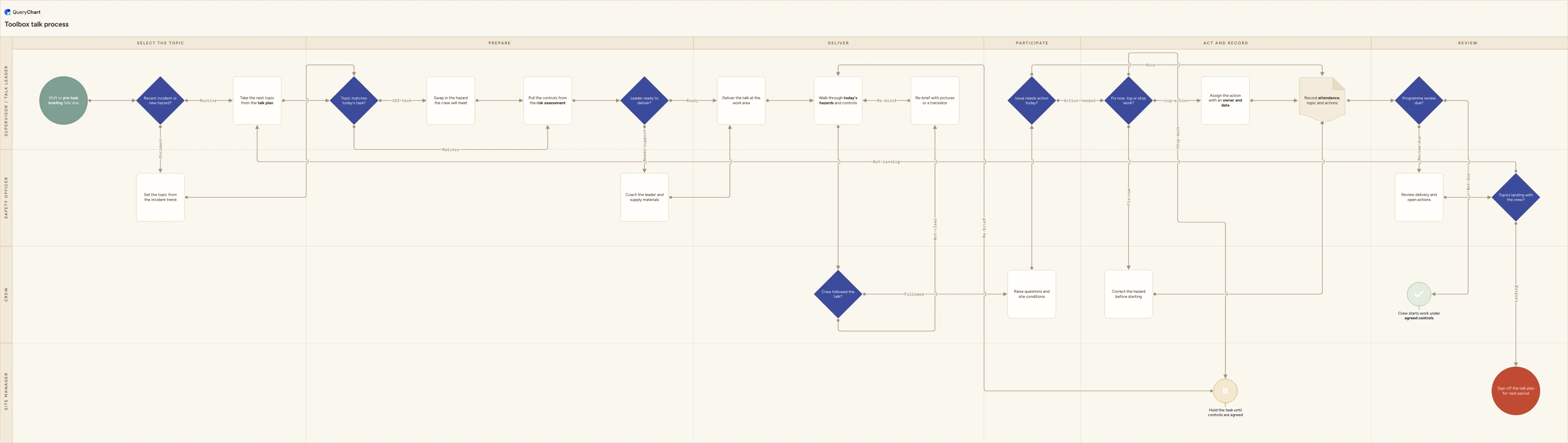
Toolbox talk process flowchart (daily pre-task safety briefing)
Toolbox talk flowchart template: topic from the talk plan or a recent incident, controls from the risk assessment, the talk delivered at the workface, issues fixed, logged or stopped, attendance recorded.
What the toolbox talk process flowchart (daily pre-task safety briefing) process is
A toolbox talk is a short safety briefing held with a crew at the place the work is about to happen, usually at the start of a shift or immediately before a task. It is not a course and it is not a lecture: a few minutes on one topic, tied to what the crew will do that day, with time for them to say what the plan does not cover. The trigger is either the talk plan coming round or something that has just changed on site, and the chart below follows one talk end to end. The topic is chosen, checked against today's task and backed by controls already written into the risk assessment. The leader is supported if they need it. The talk is delivered at the work area, understanding is checked, and the crew raises questions and the site conditions the plan did not anticipate. Whatever they raise is routed to a fix, an action or a hold, the attendance and the issues are recorded, and the programme is reviewed periodically against what is actually changing on site.
This chart covers the recurring briefing given to a crew that is already inducted and already competent. It is not induction: checking identity, certificates and site rules before someone is allowed on site for the first time is contractor safety induction, a one-off gate with an expiry date rather than a daily conversation. It is not competence training either, and a talk should never be the place a skill is taught for the first time. The 'Stop work' branch is a handoff rather than a process: once a job is held because it is unsafe, stop work authority takes over, with its own escalation, its own protection for the person who stopped the work and its own record. Anything the crew reports that has already happened belongs to near miss reporting instead. Keeping those boundaries visible is what stops a short briefing becoming an untracked substitute for training, permits and investigation. Treat the chart as a starting point to adapt under your own procedures, the regulations that apply where you work and competent-person review.
Four decisions carry the process. 'Topic matches today's task?' is the one that separates a talk from a formality, because a scheduled sheet on a hazard nobody will meet today teaches the crew that the exercise is paperwork. 'Crew followed the talk?' sits in the Crew lane rather than the leader's on purpose: the person who delivered the talk is a poor judge of whether it landed, and language, literacy and agency labour are the usual reasons it did not. 'Fix now, log or stop work?' is where most of the value sits, because a briefing that surfaces an issue and then does nothing with it is worse than one that surfaces nothing at all. And 'Topics landing with the crew?' closes the loop, feeding repeat findings back onto the talk plan so the programme is judged on what changes on site rather than on the number of sheets filed.
What this flowchart covers
In this template
- Four swimlanes (Supervisor / talk leader, Crew, Safety officer and Site manager) across six phases: select the topic, prepare, deliver, participate, act and record, and review, so the briefing has an owner at every step
- A "Recent incident or new hazard?" decision at the top, so the topic either comes off the talk plan in sequence or is set from the incident trend by the safety officer when something on site has just changed
- The preparation half that most toolbox talk charts skip: a "Topic matches today's task?" decision that swaps a scheduled sheet for the hazard the crew will actually meet, and controls lifted from the risk assessment rather than invented at the tailgate
- A "Crew followed the talk?" check owned by the crew rather than the leader, with a "Re-brief with pictures or a translator" loop for the language, literacy and agency-labour differences a signature sheet hides
- A "Fix now, log or stop work?" decision that routes what the crew raises three ways: corrected before starting, assigned as an action with an owner and a date, or the task held in the Site manager lane until controls are agreed
- Closure on evidence: "Record attendance, topic and actions" as a document, then either "Crew starts work under agreed controls" or a periodic "Topics landing with the crew?" review that sends a repeating hazard back onto the talk plan
When to use this template
- You are writing a toolbox talk procedure and need one picture of who chooses the topic, who delivers it, who records it and what happens to whatever the crew raises
- Talks are being signed but not held, and you need the attendance sheet to sit downstream of a real discussion rather than stand in for one
- Issues raised at the tailgate go nowhere, so the fix-now, log-it and stop-work routes need to be explicit and owned by a named role
- You run multilingual or agency crews and want the comprehension check and the re-brief drawn into the process rather than left to whoever is leading
- A client, auditor or certification body has asked for a documented description of how safety briefings are planned, delivered, recorded and reviewed
How it works
Rename the lanes to your roles
Replace Supervisor / talk leader, Crew, Safety officer and Site manager with the roles that genuinely exist on your sites. On a small site the safety officer is often a visiting adviser or a head office function rather than someone present at the talk, so move their steps or merge the lane rather than drawing a handoff that never happens.
Set your own topic source and frequency
State where topics come from, who owns the talk plan and how often a talk is held. Frequency is a jurisdiction and contract question rather than a universal rule: in California, construction supervisory employees must hold toolbox or tailgate meetings, or equivalent, at least every ten working days, while many client contracts require one every shift. Write the rule that binds you onto the chart.
Write the topic-to-task rule on the chart
Decide what makes a scheduled topic wrong for today and who may swap it. The usual rule is that the talk covers a hazard the crew will meet on this shift and the controls already assessed for it. Name the document the leader pulls those controls from, whether that is the risk assessment, the method statement or the permit.
Name your comprehension check
Decide how the leader confirms the talk landed without turning it into a test. Asking one person to say back the control in their own words works better than asking whether anyone has questions. Record what triggers the re-brief for you: shared language, literacy, hearing protection, a noisy workface, or new agency labour on the crew that morning.
Agree the fix-now, log and stop-work routes
Set the rule for what the crew raises before you need it. Agree what may be corrected on the spot, what becomes an action with an owner and a due date, and what holds the task. Name who may hold work, who agrees the controls that release it, and where a held task hands over to your stop work authority procedure.
Define the record and where it is kept
List what the record must carry: date and time, topic, who led it, who attended, what the crew raised and what was agreed. Say where it is filed and how long it is kept. A record that captures attendance but never an issue tells a reviewer that the talks are being signed rather than held, so make the issues field part of the form.
Walk it against last week's talks
Take a handful of completed sheets, including one from a shift that started late, and trace them through the chart. Any step people describe that is not drawn, or drawn but skipped in practice, is the finding worth acting on before you publish. Check that every action raised has an owner and an outcome you can point at.
Frequently asked questions
What are the steps in a toolbox talk process?
A talk falls due at shift start or before a task. The topic comes from the talk plan, or from the incident trend when something on site has just changed. The leader checks the topic against today's work, swaps it if the crew will not meet that hazard, and pulls the controls from the risk assessment; a leader who needs support is coached by the safety officer. The talk is delivered at the work area, the hazards and controls for today are walked through, and understanding is checked, with a re-brief using pictures or a translator if needed. The crew then raises questions and site conditions. Anything raised is corrected before work starts, assigned as an action with an owner and a date, or holds the task until controls are agreed. Attendance, topic and actions are recorded, work starts under the agreed controls, and the delivery, open actions and talk plan are reviewed periodically.
How often should toolbox talks be held?
There is no universal frequency; it depends on where you work and what your contract says. Federal OSHA has no standard requiring a toolbox talk by name or setting an interval. The underlying construction duty is 29 CFR 1926.21(b)(2): the employer must instruct each employee in the recognition and avoidance of unsafe conditions and the regulations applicable to their work environment. California is more specific: under title 8 section 1509(e), supervisory employees must conduct toolbox or tailgate safety meetings, or equivalent, with their crews at least every ten working days. In Great Britain the duty sits in section 2(2)(c) of the Health and Safety at Work etc. Act 1974, which requires information, instruction, training and supervision so far as is reasonably practicable, but names no frequency. Many principal contractors require one every shift, so work from the rules that bind you.
What is the difference between a toolbox talk, a pre-task briefing and safety training?
The three differ in purpose, length and evidence. Safety training builds competence: it is planned, assessed, and produces a qualification or a training record that says a person may do the work. A toolbox talk maintains awareness among people who are already competent, covering one topic in a few minutes and, importantly, giving the crew a chance to speak. A pre-task or pre-start briefing is narrower still: it covers the specific job about to be done, the sequence, the controls and who is doing what, and it is repeated whenever the task or the team changes. Many sites merge the last two into a single daily conversation, which is what this chart draws, and that is a reasonable choice. The failure to avoid is using any of them to certify a skill. If the talk is the first time someone hears how to do the task safely, the problem is a training gap, not a briefing gap.
Who should deliver a toolbox talk, the supervisor or the safety officer?
The supervisor who owns the work is usually the right person, and the chart puts delivery in their lane for that reason. They know the task, they are accountable for how it is done, and a crew reads who delivers the talk as a signal about who owns safety on that job. A safety officer delivering every talk quietly moves that ownership away from the line, and it is difficult to reverse afterwards. The safety officer's role in this chart is different and just as necessary: setting the topic when the incident trend calls for it, coaching a leader who is not confident, and reviewing whether the programme is landing. Confidence is the practical constraint. A supervisor who has never led a talk should be coached, given the material and, on the first few, supported at the workface rather than left to it.
What records should a toolbox talk produce, and what will an auditor look for?
At a minimum, record the date and time, the topic, who led the talk, who attended, what the crew raised and what was agreed, including any action with an owner and a due date. Keep it for whatever period your procedure or contract specifies. What a reviewer looks at is not the signatures but the discussion: a year of sheets that never records an issue, or a stack of actions with no closure, both say the meeting is being documented rather than held. If you run an ISO 45001:2018 system, this process is one of the visible ways you meet clause 5.4 on consultation and participation of workers, clause 7.3 on awareness, which covers making workers aware of the hazards and risks relevant to them and of their ability to remove themselves from work presenting imminent and serious danger, and clause 7.4 on communication.
Where this process fits
In most operations this process follows Contractor safety induction process flowchart (site access) and hands off to Permit to work process flowchart (issue, suspend, hand back).
It is one step in Permit to work.
Step 1: Contractor safety induction process flowchart (site access)
Contractor safety induction flowchart template: pre-qualification check, ID and certificate checks at the gate, site rules and emergency briefing, work area walk, assessment, badge issue with an expiry and supervised first shift.
Step 2: Toolbox talk process flowchart (daily pre-task safety briefing) You are here
Toolbox talk flowchart template: topic from the talk plan or a recent incident, controls from the risk assessment, the talk delivered at the workface, issues fixed, logged or stopped, attendance recorded.
Step 3: Permit to work process flowchart (issue, suspend, hand back)
Permit to work process flowchart template: screening, risk assessment, permit type, isolation and proving, second signature, issue and display, suspension, shift handover, hand-back and cancellation.
Step 4: Gas testing process flowchart (permit-to-work atmospheric testing)
Step 5: Stop work authority process flowchart (stop to resumption)