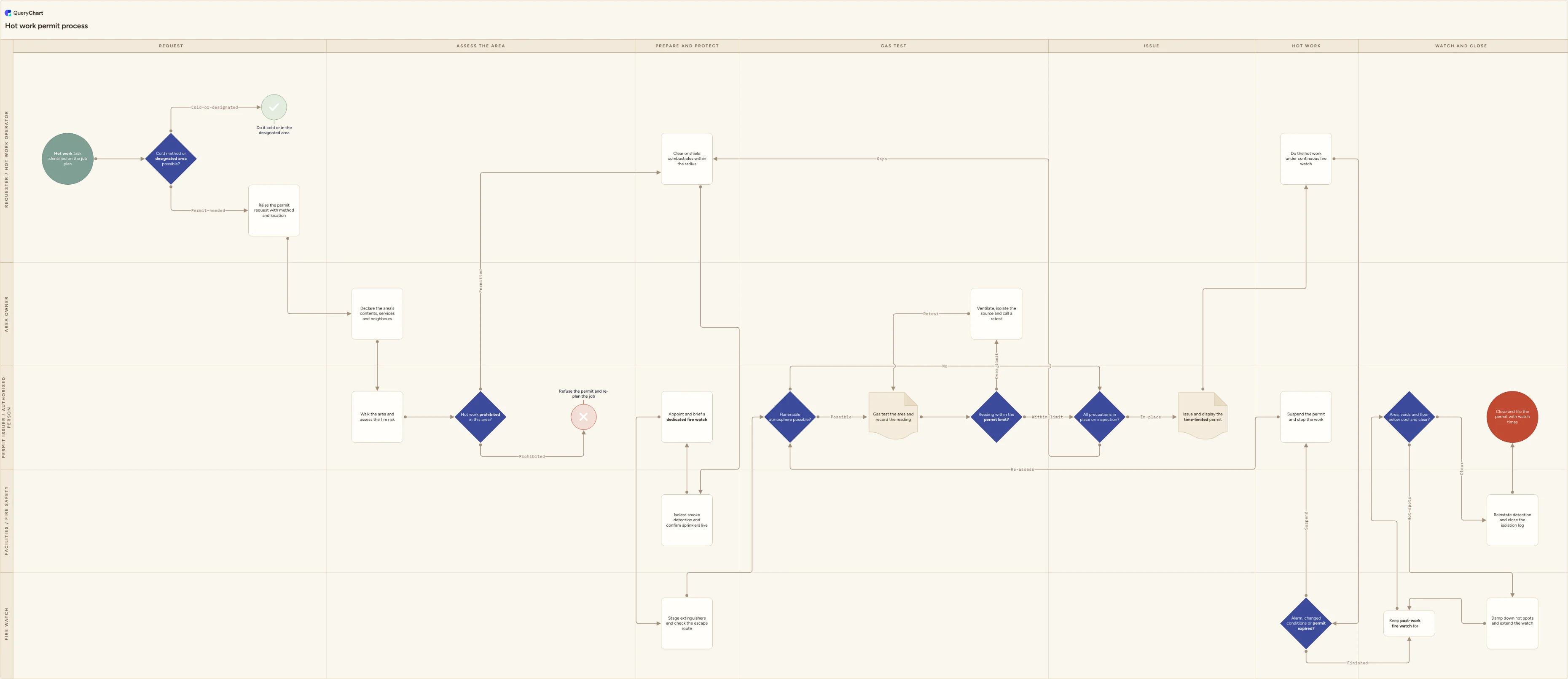
Hot work permit process flowchart (welding, cutting and grinding)
Hot work permit process flowchart template: cold-method challenge, area fire risk assessment, combustibles cleared, fire watch appointed, gas test, time-limited permit, suspension on alarm, post-work watch and closure.
What the hot work permit process flowchart (welding, cutting and grinding) process is
Hot work is any job that produces a flame, sparks or enough heat to ignite what is nearby: welding, oxy-fuel cutting, grinding, brazing, soldering, torch-applied roofing. It is a classic cause of fire because the fire it starts is usually not at the work point but in a wall void, a duct, packaging on the floor below, or insulation that smoulders for an hour before it flares. The permit exists to make someone other than the person holding the torch look at the area first, decide what has to be moved, covered, isolated or tested, and then stay and watch after the torch is off. The chart below follows one job from the job plan to closure: the challenge to do it cold or in a designated area, the area owner's briefing and the issuer's fire risk assessment, combustibles cleared, detection isolated, a fire watch appointed, extinguishers staged, a gas test where a flammable atmosphere is credible, a time-limited permit, the work under continuous fire watch with a suspension path, the post-work watch, the re-inspection of voids and the floor below, and the permit closed with its watch times.
This is the hot work permit on its own, not the permit-to-work system around it. A general permit-to-work process decides which jobs need which permit type, sets the issuing, performing and isolating roles, and handles shift handover and cross-referencing. It is also not a site-specific hot work SOP — a ship repair procedure built around a gas-free engineer and a dock master — which fixes its own roles and readings; this chart assumes the permit-to-work structure, keeps the roles generic and draws only the fire-specific gates hot work adds. It is not a confined space entry, with its attendant, rescue plan and monitoring. A real alarm leaves this chart for the emergency process; the permit is suspended. In the United States the references are OSHA 29 CFR 1910.252 and NFPA 51B; in England and Wales the Regulatory Reform (Fire Safety) Order 2005 puts the fire risk assessment duty on the responsible person. The template is a starting point to be adapted under your organisation's own procedures, the regulations that apply to the site and competent-person review; it replaces none of them.
Seven decisions punctuate the chart, and four of them carry it. 'Cold method or designated area possible?' sits in the requester's own lane because the cheapest control is to remove the ignition source entirely: bolt instead of weld, cold-cut instead of torch, or carry the part to the workshop bay whose standing precautions already exist. 'Hot work prohibited in this area?' is the issuer's, and it produces a refusal rather than a longer list of conditions, because an explosive atmosphere or impaired sprinklers are not things a permit can compensate for. 'Alarm, changed conditions or permit expired?' sits in the fire watch's lane rather than the operator's on purpose: the person with the torch is looking at the weld, and the fire watch is the only person whose whole job is looking everywhere else. 'Area, voids and floor below cool and clear?' comes after the post-work watch, not instead of it, and the loop back through damping down is what turns a fire watch period from a timer into an inspection.
What this flowchart covers
In this template
- Five swimlanes (Requester / hot work operator, Fire watch, Permit issuer / authorised person, Area owner and Facilities / fire safety) across seven phases: request, assess the area, prepare and protect, gas test, issue, hot work, and watch and close
- A 'Cold method or designated area possible?' challenge before anything else, so a job that can be bolted, cold-cut or carried to the workshop bay ends the chart at 'Do it cold or in the designated area' without a permit, a fire watch or an alarm isolation
- The assessment as a two-lane handoff: the area owner declares the area's contents, services and neighbours, the issuer walks it and assesses the fire risk, and 'Hot work prohibited in this area?' refuses the permit outright where the atmosphere, the sprinklers or the stock make conditions pointless
- Preparation split by who owns it: the operator clears or shields combustibles within the radius, Facilities isolates smoke detection and confirms sprinklers live, the issuer appoints and briefs a dedicated fire watch, and the fire watch stages extinguishers and checks the escape route
- A 'Flammable atmosphere possible?' gate that adds a gas test only where one is credible, with 'Reading within the permit limit?' looping through ventilate, isolate the source and retest, then 'All precautions in place on inspection?' sending gaps back to the combustibles step before the time-limited permit is issued
- Continuous fire watch with 'Alarm, changed conditions or permit expired?' owned by the fire watch, a suspension that returns to re-assessment rather than restarting on the operator's word, a post-work watch, 'Area, voids and floor below cool and clear?' with a damp-down loop, and the permit closed with its watch times
When to use this template
- You are writing or rewriting a hot work procedure and need one picture of who challenges the job, who assesses the area, who watches and who signs the permit closed
- Your insurer has asked how hot work by staff and contractors is authorised on site, and a stack of signed forms does not show the gates a permit has to pass through
- A fire or near miss started after the work was declared finished, and you want the post-work watch, the re-inspection and the closure drawn as separate, owned steps
- Contractors are welding, cutting or torching roofing on your premises and their permit has to fit your area owners, your alarm isolation rules and your fire safety team
- You are moving hot work permits from a carbon pad to a digital system and want the workflow, the expiry and the suspension rules agreed before the form is built
How it works
Rename the lanes to your roles
Replace Requester / hot work operator, Fire watch, Permit issuer / authorised person, Area owner and Facilities / fire safety with the roles that exist on your site. NFPA 51B calls the issuer the permit authorizing individual (PAI), as NFPA spells it; a UK permit-to-work system calls the same role the issuing authority. What matters is that the person doing the work and the person authorising it are different, and that the fire watch is neither.
Write down what counts as hot work
List the tasks your permit covers: welding, oxy-fuel and plasma cutting, grinding, brazing, soldering, torch-applied roofing, heat guns, and anything else that makes a flame, sparks or ignition-level heat. Then name your designated hot work areas, if you have any, and the standing precautions that let work there proceed without a permit. The first decision on the chart only works if both of those lists are written down.
Set the radius and the prohibited-area list
Put a number on 'Clear or shield combustibles within the radius'. OSHA 29 CFR 1910.252 requires combustibles relocated at least 35 ft (10.7 m) from the work site where practicable, and covers floor and wall openings and floors below separately; NFPA 51B puts the 35 ft as a radius in all directions; your procedure may go further. Then write what makes the issuer refuse outright: a flammable atmosphere, impaired sprinklers or bulk ignitable stock.
Decide when a gas test is required and the limit
State which locations make a flammable atmosphere credible (tanks, pits, drains, fuel systems, spaces that have held flammable liquids or gases, dusty processes) so that 'Flammable atmosphere possible?' is answered from a list rather than a hunch. Record the permit limit as a percentage of the lower explosive limit and the retest frequency, and name who is authorised to hold the instrument. The full gas testing procedure sits outside this chart.
Fix the permit validity and the suspension rule
Decide how long a permit may run before it expires, whether a shift change ends it, and who may extend it after a fresh inspection, and list the equipment and competence checks the issuer signs off. Then write what suspends it: the building alarm, sparks somewhere unplanned, a change in the area, or the fire watch calling a halt. A suspended permit returns to 'Flammable atmosphere possible?' for re-assessment; move that point to fit your rule.
Set the post-work watch period and the closure record
Write the number of minutes into 'Keep post-work fire watch for the set period'. OSHA requires at least half an hour, NFPA 51B has required a minimum of 60 minutes since its 2019 edition, and UK insurer guidance recommends 60 minutes in high-hazard areas; the FAQ below has the detail. Then list what the closed permit must carry: the gas test readings, the watch start and end times, the re-inspection result and the detection reinstatement.
Walk it against a real permit
Take two or three closed permits, including one that was suspended or one issued to a contractor, and trace them through the chart. Any step people describe that is not drawn, or drawn but skipped in practice (the fire watch who was also grinding, the permit that ran for three days), is the finding to fix before the chart becomes the procedure.
Frequently asked questions
What are the steps in a hot work permit process?
The job is challenged first: can it be done cold, or in a designated hot work area that needs no permit? Otherwise the requester raises the request, the area owner declares what the area holds, and the issuer assesses the fire risk, refusing outright where hot work is prohibited. Combustibles in the radius are cleared or shielded, detection isolated and sprinklers confirmed live, a fire watch appointed, extinguishers staged and the escape route checked, then a gas test where a flammable atmosphere is possible, retested after ventilation if over the limit. The issuer inspects and issues a time-limited permit. The work runs under continuous fire watch; an alarm, changed conditions or expiry suspends it. Afterwards the watch runs for the set period, the area, voids and floor below are re-inspected and damped down if needed, detection reinstated and the permit closed with its watch times.
What counts as hot work, and when is a permit not needed?
Hot work is any operation that produces an open flame, sparks or enough heat to ignite nearby material: arc and gas welding, oxy-fuel and plasma cutting, grinding, brazing, soldering, torch-applied roofing. Two situations take a job out of the permit. The first is a cold method that does the same job without an ignition source: a bolted or clamped connection, a cold saw or hydraulic cutter, a section pre-fabricated off site. The second is a designated hot work area, which NFPA 51B describes as an area designed or approved for hot work — a maintenance shop or a detached outside location of noncombustible or fire-resistive construction, essentially free of combustible and flammable contents and suitably segregated from adjacent areas. Work there still has standing precautions; it just needs no permit for each job. Everything else is a permit-required area and goes through the chart.
How long should the fire watch continue after the work stops?
Long enough to catch the fire that starts late in a void, in smouldering insulation or on the floor below. The minimums differ by reference. OSHA 29 CFR 1910.252 requires a fire watch for at least half an hour after welding or cutting is completed. NFPA 51B raised its minimum to 60 minutes in the 2019 edition and added a fire monitoring period of up to three further hours at the discretion of the permit authorizing individual; the 2024 edition allows that individual to reduce it to no less than 30 minutes in the circumstances the standard defines. In the UK, the RISCAuthority RC7 guidance recommends a continuous fire watch of 60 minutes after work in a high-hazard area, or the period the fire risk assessment determines. Your procedure sets the number and the permit records the start and end times; the chart's 'Keep post-work fire watch for the set period' is its placeholder.
How is a hot work permit different from a general permit to work?
A permit-to-work system is the management framework: it decides which jobs need formal authorisation, which permit type applies, who may issue, perform and isolate, and how permits cross-reference and hand over between shifts. A hot work permit is one permit type inside that framework, and it adds the controls that are specific to an ignition source: a challenge to avoid the hot work altogether, a fire risk assessment of the area and not just of the task, a radius within which combustibles are cleared or shielded, isolation of detection so the alarm is not raised by the work itself, a dedicated fire watch, a gas test where a flammable atmosphere is credible, and a watch that outlasts the work. On a site with a mature permit-to-work system this chart is the hot work branch; on a site without one it is often the first permit written, because fire is the failure everyone can picture.
Who issues a hot work permit, and what do insurers and inspectors expect to see?
The issuer is a named, trained person who is not doing the work: NFPA 51B calls them the permit authorizing individual; UK permit-to-work guidance calls the equivalent the issuing authority. OSHA 29 CFR 1910.252 requires the area to be inspected by the individual responsible for authorising cutting and welding, who designates the precautions, preferably as a written permit. An insurer's surveyor or fire inspector wants the record of the gates, not a signature alone: the permit with its location, method, start and expiry, the precautions, equipment and competence checked off, any gas test reading, the name of the fire watch, the post-work watch times, the re-inspection and who closed it. They also look for the failures the chart draws: permits issued for days, fire watches with a second job, detection isolated and never reinstated, and contractor paperwork nobody on site reviewed.