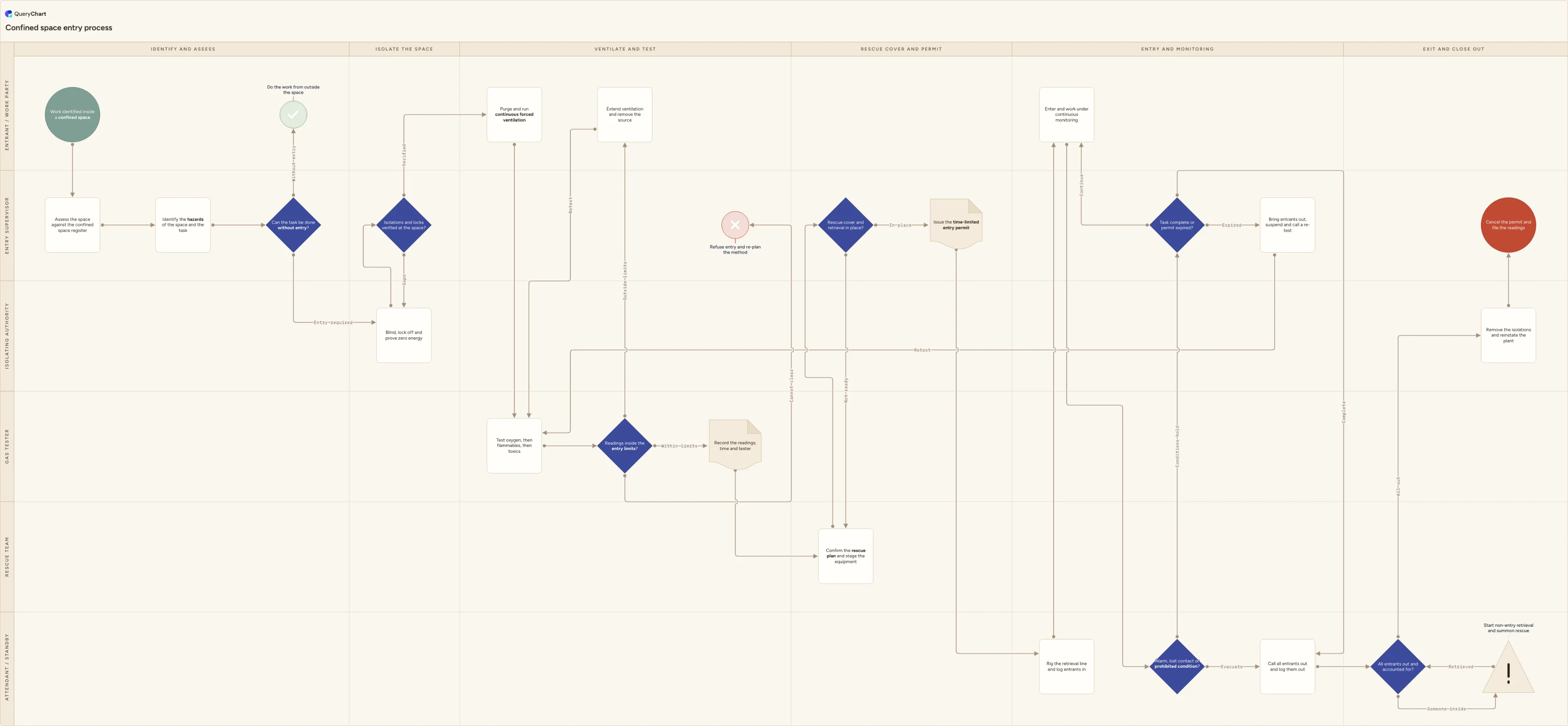
Confined space entry process flowchart (permit-required entry)
Confined space entry flowchart template: the avoid-entry test, isolation and lock-off, ventilation, gas testing, rescue cover, permit issue, attendant and monitoring, evacuation, headcount and permit cancellation.
What the confined space entry process flowchart (permit-required entry) process is
A confined space is an enclosure — a tank, a silo, a sewer, a pit, a duct, an unventilated plant room — where the danger comes from the enclosure itself rather than from the task being done inside it. The trigger for this process is a job that cannot be finished from outside: cleaning a vessel, freeing a blockage, welding a repair, recovering a dropped tool. The chart below follows one entry from the moment the space is identified to the moment the permit is cancelled: identifying the hazards of the space and the task, the test of whether entry can be avoided at all, isolation of every line and drive feeding the space, purging and forced ventilation, atmospheric testing in the order oxygen first, then flammables, then toxics, the rescue arrangement confirmed and staged, a time-limited permit issued, entry under continuous monitoring with an attendant posted outside, the evacuation call, the headcount on the way out, de-isolation and the filed record.
This chart is the entry itself, not the wider permit system and not the work done inside. A site's permit to work process governs how permits are raised, coordinated and cross-referenced, and keeps a confined space entry from running alongside hot work; that coordination sits outside this chart. Gas testing has its own procedure for instrument selection, bump tests and calibration, and this chart consumes its result rather than describing it. The job inside the space — the welding, the cleaning, the inspection — carries its own method statement. Nor is this a site-specific standard operating procedure: a yard or plant SOP names its own spaces, qualified people and equipment, where this chart is the generic decision path those procedures must satisfy. The boundary matters because confined space accidents are rarely caused by the task: they are caused by the atmosphere, a failed isolation, or a rescue nobody arranged. Treat the chart as a starting point to adapt under your own procedures and applicable regulations, reviewed by a competent person before anyone works to it.
Four decisions carry the chart. 'Can the task be done without entry?' comes first because avoiding entry is the strongest control available, and in Great Britain it is a legal test rather than a preference: regulation 4 of the Confined Spaces Regulations 1997 allows entry only where it is not reasonably practicable to achieve the purpose without entering. 'Readings inside the entry limits?' sits in the Gas tester lane and carries three branches, because a bad reading is usually a ventilation problem to be fixed and retested, and only sometimes a space that cannot be cleared at all. 'Rescue cover and retrieval in place?' is deliberately separate from issuing the permit, since a permit records that the space was assessed, not that somebody is standing outside able to get an entrant out. And 'Alarm, lost contact or prohibited condition?' sits in the Attendant / standby lane rather than the supervisor's, because the person watching the hatch has to be able to order an evacuation without asking anyone first.
What this flowchart covers
In this template
- Six swimlanes (Entrant / work party, Attendant / standby, Entry supervisor, Gas tester, Isolating authority and Rescue team) across six phases: identify and assess, isolate the space, ventilate and test, rescue cover and permit, entry and monitoring, and exit and close out
- A "Can the task be done without entry?" gate before any preparation begins, with a terminal branch to "Do the work from outside the space" — camera survey, external nozzle, long-reach tool — so the cheapest control is a drawn outcome rather than an afterthought
- Isolation as its own phase in its own lane: "Blind, lock off and prove zero energy" is followed by an "Isolations and locks verified at the space?" check that loops straight back when something is missing, so nobody ventilates a vessel still connected to a live line
- A testing sequence that names its own order, "Test oxygen, then flammables, then toxics", feeding a three-branch "Readings inside the entry limits?" decision that separates a retest after more ventilation from a space that cannot be cleared and is refused
- Rescue treated as a precondition rather than a formality: "Confirm the rescue plan and stage the equipment" and a "Rescue cover and retrieval in place?" decision that holds entry until cover is in position, both sitting before "Issue the time-limited entry permit"
- Live entry controls in the attendant's lane, where "Alarm, lost contact or prohibited condition?" can order an evacuation at any moment, an expired permit brings everyone out and routes back to a re-test, and "All entrants out and accounted for?" gates de-isolation and permit cancellation
When to use this template
- You are writing or rewriting a confined space entry procedure and need one picture of who tests, who watches, who issues the permit and who performs a rescue
- Entries at your site run on a permit form alone, and you want the decisions behind the signatures drawn out — avoid entry, atmosphere, rescue readiness — rather than implied by boxes on a page
- An entry was made on a permit issued before the rescue team was in position, or on readings taken at the hatch rather than at depth, and you need the order of those gates drawn rather than assumed
- You are training new entrants, attendants and entry supervisors and need one page showing where each role's authority begins and ends
- An auditor, client or enforcing authority has asked to see the documented system of work behind your entries, not just a folder of completed permits
How it works
Rename the lanes to your roles
Replace Entrant / work party, Attendant / standby, Entry supervisor, Gas tester, Isolating authority and Rescue team with the titles your site actually uses: top man, hole watch, permit issuer, authorised person, gas-free engineer. Where one person genuinely holds two of these roles, say which two and write down what happens on the shift when both are needed at once.
Write your avoid-entry test onto the first decision
State what has to be considered before entry is agreed: remote inspection, external cleaning, fixed sampling points, long-reach tooling, and design changes that remove the need to go in permanently. Name who is allowed to conclude that entry is unavoidable and where that conclusion is recorded. This is the only control that removes the hazard rather than managing it.
Set your isolation standard
Record what counts as isolation for each type of space: blinds and spectacle plates, removed spools, double block and bleed, locked valves, electrical lock-off, and how stored energy in agitators, pressure and suspended loads is proved dead. Say who applies the locks, who verifies them at the space itself, and who is allowed to remove them.
Put your own atmospheric limits on the test decision
The chart says 'Readings inside the entry limits?' rather than naming numbers, because the acceptable range depends on your jurisdiction, the substances involved and the work being done. Write your limits, your instrument, your pre-use bump test and your sampling depths into that row's comment so the decision is a reading against a number, not a judgement that shifts with whoever is on shift.
Name the rescue arrangement and time it
Write down who performs a rescue, what equipment is staged at the hatch, how the entrant is attached to it, and how long it takes that team to reach somebody who has collapsed. If the arrangement relies on an outside service, record their response time and their confined space capability, and verify both rather than assuming them.
Fix the permit duration and the evacuation triggers
Decide how long a permit may run, what forces a re-test — a shift change, a break in ventilation, a change in the work or in the weather — and which conditions oblige the attendant to order everybody out. List those triggers explicitly. An attendant who has to reason from first principles will hesitate, and hesitation is the failure mode this step exists to remove.
Walk it against a real entry
Take two recent entries, one routine and one that was stopped or delayed, and trace them box by box with the people who were there. Anything they describe that is not drawn, and anything drawn that is quietly skipped in practice, is the finding worth acting on before you publish the chart or build a permit form from it.
Frequently asked questions
What are the steps in a confined space entry process?
The space is assessed against the confined space register and hazards identified, and the first decision asks whether the task can be done without entry — if so, the work is done from outside and the process ends. If entry is unavoidable, every line and drive feeding the space is blinded, locked off and proved dead. The space is purged, put on continuous forced ventilation, and tested for oxygen, then flammables, then toxics. In-limit readings are recorded; out-of-limit readings send the job back for a retest, and a space that cannot be cleared is refused. Rescue cover and retrieval are staged before a time-limited permit is issued. The attendant logs entrants in; work runs under continuous monitoring, an evacuation can be ordered at any point, and an expired permit sends the job back for a re-test. On completion the headcount is checked, the isolations removed and the permit cancelled.
What is the difference between a confined space and a permit-required confined space?
Under the US general industry standard, 29 CFR 1910.146, a confined space is one large enough for an employee to bodily enter and perform assigned work, with limited or restricted means of entry or exit, and not designed for continuous occupancy. It becomes a permit-required confined space when it also has one or more of a short list of characteristics: an actual or potential hazardous atmosphere, a material with the potential to engulf an entrant, an internal configuration that could trap or asphyxiate, or any other recognised serious hazard. That distinction decides whether a permit applies. Great Britain reaches a similar place by another route: the Confined Spaces Regulations 1997 turn on the presence of a specified risk rather than a permit classification. Either way the call is made and recorded by a competent person, not inherited from what the space is called.
What does the attendant do, and can they enter to help an entrant?
The attendant stays outside for the whole entry. Under 29 CFR 1910.146 the attendant knows the hazards of the space, keeps an accurate count of who is inside, stays in contact with entrants, watches conditions inside and outside the space, orders an evacuation when a dangerous condition appears, summons rescue, and performs non-entry rescue — working the retrieval line from outside — under the employer's rescue procedure. Entering the space to reach a downed entrant is not on that list: under 1910.146(i)(4) the attendant stays outside until relieved by another attendant, and may only enter if trained and equipped for rescue. NIOSH's long-standing alert on confined space fatalities found that more than 60 per cent of the deaths were would-be rescuers, which is why this chart puts non-entry retrieval in the attendant's own hands, backed by a summoned rescue team.
How long should an entry permit last, and what has to be recorded?
The permit is time-limited on purpose: under 29 CFR 1910.146 the duration must not exceed the time required to complete the assigned task, so the entry supervisor only ever vouches for conditions they have actually verified. Sites commonly force a re-test and re-issue at a shift change, after a break in ventilation, or when the work changes. The permit records the space and purpose of entry, the date and authorised duration, the entrants, attendant and entry supervisor, the hazards, isolation and control measures, acceptable entry conditions, test results with the time and tester, the rescue arrangement and how to summon it, and any other permit running alongside. The cancelled permit is then retained for at least a year under the US standard, precisely so the permit space programme can be reviewed against those cancelled permits within a year of each entry.
Is a rescue plan that says 'call the emergency services' good enough?
No, and both major regimes say so directly. The HSE's Approved Code of Practice for the Confined Spaces Regulations 1997, L101, states that reliance on the emergency services alone will not be sufficient to comply with those regulations, and that employers must put adequate emergency arrangements in place before the work starts. The US standard arrives from the other direction: an employer using an off-site rescue service must evaluate its ability to respond in a timely manner and to perform the rescue, and a retrieval system must be used whenever an authorised entrant enters unless it would increase the overall risk or would not contribute to the rescue. The practical test is a stopwatch: how long from the alarm to hands on the entrant, and whether they survive that interval. If the answer depends on a service that still has to be called, briefed and equipped, it is not yet a plan.