Shipyard subcontractor onboarding SOP: induction to checkout
A shipyard subcontractor onboarding SOP for ship repair yards: document and insurance verification, a pass/fail safety induction, access and PPE issue, a hot work or confined space permit decision, supervised work and checkout.
What the shipyard subcontractor onboarding SOP: induction to checkout process is
FAYARD runs subcontractor labour through the yard every week: welders, riggers, blasters, electricians and hydraulics specialists moving between dry docks, cranes, workshops and repair berths that are also carrying the yard's own mechanical, electrical and hydraulic crews on the same hull. None of that work is credentialed by the vessel's owner or by the subcontractor's home office; it is credentialed by FAYARD, at the gate, before anyone crosses from the quay onto a berth. A subcontractor onboarding SOP exists because that credentialing has three separate failure modes a single sign-in step cannot catch: a welding qualification or insurance certificate that lapsed mid-contract and nobody re-checked, a worker who was inducted at a different yard on a previous job and never sat FAYARD's own site test, and a task that turns out to need a hot work or confined space permit that nobody flagged before the crew started cutting.
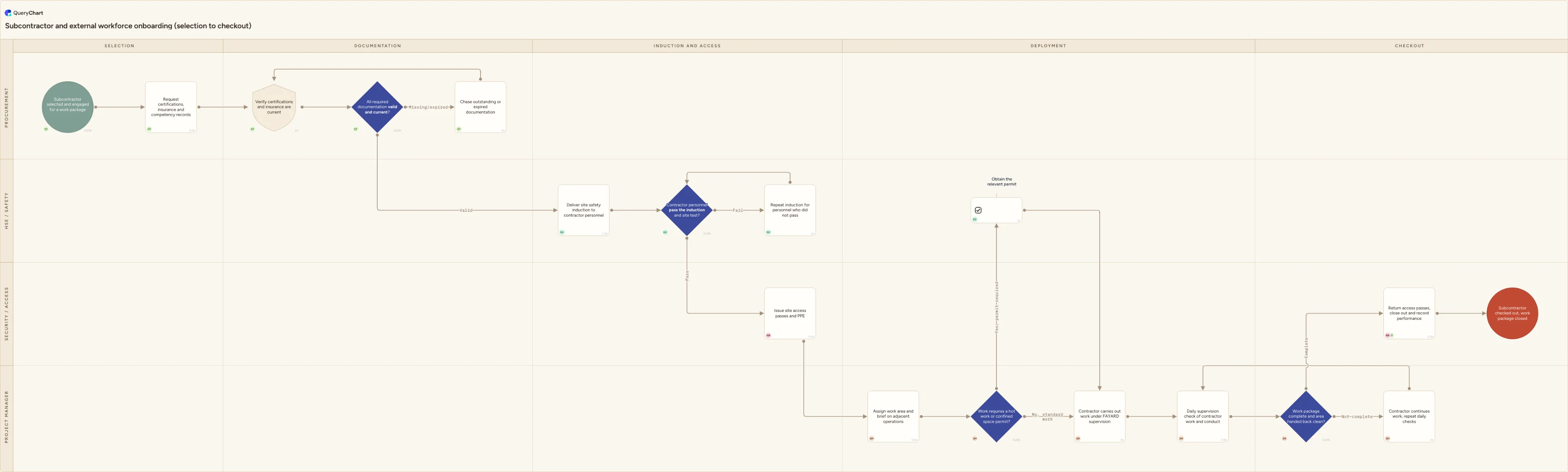
The chart is built around two loops that are allowed to fail, not steps assumed to pass. "All required documentation valid and current?" can return "Missing/expired" and route back through "Chase outstanding or expired documentation" rather than letting an incomplete file drift forward on the promise that the missing certificate will turn up later, a promise that reliably gets forgotten once the crew is already on the berth. "Contractor personnel pass the induction and site test?" works the same way: "Fail" sends the individual, not the whole crew, back through "Repeat induction for personnel who did not pass", so one worker's weak test score does not stall five others who passed. The "Work requires a hot work or confined space permit?" decision sits after work-area assignment rather than before it, because the permit requirement usually only becomes clear once the actual task and location are known, grinding near a fuel line, entering a double-bottom tank, and a permit check run too early gets answered from the work order instead of the berth.
Deployment does not end at "begin work". "Daily supervision check of contractor work and conduct" repeats for as long as the contractor is on site, because PPE compliance, permit adherence and staying inside the assigned work area are conditions that can lapse on day four of a two-week job as easily as day one, and "Work package complete and area handed back clean?" loops back through "Contractor continues work, repeat daily checks" rather than treating supervision as a one-time handover inspection. This template also carries a named person and a workload figure on every row, because a subcontractor onboarding process is inseparable from how much of FAYARD's own staff time it consumes: Grace Talbot in Procurement chases documentation, Daniel Cross in HSE / Safety runs induction and permits, Nathan Reyes in Security / Access issues passes and closes out, and Sarah Mitchell as Project Manager owns deployment and supervision. The workload BI panel reads those hours straight off the People and Workload columns, so a yard onboarding a dozen subcontractor crews in the same month can see where its own coordination time is actually going, not just how many contractors are on site.
What this flowchart covers
In this template
- Two axes of structure: five phases across the top, Selection, Documentation, Induction and access, Deployment and Checkout, crossed with four roles down the side, "Procurement", "HSE / Safety", "Security / Access" and "Project Manager", so the chart shows both what stage the onboarding is at and who owns it.
- The document verification loop: "Request certifications, insurance and competency records" feeds "Verify certifications and insurance are current", which feeds the decision "All required documentation valid and current?", where a Missing/expired result routes to "Chase outstanding or expired documentation" and back into verification rather than letting an incomplete file move forward.
- The safety induction loop: "Deliver site safety induction to contractor personnel" feeds "Contractor personnel pass the induction and site test?", where a Fail result routes to "Repeat induction for personnel who did not pass" before "Issue site access passes and PPE" is reached.
- The permit decision, placed after the work is assigned rather than before it: "Assign work area and brief on adjacent operations" feeds "Work requires a hot work or confined space permit?", and a Yes, permit required branch routes to "Obtain the relevant permit before work starts" before "Contractor carries out work under FAYARD supervision" begins.
- Daily supervision and a completion loop rather than a single handover: "Daily supervision check of contractor work and conduct" repeats for as long as the contractor is on site, and "Work package complete and area handed back clean?" can send the file back through "Contractor continues work, repeat daily checks" on a Not complete result before checkout.
- Checkout and the People/Workload trail: "Return access passes, close out and record performance" closes the "Checkout" lane at "Subcontractor checked out, work package closed", with every row carrying a named owner and a workload figure in hours for the BI panel to roll up.
When to use this template
- A subcontractor crew, welders, riggers, blasters or a hydraulics specialist, is engaged for a dry dock or repair berth work package and needs certifications, insurance and a passed site induction on record before anyone is issued a pass.
- A subcontractor who worked a previous FAYARD job is coming back for a new work package, and their certifications or insurance need re-verifying rather than assumed to still be current from the last engagement.
- You need to show a client, an insurer or a classification society how FAYARD actually controls contractor access, permit-to-work decisions and daily supervision, not just that a sign-in sheet exists.
- A near-miss involving an unpermitted hot work task or a contractor found outside their assigned work area has prompted a review of where the permit decision and the daily conduct check sit in the process.
How it works
Match the lanes to your yard's actual functions
Procurement, HSE / Safety, Security / Access and Project Manager are FAYARD's structure. A smaller yard often folds Security / Access into HSE / Safety, and a yard running its own induction training company should give it a separate lane rather than hiding it inside HSE, because who ran the induction is exactly what an incident review asks first.
Write your own document list and expiry thresholds
"All required documentation valid and current?" needs a stated list, welding qualification, liability insurance, competency card, and a stated expiry window behind it, not the word current on its own. A procurement coordinator working against a written checklist has a defensible decision; one working from memory does not.
Define what triggers the permit branch in your own terms
"Work requires a hot work or confined space permit?" should name FAYARD's actual triggers, grinding or welding near a fuel line, entry into a double-bottom tank or a void space, on the box or its comment, so the decision is answered from the task rather than guessed at from the work order.
Set how many failed inductions are allowed before a worker is pulled
"Repeat induction for personnel who did not pass" loops once in this template. A yard with a strict safety record often caps it at one repeat before removing the worker from the work package entirely, and that limit belongs on the diagram, not in an unwritten rule the HSE trainer has to remember.
Assign real names and hours to the People and Workload columns
Replace Grace Talbot, Daniel Cross, Nathan Reyes and Sarah Mitchell with the people who actually do this work, and set a realistic workload figure per row. The BI panel is only as useful as the hours behind it, and a demo name left in place is the fastest way to make the panel report nobody's real time.
Frequently asked questions
What happens when a subcontractor's documentation is missing or expired?
"All required documentation valid and current?" returns "Missing/expired", which routes to "Chase outstanding or expired documentation" and back into verification rather than letting the file move forward. The loop keeps the crew off the berth until certifications, insurance and competency records are all current, rather than treating an outstanding item as a formality that gets chased later.
Why does the permit decision come after the work area is assigned, not before?
"Work requires a hot work or confined space permit?" sits after "Assign work area and brief on adjacent operations" because the permit requirement is usually only clear once the actual task and location are known. A generic pre-check answered from the work order rather than the berth misses the case where a routine job turns out to sit next to a fuel line or inside a tank once the crew actually gets there.
What if contractor personnel fail the safety induction?
"Contractor personnel pass the induction and site test?" can return "Fail", which routes to "Repeat induction for personnel who did not pass". Only the individuals who failed repeat the induction, not the whole crew, so one worker's result doesn't stall everyone else who passed and is waiting on access passes and PPE.
Why is the daily supervision check repeated instead of a single handover inspection?
"Daily supervision check of contractor work and conduct" runs every day the contractor is on site because PPE compliance, permit adherence and staying inside the assigned area can lapse partway through a job as easily as on day one. The completion decision, "Work package complete and area handed back clean?", loops back through "Contractor continues work, repeat daily checks" rather than assuming a clean handover once the daily checks have started.
How do the People and Workload columns feed the workload BI panel?
Every row carries a named owner, Grace Talbot, Daniel Cross, Nathan Reyes or Sarah Mitchell in this template, and a workload figure in hours. The BI panel sums those hours by lane, by person and by step, so a yard running several subcontractor onboardings in parallel can see where its own coordination time is going rather than only tracking how many contractors are on site.
Where this process fits
In most operations this process follows Ship repair project kickoff SOP: specification to work packages and hands off to Hot work permit SOP: gas test, fire watch, and closure.
It is one step in Ship repair.
Step 2: Dry docking and undocking SOP: block plan to refloat
Step 3: Ship repair project kickoff SOP: specification to work packages
A ship repair project kickoff SOP: specification intake, mechanical/electrical/hydraulic review, PM assignment, work-package breakdown, subcontractor gap-fill, scheduling, and a confirm/revise kickoff before work reaches the workshops.
Step 4: Shipyard subcontractor onboarding SOP: induction to checkout You are here
A shipyard subcontractor onboarding SOP for ship repair yards: document and insurance verification, a pass/fail safety induction, access and PPE issue, a hot work or confined space permit decision, supervised work and checkout.
Step 5: Shipboard repair quality inspection SOP
A shipboard repair quality inspection SOP for ship-repair yards: technician self-check, independent QA/QC inspection, conditional NDT verification, class surveyor sign-off, and customer acceptance before the record is filed and closed out.
Step 6: Vessel repair handover SOP: completion review to departure