Change order approval SOP for a ship repair yard
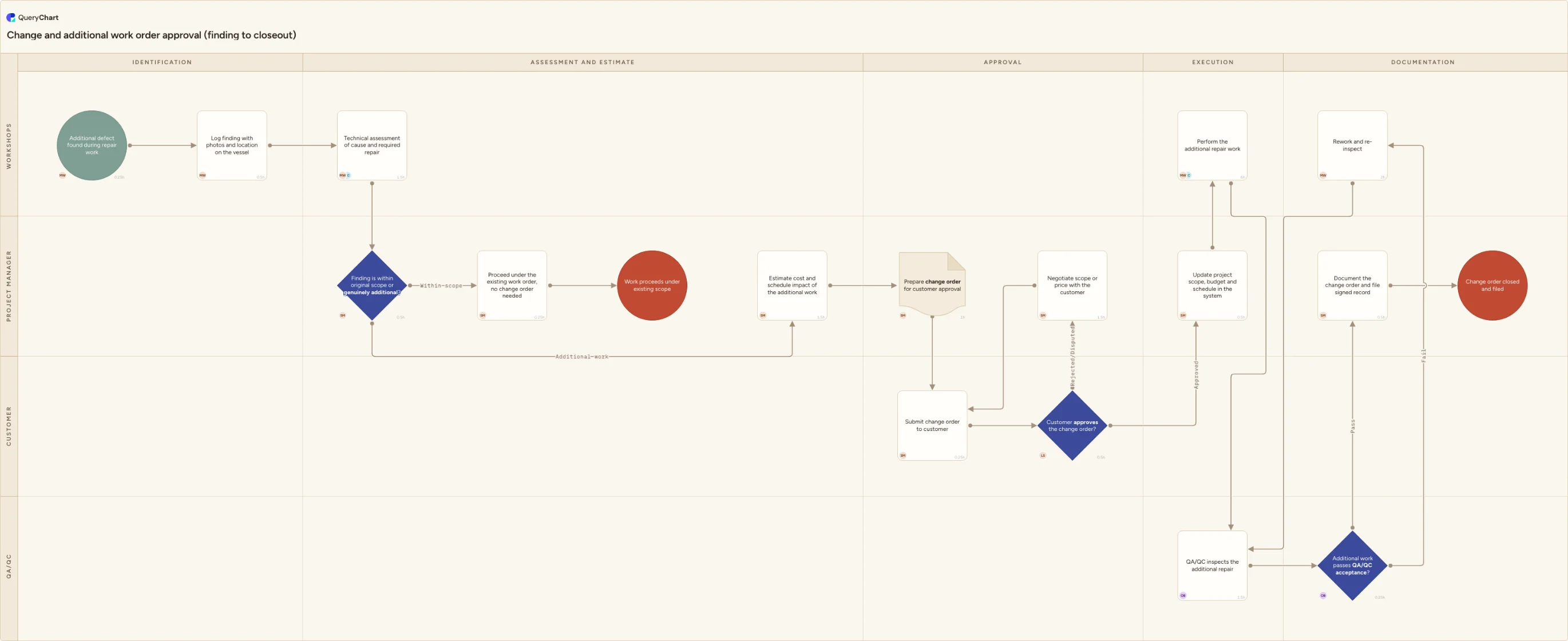
A change order approval SOP for ship repair: a mid-repair finding is assessed against original scope, estimated, submitted to the customer for approval, executed, QA/QC inspected, and filed on closeout.
What the change order approval SOP for a ship repair yard process is
A dry dock always finds more than the specification described. A hull plate that looked sound on the survey turns out to be wasted below the coating once it's blasted, or a shaft seal that was only meant to be inspected has to come out. The operational risk isn't the finding, it's what the workshop does next: if a fitter can start cutting on their own judgment that the extra corrosion is obviously worth fixing, the yard has performed work no one priced, no one scheduled, and no one at the customer has agreed to pay for. This chart exists to put one decision in the way of that instinct, right after the finding is logged and assessed: is this within the original work order, or is it genuinely additional. Everything else in the process only runs for the additional branch.
The second half of the process is where most change-order disputes actually originate, and it's rarely the estimate itself. It's the gap between "the customer was told" and "the customer signed off". This chart makes that gap impossible to skip: a change order has to be prepared and formally submitted, and the customer's answer is a real decision with two branches, not an assumption. Building in a negotiation loop back to resubmission, rather than treating a dispute as a dead end, matters because in ship repair almost every disputed change order gets resolved, not cancelled, and the process should show how it got resolved rather than pretending the dispute never happened.
QA/QC gets its own decision for the same reason: an additional repair that fails inspection is not documentation-ready just because the customer already approved paying for it. The rework loop sends a failed inspection back through re-inspection, not back through the whole repair from scratch, which is a deliberate distinction, since most rework is a correction to the finished job, not a restart. Because every step in this chart also carries a named person and a workload estimate in days, the same diagram doubles as a live resourcing record: Marcus Webb and Ethan Cole's hours on the workshop floor, Sarah Mitchell's hours preparing and negotiating the change order, and Olivia Bennett's inspection hours all roll up into the workload panel, so a project manager can see how much additional-work load is stacked against one person across every change order currently open on the yard, not just this one.
What this flowchart covers
In this template
- Identification: the process starts at "Additional defect found during repair work", and the very next step, "Log finding with photos and location on the vessel", requires photo evidence and a location on the vessel before anyone assesses it, so a verbal report from the workshop floor is never what a customer ends up approving against.
- Assessment and the scope decision: in the "Assessment and estimate" lane, "Technical assessment of cause and required repair" feeds the decision "Finding is within original scope or genuinely additional?" — in-scope work is routed straight to "Proceed under the existing work order, no change order needed" and ends at "Work proceeds under existing scope" without ever reaching a change order.
- Estimating and customer sign-off: only genuinely additional findings reach "Estimate cost and schedule impact of the additional work" and "Prepare change order for customer approval", before the order is "Submit change order to customer" and put to the decision "Customer approves the change order?" — a dispute doesn't end the process, it routes to "Negotiate scope or price with the customer" and loops back to resubmission.
- Execution: an approved change order is never performed on a handshake in this lane — "Update project scope, budget and schedule in the system" commits the new scope and budget first, and only then does "Perform the additional repair work" begin, so the crew that shows up is working against a scope the customer has actually agreed to pay for.
- The QA/QC gate and rework loop: "QA/QC inspects the additional repair" feeds the decision "Additional work passes QA/QC acceptance?", and a failed inspection loops through "Rework and re-inspect" back to the same inspection step, rather than falling through to documentation on a customer approval alone.
- Documentation and closeout: only after inspection passes does "Document the change order and file signed record" run, and the chart ends at "Change order closed and filed" — a distinct terminal from the in-scope ending, so the two ways a finding can close are never conflated in reporting.
When to use this template
- A hull, shaft or hydraulic inspection during a dry-dock repair turns up damage beyond the contracted scope, and the workshop needs a fixed route from finding to priced, approved work before spending another hour on it.
- A project manager needs to show a shipowner's technical superintendent exactly how an additional defect becomes a costed, approved change order, rather than a line item that appears on the final invoice with no paper trail behind it.
- A yard running mechanical, electrical and hydraulic repair crews on the same vessel needs one shared change-order process so a finding from any trade gets the same assessment, estimate and QA/QC discipline.
- A customer disputes a change order after the fact, and the yard needs the negotiation and resubmission loop drawn out to show the dispute was resolved through an agreed route, not worked around under schedule pressure.
- You're onboarding a new project manager or QA/QC inspector who needs one diagram showing at what point they can commit price and schedule, and at what point they can withhold sign-off on quality.
How it works
Match the lanes to your yard's real handoffs
Workshops, Project Manager, QA/QC and Customer map to how FAYARD actually hands this work off. If your yard splits QA and QC into separate functions, or routes customer approval through a broker rather than the owner directly, add that lane rather than folding a real handoff into one that doesn't reflect it.
Put a named person and a realistic workload on every row
Use the People and Workload columns on every step, not only the decisions: "Technical assessment of cause and required repair" carries both the workshop lead and a technical reviewer at 1.5 days, and "Perform the additional repair work" carries 6. Workload here means effort, not elapsed calendar time, so a step that runs over three shifts but only takes a person half a day should be recorded as the half-day.
Write the criteria behind the scope decision
"Finding is within original scope or genuinely additional?" is only a fast, consistent gate if the technical lead has a written standard for what counts as in-scope: what the original specification and drawings covered, what a standard survey should have caught, and what genuinely couldn't have been known before the vessel was opened up. Without that standard, the decision becomes a judgment call that shifts depending on who assesses the finding.
Set a limit on the negotiation loop
"Negotiate scope or price with the customer" can resubmit indefinitely as drawn. Decide how many rounds of negotiation are normal before the change order escalates to a commercial manager or gets formally withdrawn, and note that limit next to the decision, so an unresolved dispute doesn't quietly stall a vessel's undocking.
Check the workload panel before you approve the next change order
Because every row carries an owner and an estimate, the workload BI panel totals live change-order hours per person across every open chart, not just this one. Before signing off on a new change order, check whether the project manager or workshop lead it depends on is already carrying more additional-work hours than the vessel's remaining time in dock allows.
Frequently asked questions
What's the difference between the in-scope path and the additional-work path?
The single decision after the technical assessment, "Finding is within original scope or genuinely additional?", is what splits them. In-scope work proceeds under the existing work order and closes immediately with no change order, no customer approval step and no separate cost record, because the work is already covered by the original contract. Genuinely additional work is the only branch that reaches a change order, an estimate and a customer decision, which keeps the change-order process from being invoked for work that never needed it.
Why does a rejected or disputed change order loop through negotiation instead of just closing?
Because in practice almost no disputed change order in ship repair simply goes away: the customer still needs the repair, and the yard still needs to be paid for finding and assessing it. "Negotiate scope or price with the customer" gives the dispute a real step and a named owner instead of letting it get resolved informally over email, and looping back to resubmission means the final agreed price and scope go through the same formal approval as the original proposal, not a side agreement that never gets filed.
Why does a failed QA/QC inspection loop back to re-inspection and not back to performing the repair?
"Rework and re-inspect" is deliberately one step, feeding back into "QA/QC inspects the additional repair" rather than restarting the whole repair. A failed inspection is normally a correction to work that's largely complete, not evidence the entire job needs redoing, and routing rework through the identical inspection step means the pass/fail record for that repair always reflects the same inspector checking against the same standard, which matters if the vessel's classification society later asks for the inspection trail.
What do the People and Workload columns add to a change order SOP like this one?
They turn the diagram from a description of the process into a live account of who's doing it and how much of their time it's taking. Every step here carries a named person and a workload figure in days, and QueryChart's workload panel rolls those figures up across every open chart, so a project manager can see that, say, the same estimator is carrying change-order hours on three vessels at once before that shows up as a missed customer deadline. A process map with no owners is a description; with People and Workload attached, it's a resourcing tool.
Does this SOP apply outside ship repair?
The shape is common to any project-based repair or contracting business where the scope is only fully known once work has started: heavy equipment overhaul, industrial plant turnarounds, construction remediation. The lane names and the specific decision criteria should change to match the trade, but the underlying discipline, an explicit scope decision, a formal customer approval with a negotiation route, and an inspection gate before closeout, transfers directly.