Project recovery plan Gantt chart template for a late project
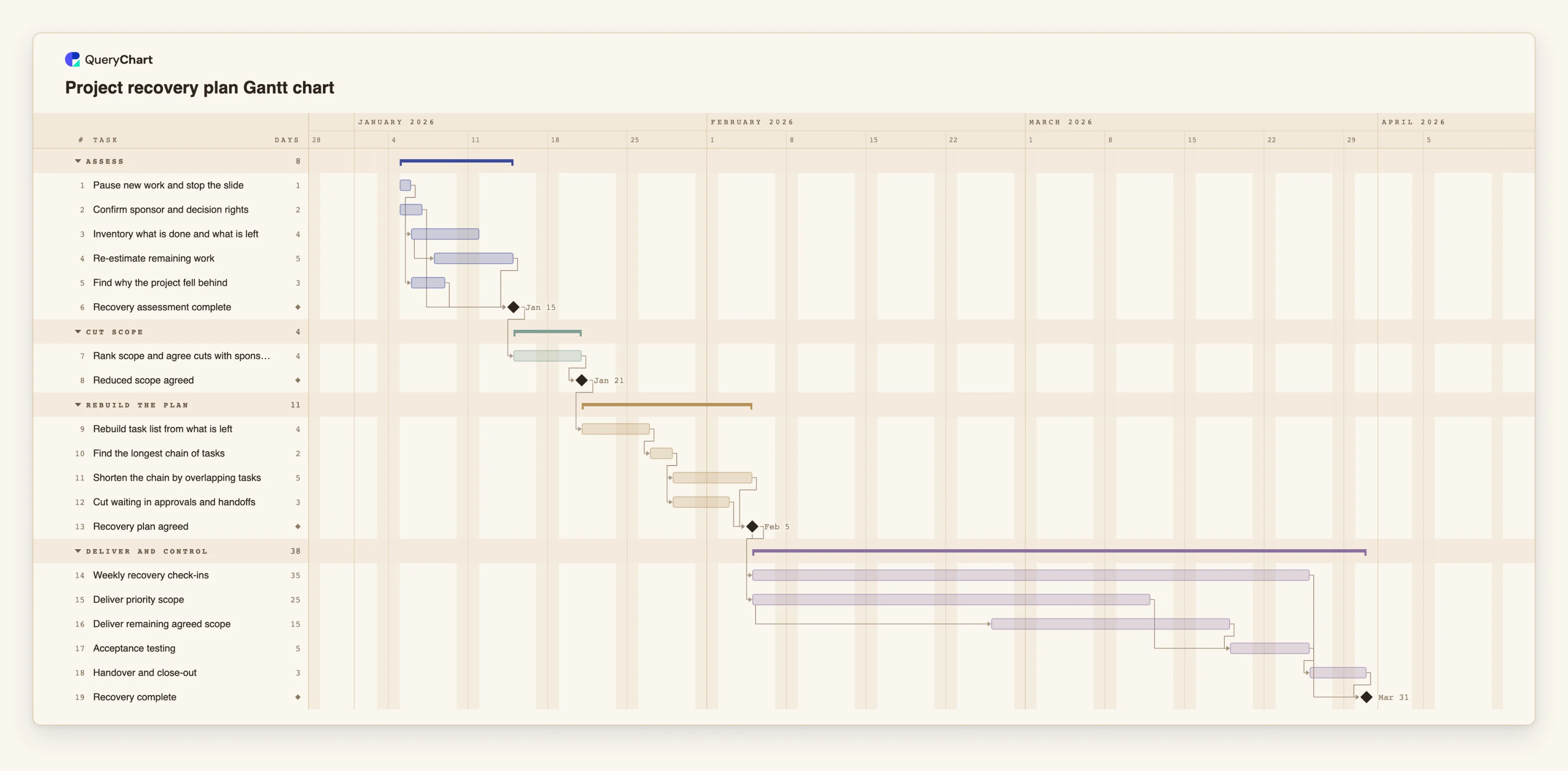
An editable project recovery Gantt chart: assess what is left, cut scope, rebuild the plan from the remaining work, shorten the critical chain and deliver the priority scope first, with dependencies and milestones.
What the project recovery plan gantt chart template for a late project process is
A late project is usually not rescued by editing dates. The original plan describes work that has changed, tasks that are done and tasks that are no longer wanted, and every date in it has already been wrong once. A recovery plan starts again from what is left: the work that remains, the scope you are now willing to deliver, and the longest chain of tasks that still has to run in order. Only then can you see whether the date you need is possible.
This template has four phases: Assess, Cut scope, Rebuild the plan, and Deliver and control. "Pause new work and stop the slide" and "Confirm sponsor and decision rights" start together. "Inventory what is done and what is left" follows the pause, and "Re-estimate remaining work" starts two working days into it, because re-estimating can begin on the parts already inventoried. "Find why the project fell behind" runs beside them. "Recovery assessment complete" is a milestone that waits for the estimates, the cause and the decision rights.
Then comes the cut: "Rank scope and agree cuts with sponsor" leads to the "Reduced scope agreed" milestone. "Rebuild task list from what is left" and "Find the longest chain of tasks" follow, and two tasks work on that chain at the same time: "Shorten the chain by overlapping tasks" and "Cut waiting in approvals and handoffs". "Recovery plan agreed" waits for both. Delivery starts with "Deliver priority scope", and "Deliver remaining agreed scope" starts 15 working days into it, so the less urgent work overlaps the priority work. "Acceptance testing", "Handover and close-out" and the "Recovery complete" milestone follow.
QueryChart has no baseline and does not compare the new plan with the old one, so this chart will not show the size of the slip. If you need the original plan for the record, export a PDF before you change anything. To judge the recovery, compare the finish date in the chart with the date you need. If the chart finishes later, the options are fewer scope or a shorter chain, which is why the scope cut comes before the plan is rebuilt. All durations are illustrative.
For the project as it should have run, see /templates/project-gantt-chart. For the process side, see /templates/project-risk-management-process, /templates/project-change-request-process and /templates/project-governance-process; for closing the project afterwards see /templates/project-closure-process.
What this flowchart covers
In this template
- Four phases, Assess, Cut scope, Rebuild the plan, and Deliver and control, with 19 tasks and four milestones: "Recovery assessment complete", "Reduced scope agreed", "Recovery plan agreed" and "Recovery complete".
- An assessment that overlaps itself: "Re-estimate remaining work" starts two working days after "Inventory what is done and what is left" starts, and "Find why the project fell behind" runs beside both.
- A scope decision before the plan: "Rank scope and agree cuts with sponsor" leads to "Reduced scope agreed", and "Rebuild task list from what is left" waits for it.
- Two ways to shorten the critical chain, started together after "Find the longest chain of tasks": "Shorten the chain by overlapping tasks" and "Cut waiting in approvals and handoffs".
- Delivery in two overlapping pieces: "Deliver priority scope" (25 working days) and "Deliver remaining agreed scope" (15) starting 15 days into it, with "Weekly recovery check-ins" running alongside.
When to use this template
- A project has missed its date and the old plan no longer describes the work that is left.
- You need to show a sponsor what a recovery would take: which scope goes, which chain is longest and when the work could finish.
- You want to see whether a date you have been given is possible once the scope has been cut.
- You are taking over a late project and want to rebuild the plan before committing to a new date.
The plan, task by task
Every task in the chart with its length in working days and what it waits for. A dependency is a step number; SS is start-to-start, FF is finish-to-finish, and +n is a lag in working days.
| # | Task | Group | Working days | Depends on |
|---|---|---|---|---|
| 1 | Pause new work and stop the slide | Assess | 1 | |
| 2 | Confirm sponsor and decision rights | Assess | 2 | |
| 3 | Inventory what is done and what is left | Assess | 4 | 1 |
| 4 | Re-estimate remaining work | Assess | 5 | 3SS+2 |
| 5 | Find why the project fell behind | Assess | 3 | 1 |
| 6 | Recovery assessment complete | Assess | Milestone | 2, 4, 5 |
| 7 | Rank scope and agree cuts with sponsor | Cut scope | 4 | 6 |
| 8 | Reduced scope agreed | Cut scope | Milestone | 7 |
| 9 | Rebuild task list from what is left | Rebuild the plan | 4 | 8 |
| 10 | Find the longest chain of tasks | Rebuild the plan | 2 | 9 |
| 11 | Shorten the chain by overlapping tasks | Rebuild the plan | 5 | 10 |
| 12 | Cut waiting in approvals and handoffs | Rebuild the plan | 3 | 10 |
| 13 | Recovery plan agreed | Rebuild the plan | Milestone | 11, 12 |
| 14 | Weekly recovery check-ins | Deliver and control | 35 | 13SS |
| 15 | Deliver priority scope | Deliver and control | 25 | 13 |
| 16 | Deliver remaining agreed scope | Deliver and control | 15 | 15SS+15 |
| 17 | Acceptance testing | Deliver and control | 5 | 15, 16 |
| 18 | Handover and close-out | Deliver and control | 3 | 17 |
| 19 | Recovery complete | Deliver and control | Milestone | 14, 18 |
How it works
Pause and take stock
Keep "Pause new work and stop the slide" short. The point is to stop starting work, not to stop working. Fill in the inventory with what is done, partly done and not started.
Re-estimate only what is left
Give each remaining task a new length in working days. Do not carry over the old estimates for tasks that have changed. Record the cause of the delay in the notes of "Find why the project fell behind".
Cut scope before you re-plan
Rank what remains by value and agree what goes with the sponsor. Replace the "Reduced scope agreed" milestone with an approval task if the decision needs time.
Find and shorten the longest chain
Switch on the critical path in the View menu after you enter the new tasks. Shorten that chain by overlapping tasks that need not run in order and by removing waiting in approvals and handoffs.
Deliver the priority scope first
Put the work that carries the most value at the start of delivery, and link the rest so that it can start before the priority work is finished where it truly can.
Compare, share and export
Compare the finish date with the date you need, share the chart with the sponsor and export a PDF of the old plan before you change it and the new one when it is agreed.
Frequently asked questions
Does QueryChart show how far behind the project is?
No. There is no baseline or planned versus actual view. Export a PDF of the old plan before you change it if you want a record to compare with.
What if the finish date is still too late?
There are two levers in the chart: cut more scope, or shorten the longest chain. Change those and the date moves. If neither is possible, the date needs to be renegotiated.
Can the chart say whether adding people would help?
No. QueryChart does not model resources or workloads. It shows the dependencies and the length of each task, so you can judge which tasks could be split or done at the same time.
Why re-estimate before cutting scope?
The re-estimates tell the sponsor what the remaining work costs in time, which is what the scope cut is decided against. In the template the assessment finishes first.
Can I use this for a program or portfolio?
The pattern works for one project at a time. For a general plan start from /templates/project-gantt-chart, and for approvals and changes see /templates/project-change-request-process.