Warehouse Shipping Process
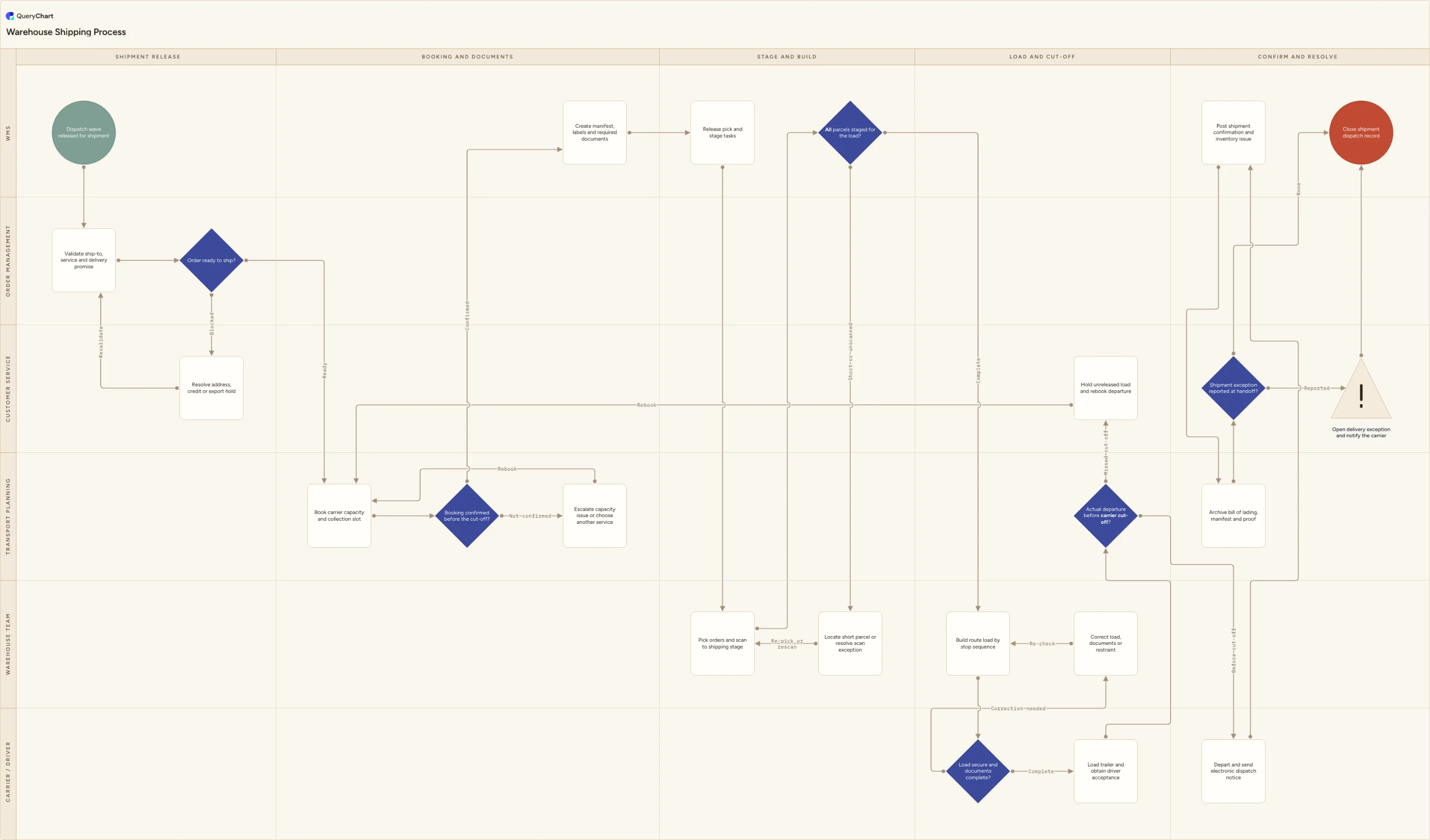
Warehouse shipping process template: validate orders, book capacity, create documents, stage and load freight, manage cut-offs, confirm dispatch and handle exceptions.
What the warehouse shipping process is
Warehouse shipping starts before freight reaches the loading door. The order has to be valid for the promised destination and service, carrier capacity has to be booked before the relevant cut-off, and the manifest, labels and documents must be created from the same shipment data the floor will scan. This template then follows the physical flow through released pick tasks, shipping-stage scans, a complete-load check, route and stop-sequence building, trailer loading and driver acceptance. The final transactions post the inventory issue, send a dispatch notice and retain the bill of lading, manifest and handoff evidence so the shipment can be traced after the truck leaves.
The chart is a warehouse execution process, not a transport-tendering strategy or proof-of-delivery workflow. It owns the operational interfaces with those processes: transport planning confirms capacity, the warehouse confirms staged parcels and secure loading, and customer service resolves a blocked order, missed cut-off or exception reported at handoff. The rework loops prevent common false closures. A missing parcel sends the team back to pick or rescan, incomplete documents send the load back to correction, and a missed departure returns the held freight to a controlled rebooking path. Set the booking lead times, document types, load-restraint checks and notification rules to match your modes, carriers and trading terms.
What this flowchart covers
In this template
- Six swimlanes for order management, transport planning, WMS, warehouse, carrier and customer service from shipment release through confirmed dispatch
- Order validation before booking, including a loop that resolves address, credit or export holds rather than allowing a blocked order into the shipping wave
- Carrier capacity booking and cut-off confirmation followed by manifest, label and required-document creation before pick and stage work starts
- Shipping-stage scans, a complete-load decision, route and stop-sequence build, secure-load and document check, driver acceptance and an actual-departure cut-off gate
- Dispatch notice, shipment confirmation, inventory issue and record archive, with a customer-service route for carrier handoff exceptions before the dispatch record closes
When to use this template
- You are documenting the handoff between order release, transport booking, warehouse loading and customer communication for a multi-carrier operation
- Loads are built before capacity or documentation is confirmed, creating last-minute rework at the door
- Short parcels and unscanned freight are discovered during loading but staff have no consistent route back to pick, scan or rebook work
- Missed carrier cut-offs and driver handoff issues are not recorded consistently, so customers and inventory records disagree about what shipped
How it works
Define shipment readiness
List the checks that make an order ready to ship in your operation, including address validation, credit or compliance holds, service eligibility and any export data. Name the owner who clears each hold and the system status that prevents release while it remains open.
Map carrier booking and cut-off rules
Replace the generic booking step with your carrier portals, collection schedules, booking references and cut-off times. Specify when transport planning may substitute a service and which customer commitment must be updated when it does.
List required shipping documents
Define the manifest, bill of lading, commercial, customs and other documents that apply by route and shipment type. Keep the condition in a controlled system rule or work instruction so a document check does not depend on a loader remembering every destination.
Set the staged-load and acceptance checks
Identify the scan that confirms a parcel is in the shipping stage, the check that confirms every unit is present, the load-restraint standard and what constitutes driver acceptance. Make the location and ownership of an unreleased or missed-cut-off load explicit.
Review recent exceptions
Trace one ordinary departure, one capacity failure, one short parcel and one missed cut-off against the chart. Compare the manifest, WMS shipment confirmation, customer notice and physical freight location; any disagreement identifies the next control to strengthen.
Frequently asked questions
What are the main steps in a warehouse shipping process?
A shipping wave is released after the order, address and service are validated. Transport capacity is booked and confirmed before cut-off, then the WMS creates the labels, manifest and required documents. The warehouse picks and scans freight into the shipping stage, verifies that the load is complete, builds it by route and stop sequence, checks the secure load and documents, and obtains driver acceptance. After departure, the system posts shipment confirmation and inventory issue, sends dispatch information and archives the handoff record.
What should happen when a carrier cut-off is missed?
Treat the freight as an unreleased shipment, keep it in a controlled staging location and route it back to transport planning for a new capacity and departure decision. Customer service should update the affected commitment using the rule your business has agreed, and the WMS should not post the inventory issue as if the load had departed. The important control is that physical freight, carrier booking and shipment status all return to the same state before the load is re-manifested.
Why are shipping-stage scans important?
A shipping-stage scan confirms that the expected unit reached the outbound area and can be included in the load-complete check. Without it, a manifest can show an order as ready while the carton remains in a pick aisle, at a pack bench or in the wrong route cage. The scan gives the team a specific exception to investigate before loading and creates evidence for later handoff or inventory disputes.
Where this process fits
In most operations this process follows Pre-delivery inspection process flowchart (PDI before dispatch) and hands off to Proof of delivery process flowchart (ePOD capture to invoice).
It is one step in Warehouse outbound.
Step 1: Warehouse Replenishment Process
Step 2: Warehouse Order Picking Process
Step 3: Warehouse Packing Process
Warehouse packing process template: verify every picked item, select packaging, add inserts and documents, capture dimensions when needed, label and check parcels.
Step 4: Warehouse Shipping Process You are here
Warehouse shipping process template: validate orders, book capacity, create documents, stage and load freight, manage cut-offs, confirm dispatch and handle exceptions.