Pick-Pack-Ship Process
Pick-pack-ship process template covering order verification, protective packing, carrier-rule handling, weight and address checks, label validation, staging, missed cutoffs, and shipment confirmation.
What the Pick-Pack-Ship process is
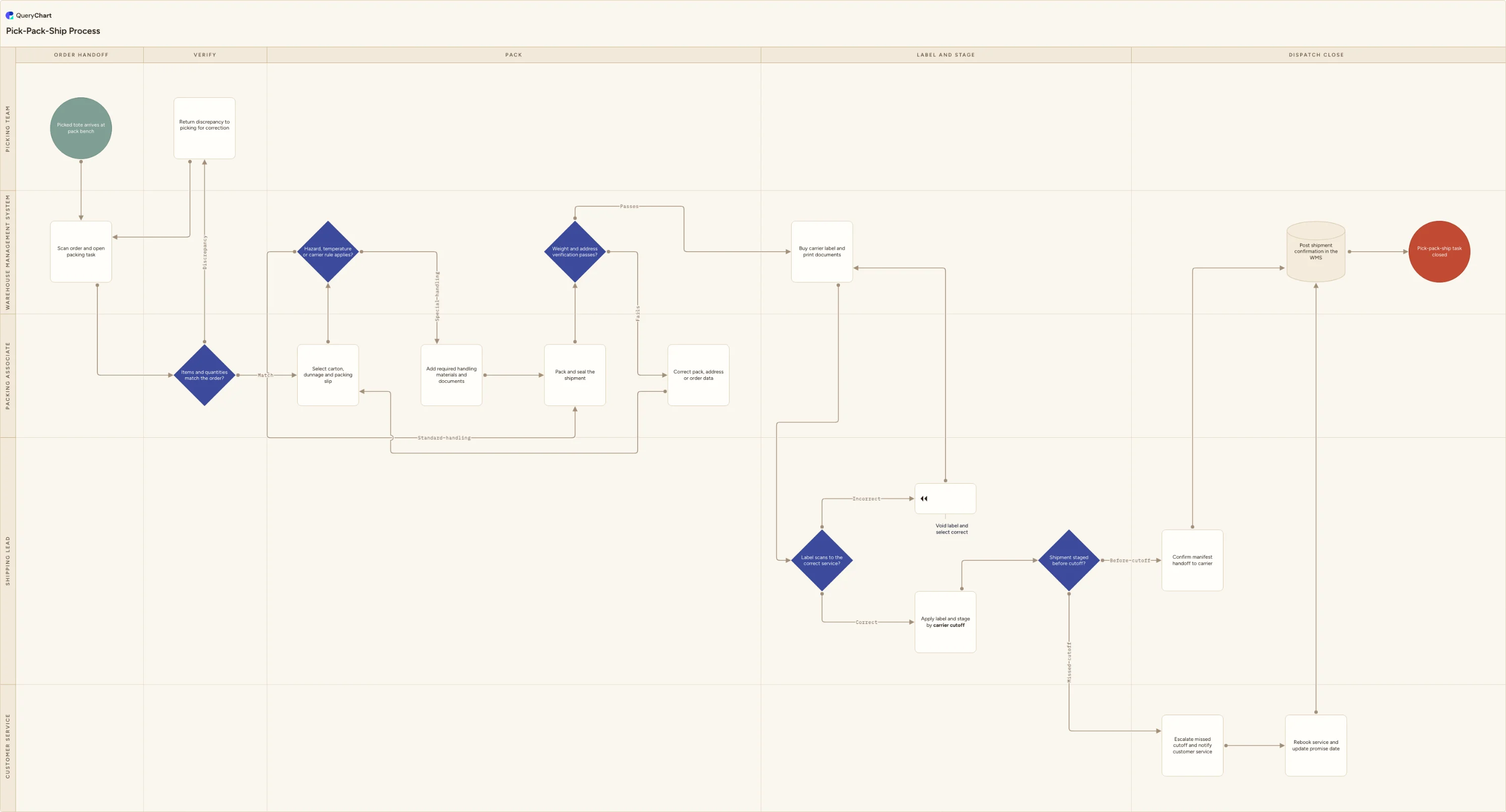
Pick-pack-ship is not simply the act of putting items in a box. It is the last controlled opportunity to catch a wrong item, wrong quantity, wrong address, wrong service or unsuitable packaging before a parcel leaves the warehouse. This template begins when a picked tote reaches the pack bench and the packing task is opened. The packer verifies the order contents, selects the carton, dunnage and packing slip, applies any hazard, temperature or carrier-specific handling requirement, seals the shipment and validates both weight and address before a label is purchased. Each check has a correction loop because a check that cannot fail is only paperwork.
The outbound handoff is equally important. A carrier label can be valid but assigned to the wrong service, and a correctly labelled parcel can still miss the cutoff that made its delivery promise possible. The chart therefore verifies the label scan, stages the parcel by carrier and cutoff, and separates a normal manifest handoff from a missed-cutoff escalation. In either case the WMS posts the shipment confirmation only after the warehouse knows what actually happened. Adapt the lanes and carrier rules to your own operation, but retain the distinction between a parcel that is packed, one that is labelled, and one that has genuinely been handed to the carrier.
What this flowchart covers
In this template
- Five swimlanes for Picking team, Packing associate, Warehouse management system, Shipping lead and Customer service from tote arrival through shipment confirmation.
- An order-content and quantity verification before packing, with a discrepancy loop that returns the tote to picking for correction rather than hiding the difference in packing.
- Carton, dunnage and paperwork selection plus a branch for hazard, temperature or carrier-specific materials and documents.
- Weight and address verification before label purchase, followed by a label-to-service scan that can void and replace an incorrect label before the parcel reaches staging.
- Carrier-cutoff staging, a missed-cutoff escalation and customer-service update, then a final WMS shipment confirmation after the actual outbound outcome is known.
When to use this template
- You are documenting the warehouse sequence after picking and need to separate pack-bench verification, packaging, carrier labelling and dispatch staging into accountable steps.
- Wrong items, wrong addresses, damaged parcels or wrong carrier services are being found by customers rather than at the final warehouse control point.
- You ship products with temperature, hazardous-material, export-document or carrier-specific requirements and need those conditions to change the pack route visibly.
- Missed carrier cutoffs are discovered after the promised dispatch date has passed, with no owner for rebooking service or updating the customer.
How it works
Define the packing verification standard
Set what the packer compares against the order: SKU, quantity, serial number, lot, expiry, personalisation, paperwork and destination. Decide whether a second scan, scale check or visual dual check is needed for higher-value or regulated orders.
Build your packaging rules into the chart
Replace the general carton and dunnage step with your actual pack matrix. Include item fragility, dimensional weight, temperature protection, dangerous-goods marks, tamper seals and documents, and name the source that stays current when a carrier changes its rule.
Set weight and address tolerances
State how much weight variance is acceptable for each order type and which address fields must be validated before label purchase. A tolerance should route a real exception, not let a missing item or wrong service disappear behind a broad packing allowance.
Map carriers and cutoff times
Add the carriers, services, collection points and cutoffs used at your site. Define who may change service after a label fails validation, who can authorise an upgrade, and what customer message is sent when a parcel misses the final collection.
Reconcile manifests to shipment confirmations
At the end of each dispatch window, compare staged and manifested parcels with the WMS confirmations. Investigate a parcel that has a label but no handoff, or a confirmation without a manifest event, before the tracking promise reaches the customer.
Frequently asked questions
What are the steps in a pick-pack-ship process?
A picked tote arrives at the pack bench and the packing task is opened. The contents and quantities are checked against the order, then the packer selects the carton, protective material and paperwork required. Special temperature, hazard or carrier requirements add their own materials and documents. The shipment is packed and sealed, its weight and address are verified, and a carrier label is purchased and scanned against the chosen service. The labelled parcel is staged by carrier cutoff, handed to the carrier or rebooked after a missed cutoff, and the WMS records the confirmed shipment outcome.
Why is a weight check useful after packing?
A weight check is an independent signal that the packed order is plausible. It can reveal a missing item, an extra item, a wrong unit of measure, the wrong carton or an incomplete special-handling pack before a label is finalised. It is not a substitute for item verification, because different items can weigh the same, but paired with a content scan and an address check it provides a practical final control at the pack bench.
What should happen when a parcel misses the carrier cutoff?
The parcel should not be marked as dispatched simply because its label exists. The shipping lead should record the missed cutoff, select or rebook the next viable service, and customer service should update the affected delivery promise when necessary. The WMS shipment confirmation should reflect the actual carrier handoff or revised service event, so tracking, customer communication and warehouse performance reporting describe what happened rather than what was intended.