Warehouse Packing Process
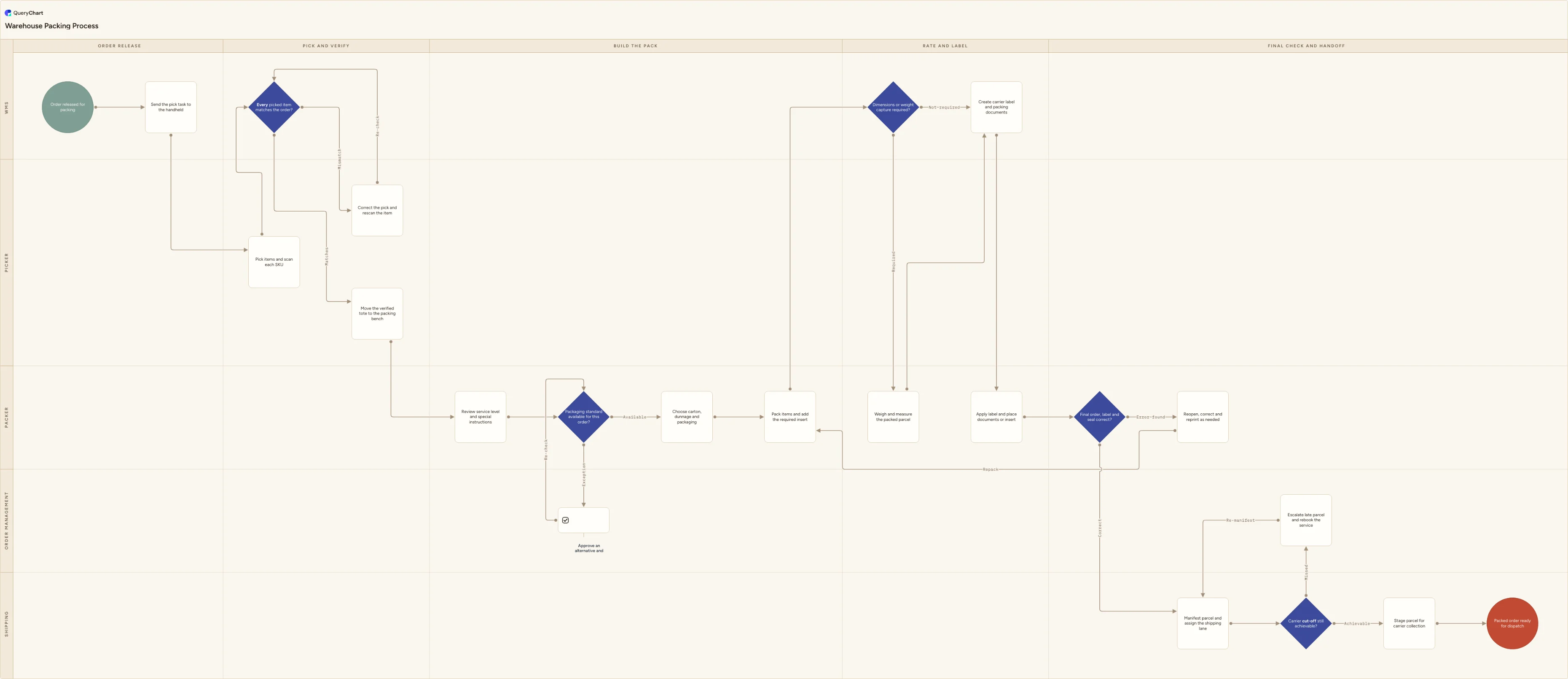
Warehouse packing process template: verify every picked item, select packaging, add inserts and documents, capture dimensions when needed, label and check parcels.
What the warehouse packing process is
Packing is the point where an order becomes a carrier-ready parcel, so it is where item accuracy, protection, service selection and customer-facing documents meet. This template starts with a WMS-released order and a scan-verified pick, not with a tote that simply appears at a bench. The packer reviews the service level and special instructions, chooses the appropriate carton and dunnage, packs the items and adds the required insert. Where the carrier or service requires it, the parcel is weighed and measured before the WMS produces the label and packing documents. The final check deliberately compares the physical order, label and seal together before manifesting the parcel and moving it to the carrier collection lane.
This is not a general picking process and it is not a carrier booking process. Picking ends after every SKU is verified and the tote is transferred to the bench; carrier rate-card setup and collection capacity are inputs that determine the service and label. The chart does own packing exceptions: a wrong pick is corrected before the tote progresses, an unavailable packaging standard is formally substituted, a failed final check reopens and repacks the parcel, and a missed cut-off is escalated and re-manifested instead of being silently left in the wrong cage. Adapt the approved packaging rules, inserts, dimension triggers and final-check responsibility to your product, carrier contracts and customer commitments.
What this flowchart covers
In this template
- Five swimlanes for order management, WMS, picking, packing and shipping across order release, pick verification, pack build, label creation and final handoff
- An item-level scan check before packing, with a correction and rescan loop that keeps a wrong SKU out of the parcel rather than relying on a visual check at the bench
- Packaging selection based on the order's approved standard, including a controlled alternative path when the required carton, dunnage or protection is unavailable
- Packing of the product with the required insert, conditional dimension and weight capture, and carrier label plus packing-document creation before the label is applied
- A final order, label and seal verification loop followed by manifesting, cut-off handling and staging in the assigned collection lane
When to use this template
- You need a repeatable packing-bench process that prevents the correct pick from leaving in the wrong carton, service or label
- Customer inserts, invoices, return documents or product instructions are inconsistently included because they are not part of the pack sequence
- Your carrier charges or service eligibility depend on actual parcel dimensions and weight, but those measurements are captured only sometimes
- Late parcels are left in a carrier cage after cut-off and customers are not told that their promised shipment date has changed
How it works
Define the final verification rule
State whether the packer, a second checker or a scan station owns final verification. The rule should compare the order contents, destination, service, label and closure of the parcel, not just whether a label printed successfully.
List approved packaging standards
Map product families and order types to carton sizes, dunnage, sealing method and any required protective material. Name who can approve an alternative when stock runs out and require the updated instruction to travel with the order.
Configure inserts and documents
Identify exactly which service, destination, customer or product conditions trigger an insert, packing slip, invoice, return form or other document. Keep the decision in the WMS or a controlled bench instruction so it is not reconstructed from memory.
Set dimension and weight triggers
Define which carriers, services or parcel types need actual dimensions and weight, where the scale and measuring equipment are maintained, and how an implausible result is corrected before a label is bought or printed.
Test the loops with real orders
Run one ordinary parcel, one wrong-SKU correction, one packaging exception and one missed-cut-off order through the chart. Confirm that the WMS status, physical parcel and customer communication all converge after each rework loop.
Frequently asked questions
What are the steps in a warehouse packing process?
A released order is picked and scanned at item level, then transferred to the packing bench after the pick matches the order. The packer reviews service and special requirements, selects the approved packaging, packs the items and adds the required insert or document. The parcel is weighed and measured when required, the carrier label and packing paperwork are created and applied, and a final check confirms the contents, label and seal. The parcel is then manifested and staged for the correct carrier collection.
Why is a final packing check needed after item scanning?
Item scanning verifies what was picked, while the final packing check verifies what will actually travel: the contents, destination label, service, documents and sealed parcel. A tote can be correct at pick confirmation and still be packed into the wrong order, labelled for the wrong address or left open after an insert is added. Keeping both controls catches errors at the stage where they can still be corrected without a customer return or carrier claim.
When should a parcel be weighed and measured?
Capture dimensions and weight whenever the carrier, service, product type or commercial agreement requires actual parcel data. Some operations measure every parcel; others apply the step only to services charged by dimensional weight or to exceptions outside a standard pack profile. The right trigger is the one your carrier setup and billing controls can support reliably. This chart makes that condition visible so a measurement requirement is not left to individual judgement.
Where this process fits
In most operations this process follows Warehouse Order Picking Process and hands off to Warehouse Shipping Process.
It is one step in Warehouse outbound.
Step 1: Warehouse Replenishment Process
Step 2: Warehouse Order Picking Process
Warehouse order picking process template covering SKU, location and lot scans, quantity confirmation, short-stock handling, reserve replenishment, allocation correction, and packing handoff.
Step 3: Warehouse Packing Process You are here
Warehouse packing process template: verify every picked item, select packaging, add inserts and documents, capture dimensions when needed, label and check parcels.
Step 4: Warehouse Shipping Process
Warehouse shipping process template: validate orders, book capacity, create documents, stage and load freight, manage cut-offs, confirm dispatch and handle exceptions.