Pre-delivery inspection process flowchart (PDI before dispatch)
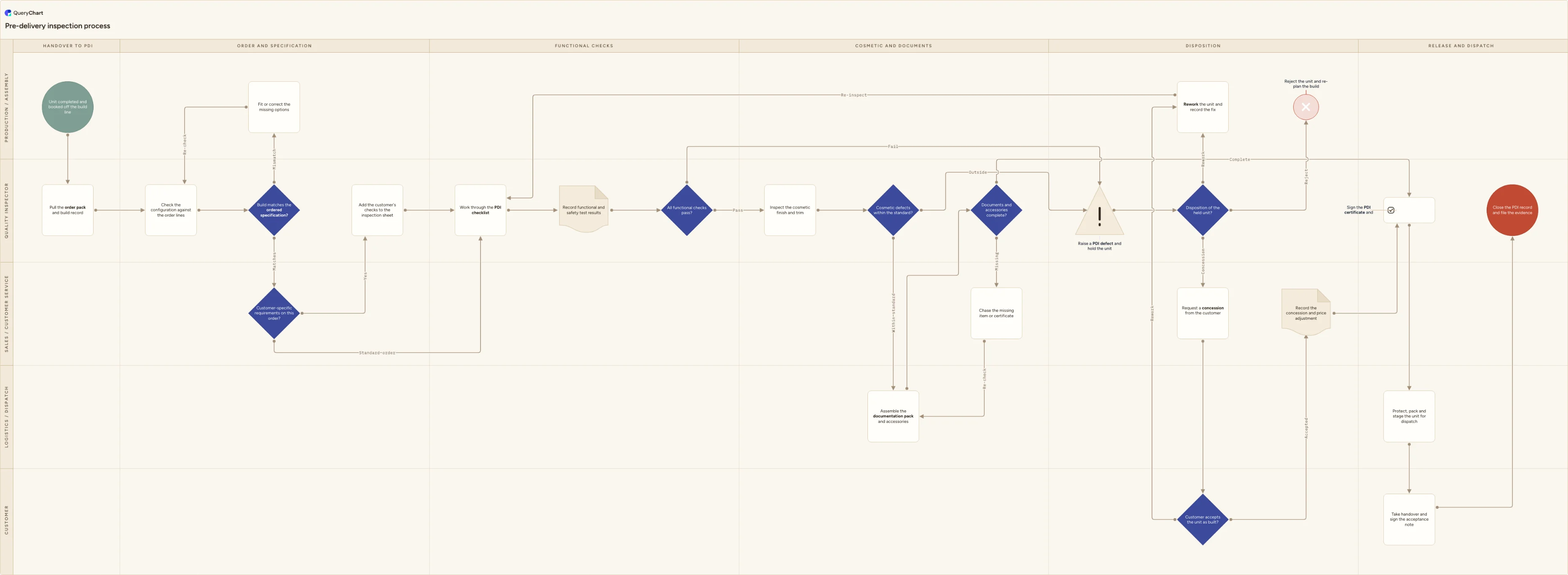
Pre-delivery inspection process flowchart template: order and configuration check, PDI checklist, functional and cosmetic checks, documentation pack, defect disposition and release for dispatch.
What the pre-delivery inspection process flowchart (PDI before dispatch) process is
A pre-delivery inspection is the last look at a finished unit while it is still yours. The trigger is a build or an order that has been completed and booked off the line, and the point of the check is not that the unit was made correctly, because a shop-floor inspection has already answered that. It is that this unit is the one the customer ordered, that it works, that it looks the way a new product should, and that everything which is supposed to travel with it is actually with it. The chart below follows one unit from the moment it comes off the build line to the moment the record is closed: the order pack pulled, the configuration checked against the order lines, any customer-specific requirements added to the inspection sheet, the PDI checklist worked through, functional and safety results recorded, the cosmetic finish inspected, the documentation pack assembled, defects held and dispositioned, the certificate signed, and the unit packed, handed over and accepted.
This is the final gate, not the whole inspection regime. It does not cover the in-process checks made against the control plan while the unit is being built, and it does not cover goods-in inspection of the parts that went into it; those are separate processes with their own sampling rules, their own lanes and their own records. It also stops once the unit is staged and handed over. Route planning, carrier booking, proof of delivery and anything that goes wrong in transit belong to the outbound shipping process, and a fault reported after handover belongs to warranty and complaint handling. That boundary is commercial as well as operational: in the Incoterms 2020 rules published by the International Chamber of Commerce, delivery is tied in all eleven rules to the point at which risk passes from seller to buyer, so a defect found at the gate and the same defect found a day later are very different conversations. Treat the chart as a starting point to adapt under your own procedures, product requirements and competent inspection authority rather than as a compliance document in itself.
Four of the seven decisions carry the process. The specification gate sits in the quality inspector's lane rather than production's, because comparing a unit against the order it was built to is the one check the people who built it are least able to make objectively. The customer-specific question sits with sales, who are the only people who know what was promised beyond the standard specification. The disposition decision chooses between rework, a concession and rejecting the unit back into the build programme, and it is drawn as one decision with three named branches precisely so that nobody makes that call informally on the dispatch bay. The last of the four sits in the customer's own lane, because a concession is not something a supplier grants itself. The release step then puts a name against the unit, which is what turns a completed checklist into evidence.
What this flowchart covers
In this template
- Five swimlanes (Production / assembly, Quality inspector, Logistics / dispatch, Sales / customer service and Customer) across six phases: Handover to PDI, Order and specification, Functional checks, Cosmetic and documents, Disposition, and Release and dispatch.
- The order pack is pulled before anything is tested, and a "Build matches the ordered specification?" decision compares the unit against the order lines, so a correctly built machine of the wrong variant is caught at the gate rather than on the customer's yard.
- A "Customer-specific requirements on this order?" branch in the sales lane, which adds what a standard checklist never asks about (manual language, export packing, special labelling, a witnessed test) to the inspection sheet before the inspection starts.
- Functional and safety results captured as readings rather than ticks, then a cosmetic gate: "Cosmetic defects within the standard?" sends anything outside the written finish standard to the same hold as a failed functional check.
- "Documents and accessories complete?" treats the documentation pack as part of the product, with a chase loop back to the pack step for a missing certificate instead of a unit that ships now and is completed later.
- A "Disposition of the held unit?" decision with three named branches (rework and re-inspect, ask the customer for a concession, or reject the unit back into the build programme) before "Sign the PDI certificate and release the unit" puts a name against the release.
When to use this template
- You are writing a PDI procedure and want the order check, the functional checks, the documentation pack and the release signature in one picture.
- Units are reaching customers with the wrong options fitted, and nobody can say whether the order was ever compared against the finished build.
- Defects found at the gate are being fixed informally on the dispatch bay, so there is no record of what was reworked or who released the unit.
- Manuals, certificates and accessories are being sent on after delivery, and the chase for a missing document has no owner and no deadline.
- A customer, an auditor or a certification body has asked how you verify a finished unit against its order before you release it for dispatch.
How it works
Rename the lanes to your roles
Replace Production / assembly, Quality inspector, Logistics / dispatch, Sales / customer service and Customer with the roles you actually have. In a dealership the inspector and the technician are the same person and the sales lane is the handover executive; in a factory the customer lane is often an agent or a distributor rather than the end user. Merge lanes rather than drawing a handoff that never happens.
Put your real PDI checklist behind the checklist step
The checklist step is a placeholder for your own document. Record which checklist revision applies to which model or variant, who maintains it, and how an engineering change reaches it. Then decide what the checklist asks for at each line: a reading, a photograph, or a pass and fail. A checklist that only offers ticks produces no evidence and nothing to trend.
Define the order check and where its data comes from
State exactly what the unit is compared against: the sales order and its option codes, the build sheet or drawing revision, the serial or chassis number, and any variation agreed after the order was placed. Name the system the inspector reads it from, because an order pack printed three days ago is the usual reason a late change is missed.
Write the cosmetic and functional acceptance criteria
The cosmetic decision only works if a written finish standard sits behind it: viewing distance, lighting, and what size of blemish is acceptable on which surface. Do the same for the functional checks by giving each one a limit rather than an opinion, and say which failures stop the release outright instead of going to disposition.
Agree the disposition rules and who owns each branch
Write down who may authorise rework, who may ask the customer for a concession, and who may reject the unit back into the build programme. ISO 9001:2015 expects a nonconforming output accepted under concession to carry an authorisation, and a record describing the nonconformity, the action taken, any concession obtained and the authority that decided it. Where the requirement is the customer's, the customer has to be told.
List what the documentation pack must contain
Name every item that travels with the unit: instructions, the declaration or certificate of conformity, test and calibration certificates, the warranty registration, the spares list, keys and accessories. Say who assembles the pack and who checks it. What is required depends on the product and the market it is sold into, so build the list from your own product compliance file rather than from this chart.
Walk it against a unit that went wrong
Take two units that have already been delivered, one that went out cleanly and one that came back, and trace both through the chart. The step people describe that is not drawn, and the step that is drawn but quietly skipped when the month-end shipping target is close, are the two findings worth acting on before you publish it.
Frequently asked questions
What are the steps in a pre-delivery inspection process?
The unit is booked off the build line and the inspector pulls the order pack and build record. The configuration is checked against the order lines, and a mismatch goes back to production to be corrected and re-checked. Customer-specific requirements are added to the inspection sheet before the inspection starts. The inspector works through the PDI checklist, records the functional and safety test results, inspects the cosmetic finish against the finish standard, and confirms that the documentation pack and accessories are complete. Any failure raises a defect and holds the unit, and the disposition decides between rework and re-inspection, a concession agreed with the customer, or rejecting the unit back into the build programme. Once the unit is clear, the certificate is signed, the unit is packed and staged, the customer signs the acceptance note and the record is closed.
How is pre-delivery inspection different from in-process and incoming inspection?
They sit at different points and answer different questions. Incoming inspection checks purchased material at goods-in against the purchase order and the inspection plan. In-process inspection checks characteristics against the control plan at a sampling frequency while parts are being made, and a first article inspection proves once that the process makes a conforming part. Pre-delivery inspection is the last of them: it is normally carried out on every unit rather than on a sample, and it is measured against the customer's order as much as against the drawing. Many organisations use the term final inspection for the same gate. The practical difference is scope, because a PDI also covers the commercial and documentation checks (options fitted, manuals, accessories, handover paperwork) that a technical inspection does not.
Who should carry out the PDI, and can the builder sign off their own work?
Someone other than the person who built the unit should carry out and sign the inspection wherever the organisation is large enough to allow it, for the same reason a second pair of eyes finds proofreading errors the writer cannot. ISO 9001:2015 does not name a job title, but it does require that release to the customer does not proceed until the planned arrangements have been satisfactorily completed, unless approved by a relevant authority and, as applicable, by the customer, and it requires documented information on release that gives evidence of conformity with the acceptance criteria and traceability to the person authorising it. That traceability is the practical test: your process should name who is competent to release a unit, and that record should show it was them. In a very small business where separation is impossible, write down the compensating control you use instead.
What should be in the documentation pack that goes with the unit?
Typically the instructions for use, the conformity documents, any test, calibration or material certificates, the warranty registration, a spares or parts list, and the keys and accessories the customer expects to find. Two are commonly confused: a declaration of conformity is the manufacturer's own statement that the product meets the requirements it is placed on the market under, while a certificate of conformity is issued by a third party such as a notified body. As an example of how product-specific this is, machinery placed on the European Union market must be accompanied by instructions for use, and from 20 January 2027 Regulation (EU) 2023/1230 replaces the Machinery Directive and lets the EU declaration of conformity be supplied with the machinery or as an internet address or machine-readable code. Build your own list from the product's compliance file and the contract.
What should happen when a defect is found at pre-delivery inspection?
Hold the unit in a way that actually blocks dispatch, which means a status in the system as well as a label on the machine, then take the disposition as a named decision rather than a conversation at the bay. ISO 9001:2015 sets out the options for a nonconforming output: correction; segregation, containment, return or suspension; informing the customer; and obtaining authorisation for acceptance under concession. It also expects a record that describes the nonconformity, the action taken, any concession obtained and the authority deciding it. In this chart those become rework and re-inspection, a concession the customer is asked for rather than told about, and rejection back into the build programme. Agree the re-inspection scope before the rework starts, because a fix that is signed off in isolation misses what was disturbed to reach it.
Where this process fits
In most operations this process follows Manufacturing quality inspection process flowchart (shop floor) and hands off to Warehouse Shipping Process.
Comes before
- Manufacturing quality inspection process flowchart (shop floor) — Manufacturing quality inspection process flowchart for in-process and final checks: control plan sampling, hold and quarantine, retest, disposition, SPC.
Comes after
- Warehouse Shipping Process — Warehouse shipping process template: validate orders, book capacity, create documents, stage and load freight, manage cut-offs, confirm dispatch and handle exceptions.