Safety inspection process flowchart (EHS hazard inspection)
Safety inspection process flowchart template: risk-based schedule, checklist walk-through, imminent danger stop, hazard rating, hierarchy of controls, action owners, on-site verification and trend review.
What the safety inspection process flowchart (EHS hazard inspection) process is
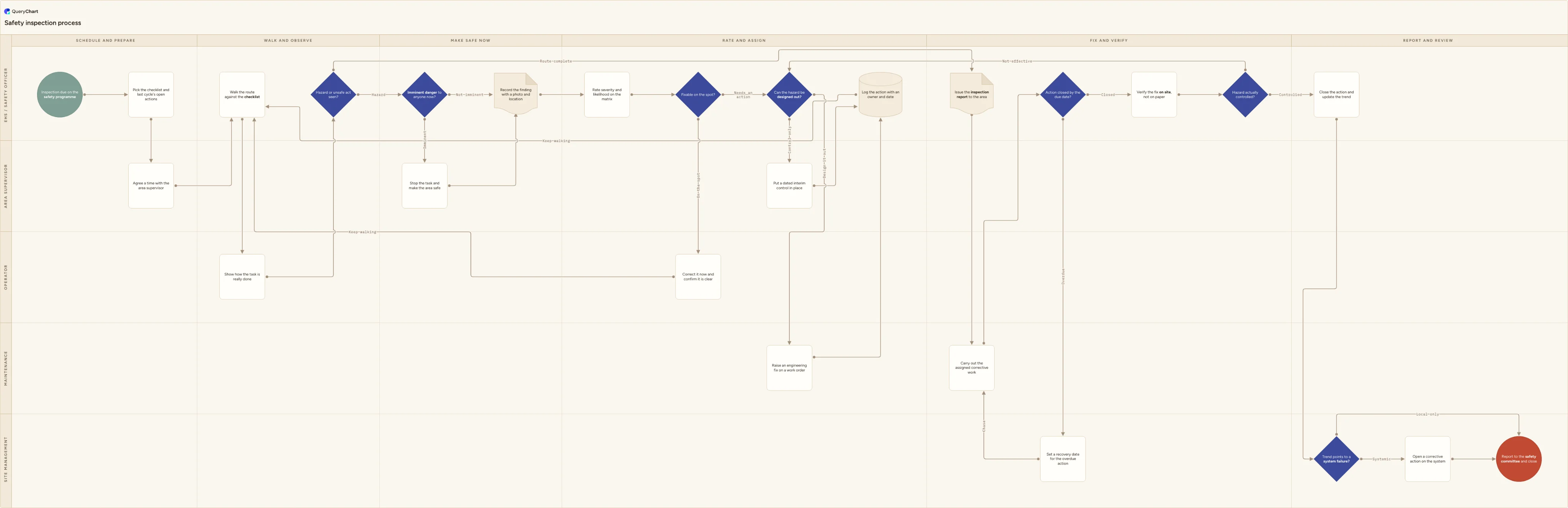
A safety inspection is a planned look at a real area while real work is happening, carried out by someone whose job is safety rather than output. The trigger is a due date on the inspection programme, and the frequency behind that date is a risk judgement: the areas that change most, or that can hurt people worst, are walked most often. The chart below follows one inspection from that due date to the close of the cycle: the checklist chosen for the area and the open actions carried over from last time, the walk itself with the operator explaining how the task really runs, each observation rated and either fixed on the spot or turned into an action with a named owner, the report issued to the area, the work done and then verified on site rather than on paper, and the findings trended for the safety committee.
This is a planned, proactive inspection. Nothing on this chart starts from an injury, a spill or a damaged machine: an event that has already happened belongs to incident reporting and to the investigation that follows it, both of which begin with a report rather than with a schedule. Nor is this the routine housekeeping and condition check that a supervisor and a worker representative run over their own area, which is a wider and lighter sweep by the line; this one is the EHS-led hazard inspection that carries a stop-work branch. The two meet at the action register, where a finding from either route is owned, dated and verified the same way. Treat the chart as a starting point to adapt under your own procedures, your jurisdiction's regulations and competent-person review. It describes a process; it does not make anyone compliant and it does not replace a site-specific safe system of work.
Three decisions carry the process. 'Imminent danger to anyone now?' comes first because it is a decision about time rather than severity, and it sits between the safety officer who raises it and the area supervisor who actually stops the task: the person with the authority to halt production is the person drawn holding it. 'Can the hazard be designed out?' is where the hierarchy of controls enters the chart, routing the finding either to maintenance as an engineering fix or back to the supervisor as a dated interim control, which is what keeps a sign and a briefing from being recorded as a solution. 'Hazard actually controlled?' sits after verification on site, and it loops back to that same design decision when the control did not work, so a closed finding has to survive a second look before the register is allowed to believe it.
What this flowchart covers
In this template
- Five swimlanes (EHS / safety officer, Area supervisor, Operator, Maintenance and Site management) across six phases: schedule and prepare, walk and observe, make safe now, rate and assign, fix and verify, and report and review
- A walking loop rather than a straight line: "Hazard or unsafe act seen?" is asked again at every observation, and both the on-the-spot fix and the logged action return to "Walk the route against the checklist" until the route is complete
- "Imminent danger to anyone now?" kept separate from the risk rating, with a stop-work branch that hands the area supervisor "Stop the task and make the area safe" before anything is written down or scored
- The hierarchy of controls made visible: "Can the hazard be designed out?" splits an engineering fix raised on a work order in the Maintenance lane from a dated interim control in the supervisor's, and both converge on one action record
- Close-out that is chased and then checked: "Action closed by the due date?" sends an overdue action to site management for a recovery date, and "Hazard actually controlled?" loops a control that did not work back to the design decision
- Three records the cycle produces, being the observation with a photo and location, the action logged with an owner and date, and the inspection report issued to the area, feeding a trend the safety committee reads for system failure
When to use this template
- You are writing or rewriting an inspection procedure and need one picture of who walks, who stops the job, who fixes it and who verifies it
- Inspections happen but findings do not close, and you need to see whether the register stalls at the owner, at the due date or at verification
- You are moving from a paper checklist to an EHS app and want the process agreed before hazard categories, risk ratings and action workflows are configured
- Auditors have asked how hazards found during inspections are rated, actioned and closed, and the current answer is a folder of signed checklists
- The same findings keep coming back in the same areas, so the trend review and the system corrective action need to be drawn steps rather than good intentions
How it works
Rename the lanes to your roles
Replace EHS / safety officer, Area supervisor, Operator, Maintenance and Site management with the roles that genuinely exist on your site. On a small site the safety officer and the manager are often the same person: merge those lanes rather than drawing a handoff that never happens, and add a contractor lane if contractors work in the area.
Set the frequency and the trigger list
Write down what decides how often each area is inspected, such as its risk rating, its incident history and how much it changes, and then list the events that pull an inspection forward: new plant, a changed method, a complaint or a regulator's visit. Record the basis on the programme so it survives a change of safety officer.
Define imminent danger in your own words
The stop-work branch is only usable if people agree what triggers it. Write a short test onto the decision, name who may stop a task and who may authorise the spend to restart safely, and say what happens to the rest of the walk while the area is being made safe. Ambiguity here is what turns a stop into a discussion.
Put your own risk matrix on the rating step
Replace the generic rating step with the severity and likelihood scale you already use, and state what each band obliges: which ratings need an interim control the same day, which set a due date in days rather than weeks, and which are reported upward immediately. Two inspectors rating the same hazard differently is the first thing to fix.
Agree the control hierarchy and interim rules
Decide who may accept a control below elimination or engineering, and record that reasoning on the action rather than leaving it in a conversation. Give every interim control an expiry date and a named owner for the permanent fix, so that a barrier and a briefing cannot quietly become the answer for the next two years.
State the close-out and verification rule
Say who may close an action, what evidence a close needs, and whether the person who raised the finding has to see it. Set the escalation route for overdue actions in advance: how many days late, to whom it goes, and what happens on a second miss. Then decide how a failed verification reopens the finding rather than restating it.
Walk it against a real inspection
Take two or three completed inspections, one that went smoothly and one where a finding was stopped, escalated or reopened, and trace them through the chart. Any step people describe that is not drawn, or drawn but skipped in practice, is the finding worth acting on before you publish it.
Frequently asked questions
What are the steps in a safety inspection process?
The inspection falls due on the safety programme, the safety officer picks the checklist for that area and pulls the open actions from the last visit, and a time is agreed with the supervisor so the walk happens while the work is running. On the walk each observation is tested twice: whether it is an imminent danger, which stops the task and makes the area safe first, and then how it rates for severity and likelihood. Anything fixable on the spot is corrected and confirmed there; anything else goes down the hierarchy of controls, either to maintenance as an engineering fix or to the supervisor as a dated interim control, and is logged as an action with an owner and a date. The walk resumes until the route is complete. The report is issued to the area, the work is done and chased if it runs late, the fix is verified on site, and the closed findings are trended for the safety committee.
What is the difference between a safety inspection, an audit and a risk assessment?
An inspection looks at conditions and behaviour in a physical place at a moment in time: is the guard on, is the aisle clear, is the permit displayed, is the job being done the way it was planned. An audit looks at the management system rather than at the workplace, sampling records and interviews to test whether the process people described is the process they actually run. A risk assessment is done before the work, to decide what controls the task needs at all, and it is the document an inspection checks reality against. The three feed each other: an inspection finding that keeps recurring is evidence for the audit, and an inspection that turns up a hazard nobody assessed sends the risk assessment back for revision.
Who should carry out a safety inspection, and how often?
This chart draws an inspection led by someone with a safety remit, walking with the supervisor and with the people doing the job, because both the observation and the rating improve when the person who runs the task is in the conversation. Frequency is a risk decision rather than a fixed number. ISO 45001:2018 leaves it to the organisation, requiring under clause 9.1 that it determine what needs to be monitored and measured, by what methods, and when monitoring is performed and the results analysed. In practice sites set a base interval by area risk and then pull inspections forward on triggers such as new plant, a changed method, an incident or a complaint. Statutory examination and inspection duties for particular equipment and hazards also exist in most jurisdictions and set their own frequencies, so check what applies where you operate.
What should a safety inspection record contain?
Enough that someone who was not there can act on it and, later, tell whether it worked. For each finding: where it was, what was seen, a photograph, the hazard type, the risk rating, and the standard or risk assessment it departs from. For each action: one named owner, a due date driven by the rating, the control chosen and where that control sits in the hierarchy, and whether an interim measure is holding the risk in the meantime. For the close: the evidence, who verified it on site, and the date. The inspection as a whole then carries who walked, when, which checklist version was used, which areas were covered and which open actions were carried forward. Keep the observation and the action as separate records, because an on-the-spot fix produces an observation and no action, while one systemic finding can produce several.
Why do safety inspection findings keep reopening?
Usually because the control chosen was the cheapest available rather than the highest one that would have worked. ISO 45001:2018 sets the order out in clause 8.1.2: eliminate the hazard, substitute something less hazardous, apply engineering controls and reorganise the work, then administrative controls including training, and personal protective equipment last. A finding closed with a sign, a briefing and a promise sits at the bottom of that list, so it depends on everyone remembering forever. The second cause is closure on the owner's word, which lets a register read as complete while the hazard is untouched; that is why this chart verifies on site and loops a failed verification back to the design decision. The third is treating a repeat as an area problem when the same finding in three areas is a design, purchasing, training or scheduling problem.