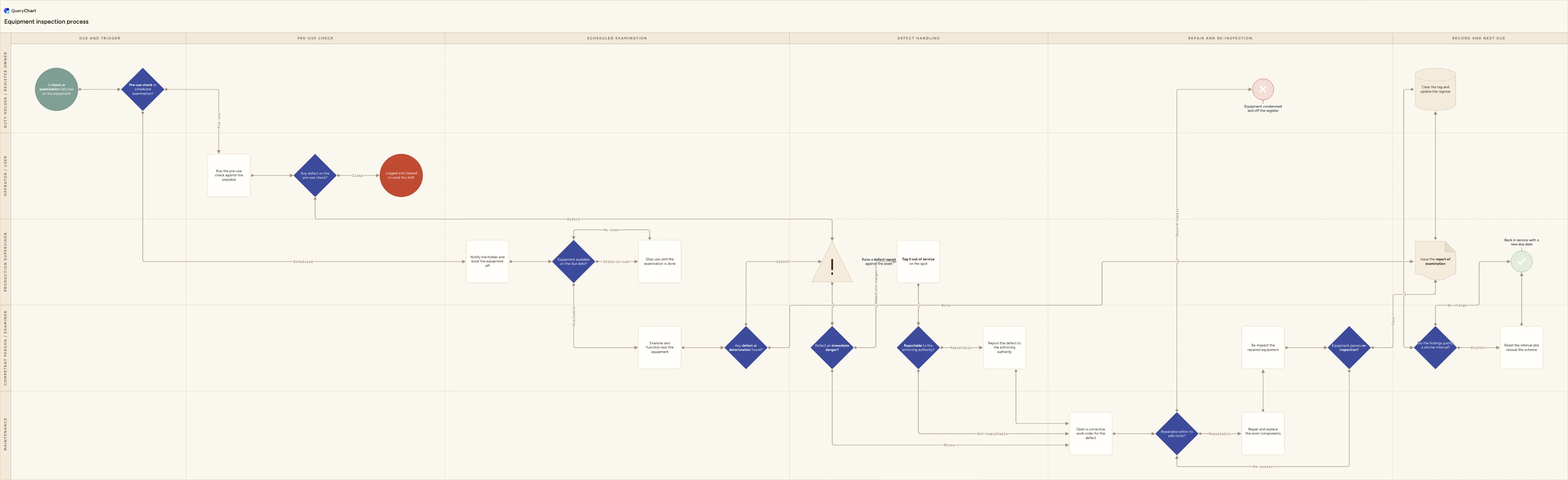
Equipment inspection process flowchart (pre-use to thorough examination)
Equipment inspection process flowchart template: due date from the register, operator pre-use check, examination by a competent person, defect grading, out-of-service tagging, repair, re-inspection and the next due date.
What the equipment inspection process flowchart (pre-use to thorough examination) process is
Inspection is the independent check that equipment is still safe to use, and it is a different duty from maintaining it. Maintenance keeps a machine in good order; inspection is what establishes whether that is actually working, and the two are normally evidenced separately. The trigger here is a check falling due: a shift starting, or a due date on the equipment register, and most assets carry two regimes against them at once: a check the operator makes before use, and a periodic examination by someone competent to detect defects and judge how much they matter. This chart follows one asset through both, from the due date reaching the register owner to a report, a new due date and the equipment back at work. It draws the pre-use check and what the operator is allowed to stop, the examination and its function test, the grading call that either tags the asset out of service on the spot or lets the job finish while a corrective work order is raised, the corrective work order, the re-inspection, and the register update that decides when all of this happens again.
This chart inspects an asset. It does not service one and it does not audit a place. Servicing to a schedule, with its downtime slot, parts kit and handback, is the preventive maintenance process, and this chart hands over to it at the corrective work order rather than absorbing it. Proving that an instrument still reads true, with an as-found value taken before anything is adjusted, is the equipment calibration process: calibration is about measurement, inspection is about condition. A walk of a workplace against a checklist of housekeeping, guarding and access is an area safety inspection, which starts from a location rather than an asset. The boundary matters because the three produce different records under different retention rules, and merging them is how a maintenance log ends up standing in for an inspection nobody carried out. Inspection regimes are set by law, by the manufacturer and by your own risk assessment, and they differ by country and equipment class, so treat this chart as a starting point to adapt under your own procedures and competent-person review.
Four decisions carry the process. "Pre-use check or scheduled examination?" sits at the top because one asset usually has both regimes running against it, and drawing only the periodic one is how a daily check quietly becomes optional. "Equipment available on the due date?" admits the thing every register pretends does not happen, and allows it only two honest answers: re-book the examination, or stop using the equipment until it has been done. "Defect an immediate danger?" is the grading call, and it sits with the competent inspector because judging how much a defect matters is what competence means here — while the act of stopping the job next to it belongs to the supervisor, who is the one who can. "Reportable to the enforcing authority?" sits there too, because under several regimes it is the examiner, not the employer, who carries that duty. The tail closes the loop the way a maintenance programme does: the findings either justify a shorter interval or they do not, and either way somebody records the answer against the asset.
What this flowchart covers
In this template
- Five swimlanes (Duty holder / register owner, Operator / user, Production supervisor, Competent person / examiner and Maintenance) across six phases: Due and trigger, Pre-use check, Scheduled examination, Defect handling, Repair and re-inspection, and Record and next due.
- A "Pre-use check or scheduled examination?" decision at the top, so one chart carries both regimes an asset lives under: the check its operator makes before use, and the periodic examination the register schedules against a legal, manufacturer or risk-based interval.
- "Equipment available on the due date?" with a loop through "Stop use until the examination is done", so an asset that cannot be released is withdrawn and re-booked rather than quietly run on past the date its regime set.
- One defect route for both triggers: "Any defect on the pre-use check?" and "Any defect or deterioration found?" both arrive at "Raise a defect report against the asset", so an operator's finding is not treated as a lesser class of defect.
- The two calls that decide what happens next: "Defect an immediate danger?" sends the asset to "Tag it out of service on the spot" in the supervisor's lane, while "Reportable to the enforcing authority?" sits with the competent inspector who may carry that duty.
- A rework loop closes the repair path: "Repairable within its safe limits?" sends the asset to repair or condemns it, and "Equipment passes re-inspection?" returns a failed re-inspection to that same decision rather than to a second attempt at the same fix.
When to use this template
- You are writing or rewriting an equipment inspection procedure and need the pre-use check, the periodic examination and the defect route in one picture.
- Inspections are signed off on time but defects still reach the shop floor, so you need to see where the grading call is made and who is allowed to stop the job.
- Assets routinely run past their examination date because they are in use, and you want the withdrawal decision drawn rather than left to a chase email.
- An auditor, insurer or enforcing officer has asked how a defect found on inspection travels from the report to a repair, a re-inspection and a record.
- You are configuring an inspection module in a CMMS or EHS system and want the roles, the decisions and the record set agreed before the fields are built.
How it works
Rename the lanes to your roles
Replace Duty holder / register owner, Operator / user, Production supervisor, Competent person / examiner and Maintenance with the roles you really have. On a small site the register owner and the supervisor are often the same person, so merge those lanes rather than drawing a handover nobody makes. Keep the competent person separate from maintenance even when the examination is bought in, because that separation is the point of the lane.
List what is on the register and under which regime
Inspection applies to equipment whose condition can deteriorate into a danger, not to everything on site. Give each asset a class, the regime it sits under, where its interval comes from, who is competent to inspect it and where its last report is filed. Anything not on the register is uncontrolled in practice, and how you drew that boundary is usually the first question asked about it.
Write the pre-use check rule and its stop authority
State what the operator checks, how long it should take and, above all, what they are allowed to do about a defect. A check that ends in report it and carry on turns the checklist into a signature. Decide whether the check is recorded every time or only on exception, and say who reads the exceptions, because an unread defect log is worse than none.
Set the availability and withdrawal rule
Decide how far ahead the due list runs, who notifies the holder and books the equipment off, and what happens when it cannot be released on the day. Name the person who may withdraw an asset from use, and write down that running past a statutory examination date is not a scheduling problem to be caught up later but a reason to stop.
Grade the defects before you need to
Turn the immediate danger call into a written rule with examples from your own equipment, so it is not decided differently by every supervisor on every shift. Agree what an out-of-service tag looks like, who may apply and remove one, how the register is flagged at the same time, and which findings your regime expects the examiner to report to an enforcing authority.
Fix the report contents and the retention rule
List what a report of examination must carry before you accept one: the equipment and its identification number, who examined it and when, what was examined and tested, any defect and how serious it is, and the date the next examination falls due. Then set the retention period from the regime that applies to you, and keep the register as the index that finds it.
Walk it against a real inspection
Take two recent inspections, one that passed and one that found a defect, and trace them through the chart with the operator, the supervisor and whoever examined the asset. Any step people describe that is not drawn, or drawn but skipped in practice, is the finding worth acting on. Correct the chart, then publish that revision and keep the earlier ones.
Frequently asked questions
What are the steps in an equipment inspection process?
A check or examination falls due — a shift starting, or a due date on the equipment register — and the chart splits: the operator's pre-use check, or the periodic examination. A clean check is logged and the equipment goes to work; a defect joins the same route as an examination finding. On the scheduled path the asset is booked off, and one that cannot be released is withdrawn and re-booked rather than run on. The competent inspector examines and function-tests it, and grades any defect; an immediate danger is tagged out of service by the supervisor, a minor defect goes straight to a corrective work order. Where the regime requires it, the inspector notifies the enforcing authority. The asset is condemned and taken off the register, or repaired and re-inspected. The report is then issued, the tag cleared, the register updated and the equipment returned with a new due date.
What is the difference between inspection and maintenance?
They are separate duties producing separate evidence. Maintenance is the work that keeps equipment in an efficient state, in efficient working order and in good repair — the wording of the Provision and Use of Work Equipment Regulations 1998 in Great Britain; it describes a state to reach, not a method. Inspection is the independent check that the maintenance is working: under the same regulations, equipment whose safety depends on how it is installed must be inspected after installation and before first use, and equipment exposed to deteriorating conditions must be inspected at suitable intervals by a competent person, with the result recorded. The distinction bites at audit: a maintenance log alone proves work was done, not whether the equipment is still safe. That is why this chart keeps the corrective work order in the maintenance lane and the examination in the inspector's.
Who counts as a competent person for an equipment inspection?
Competence is about the equipment, not the job title. The usual formulation is that the person has enough practical and theoretical knowledge and experience of that equipment to detect defects and weaknesses and to judge how much they matter for safety. Guidance from the UK Health and Safety Executive on thorough examination of lifting equipment adds a second requirement that is easy to miss: the examiner should be sufficiently independent and impartial, and ideally not the person who carries out the routine maintenance, since they would otherwise be checking their own work. United States construction crane rules split the idea into two named roles, a competent person for the each-shift inspection and a qualified person for the annual comprehensive one. On a small site independence usually means buying the examination in. Whatever you decide, record how competence was judged.
How often should equipment be inspected?
There is no universal interval, which is why the chart draws the trigger instead of writing a number into the procedure. Frequency comes from three places at once: statute, the manufacturer's instructions, and your own risk assessment of how hard the equipment is worked and what happens if it fails. Statutory regimes then set floors that are not yours to move. In Great Britain, lifting equipment must have a thorough examination at least every six months where it is used to lift people or is a lifting accessory, and at least every twelve months otherwise, unless a competent person has drawn up an examination scheme; pressure systems run to a written scheme instead. In the United States, a powered industrial truck must be examined before being placed in service and at least daily, or after each shift where it runs round the clock. Take your intervals from the regime that applies to you.
What should an inspection record contain and how long is it kept?
Ask two questions of every inspection: what the record has to say, and how long it has to survive. A report of examination should identify the equipment, say who examined it and when, describe what was examined and any test applied, state any defect found and how serious it is, and give the date the next examination falls due. Retention is set by the regime rather than by filing preference. In Great Britain, reports of periodic thorough examination of lifting equipment are kept until the next report is made or for two years, whichever is later; United States construction crane rules keep monthly inspection records for at least three months and annual ones for at least twelve. Set your rule from the regime that applies to you, and keep the register itself as the index, because a report nobody can find against an asset is a report nobody has.