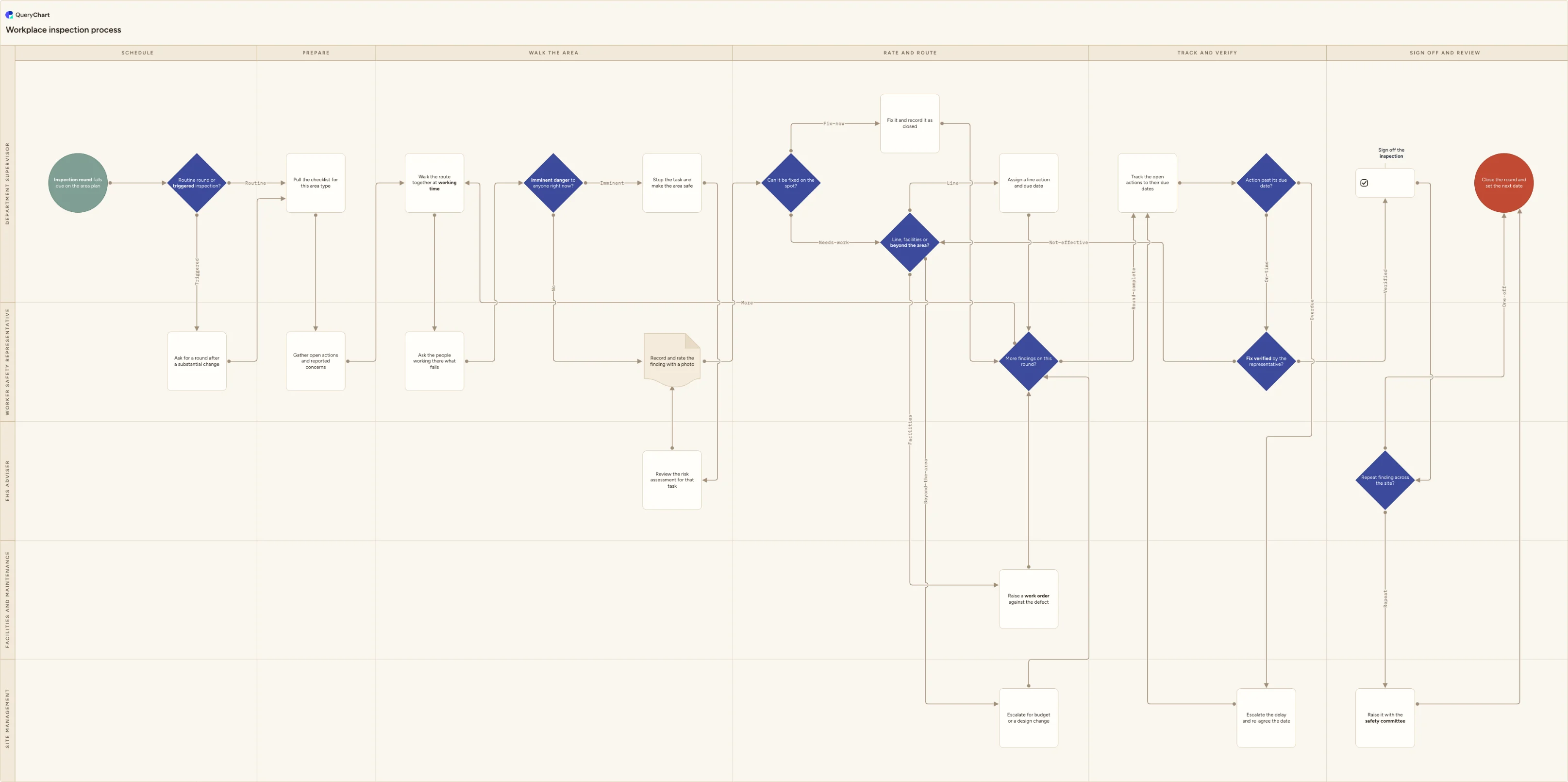
Workplace inspection process flowchart (joint routine round)
Workplace inspection process flowchart template: scheduled round, area checklist, joint walk-through, imminent-danger stop, findings rated and routed to line, facilities or management, action tracking and joint sign-off.
What the workplace inspection process flowchart (joint routine round) process is
A workplace inspection is the routine round the line runs on its own area. A supervisor and a worker safety representative walk the floor together against a checklist, look at the condition of the place and at the way the work is actually being done, and write down what they find. It is planned work rather than a reaction to an accident, and the trigger is a date on the area plan rather than somebody's report. The chart below follows one round end to end: the schedule falling due, the checklist and the previous round's open actions being pulled together, the walk itself, an imminent-danger call taken on the spot, each finding recorded, rated and routed to whoever can actually close it, the actions tracked to their due dates, the fixes verified by the person who raised them, and a signed record that feeds the site's hazard trend.
This is the round the line owns. It is not the EHS-led hazard inspection, which brings a specialist eye and a different checklist to the same area, and it is not the statutory or thorough examination of a machine, a lifting accessory or a pressure system, which needs a competent person and its own register of due dates. It is also not an investigation: if the round finds that something has already gone wrong, that leaves this chart as an incident or near-miss report and comes back as an action. The boundary matters because a joint round that starts absorbing specialist examinations stops happening on cycle, and a round that quietly becomes an investigation loses the coverage it was scheduled for. Inspection duties, the rights of worker representatives and the frequencies that apply to you are set by your own jurisdiction, so treat this chart as a starting point to adapt under your organisation's own procedures, your legal duties and competent advice rather than as a compliant procedure in itself.
Four decisions carry the round. 'Routine round or triggered inspection?' separates the scheduled cycle from the round called after a change in the work, a near miss or new guidance, and it sits at the top because the trigger changes the scope rather than the method. 'Imminent danger to anyone right now?' is deliberately taken during the walk and in the supervisor's lane: it is the one finding that is not written up and rated later, because the work stops first. 'Line, facilities or beyond the area?' is the routing call that decides whether an item can be closed by the team, needs a work order, or needs money and a design change, and getting it wrong is the usual reason inspection actions age. 'Fix verified by the representative?' sits in the representative's lane on purpose, and its failure branch goes back to the routing decision rather than to the same owner, because a control that did not work needs a higher one, not another attempt. That is the ordering ISO 45001 sets out in clause 8.1.2: eliminate, substitute, engineer, then administrative controls, then protective equipment.
What this flowchart covers
In this template
- Five swimlanes (Department supervisor, Worker safety representative, Facilities and maintenance, EHS adviser and Site management) across six phases: schedule, prepare, walk the area, rate and route, track and verify, and sign off and review
- A "Routine round or triggered inspection?" decision at the top, so one chart covers both the scheduled cycle and the round a representative asks for after a change in the work, a near miss or newly published guidance
- An imminent-danger branch taken during the walk rather than afterwards: "Stop the task and make the area safe" happens on the spot, and the EHS adviser reviews the risk assessment for that task before anything is written up
- Every finding recorded and rated with a photograph before it is routed, then a three-way "Line, facilities or beyond the area?" decision sending it to the team, to a work order in the maintenance backlog, or up for budget and a design change
- A "More findings on this round?" loop back to the walk, so the chart can follow one finding through recording, rating and routing without pretending a round produces only one
- Closure on evidence, not assertion: actions tracked to their due dates with an overdue escalation, a "Fix verified by the representative?" check whose failure branch re-routes rather than re-assigns, a joint sign-off, and a "Repeat finding across the site?" decision that lifts recurring themes upwards
When to use this template
- You are setting up monthly or quarterly rounds and need one picture of who walks, who records, who fixes and who signs the record
- Inspection findings are being raised but not closed, and you need to see whether they stall at the routing, the owner or the due date
- Supervisors and worker representatives disagree about what counts as a finding, so the rating and the routing have to be made explicit
- You are moving paper inspection sheets into a checklist app and want the process agreed before the forms, ratings and action lists are configured
- An auditor, an insurer or your safety committee has asked how routine workplace inspections are planned, recorded and followed up
How it works
Rename the lanes to your roles
Replace Department supervisor, Worker safety representative, Facilities and maintenance, EHS adviser and Site management with the roles you actually have. On a small site the supervisor and the EHS adviser are often the same person: merge those lanes rather than drawing a handoff that never happens, and add a contractor lane if contractors work in the area.
Set the schedule and the coverage rule
Write down how often each area is walked and how the areas add up to full coverage over a year. High-risk areas usually earn a shorter cycle than offices or stores. Note who may call an extra round outside the cycle and on what grounds, because that rule is what turns the second branch of the first decision into something people actually use.
Attach your checklists to the area types
One checklist per area type beats one for the whole site. Housekeeping, access and egress, guarding, electrical, chemicals, manual handling and welfare rarely all apply to the same room. Keep each line specific enough to be answered while standing in front of it, and leave room for the findings the checklist did not anticipate.
Define imminent danger and who may stop work
State plainly what obliges the pair to stop a task rather than write it down, who holds the authority to stop it, who is told, and how the area is made safe in the meantime. Then say what happens next: an isolation, a barrier, a re-briefed method, or a review of the risk assessment before the task is allowed to restart.
Write your rating scale onto the finding row
Put your own risk categories and the response time each one buys onto the record-and-rate step, treating anything already on the chart as a placeholder until your matrix is agreed. Rate for the harm that could result rather than the harm that did, and agree the rating on the walk, because a rating argued a week later from two different memories is never agreed.
Set the routing and the escalation rule
Decide what the line may close itself, what has to become a work order, and what has to go above the area for budget or a design change. Name the maintenance queue the work order joins and the forum an escalation reaches. Then set what happens to a late action: who is told, who re-agrees the date, and how many times a date may move.
Walk it against a real round
Take two completed inspection records, one that closed cleanly and one whose actions are still open, and trace them through the chart. Any step people describe that is not drawn, or drawn but skipped in practice, is the finding worth acting on before you publish it. Do that walk-through with a worker representative in the room.
Frequently asked questions
What are the steps in a workplace inspection process?
A round falls due on the area plan, or is called early after a substantial change in the work, a near miss or new guidance. The supervisor pulls the checklist for that area type and the representative gathers the open actions and the concerns raised since. The pair walk the route together while the work is running, and ask the people doing it what fails. Anything putting someone in immediate danger stops the task on the spot and sends the risk assessment for review. Every other finding is recorded and rated with a photograph, then either fixed there and then or routed to a line action, a work order or an escalation for budget and design. Once the walk is done the actions are tracked to their due dates, chased when they run late, and verified by the person who raised them. The record is signed by both, recurring themes go to the safety committee, and the next date is set.
What is the difference between a workplace inspection and a safety inspection?
The terms overlap in practice, and the useful distinction is who runs it and what is being looked at. A workplace inspection is the broad routine round the line owns: the whole area, condition and behaviour together, walked by the supervisor with a worker representative on a set cycle. A safety inspection is narrower and specialist, run by an EHS professional against a particular hazard, activity or standard, and it complements the routine round rather than replacing it. Both differ from an audit, which samples records to test whether the management system works rather than looking at the place itself, and from a statutory examination, which is a competent person's assessment of a specific machine, lifting accessory or pressure system on its own interval. Settle which of these your chart describes first, because the checklist, the competence required and the record all follow from it.
Who should carry out a workplace inspection?
The supervisor who owns the area and a worker safety representative, walking together. The supervisor can commit the area to actions; the representative brings what the team has raised and gives the round its independence, and that pairing is what makes a round joint rather than reported. Worker consultation and participation are explicit requirements of ISO 45001:2018 clause 5.4, and OSHA's Recommended Practices for Safety and Health Programs likewise advise putting workers on the inspection team and talking to them about the hazards they see. Some jurisdictions give representatives inspection rights directly: in Great Britain, regulation 5 of the Safety Representatives and Safety Committees Regulations 1977 entitles appointed safety representatives to inspect the workplace after giving reasonable written notice. Check what applies where you are.
How often should workplace inspections be carried out?
There is no single universal interval, so set the cycle from risk and from whatever your jurisdiction requires, and treat any frequency shown on the chart as a placeholder. Risk is the main driver: a busy warehouse, a workshop or a construction site earns a much shorter cycle than a quiet office. In federally regulated Canadian workplaces, section 135(7)(k) of the Canada Labour Code requires the work place committee to inspect all or part of the workplace each month, so that every part is inspected at least once a year. In Great Britain, appointed safety representatives are entitled to a formal inspection once in any three-month period, and sooner if conditions of work have changed substantially or relevant new guidance has been published. In United States construction, 29 CFR 1926.20(b)(2) requires frequent and regular inspections by competent persons without naming an interval.
What records should a workplace inspection leave behind?
The completed checklist for the area and the date it was walked, a findings list where each entry names its exact location, what is wrong and the risk rating agreed on the walk, a photograph where one helps, and for each finding an owner, a due date and the route taken: closed on the spot, line action, work order or escalation. Then the evidence of closure, the verification by whoever raised the item, and both signatures on the record. That set is what an inspector, an insurer or a certification auditor asks to see, and it is the raw material for the trend: the same finding in four areas is a system problem rather than four local ones. ISO 45001:2018 treats this as two connected duties, monitoring and measurement under clause 9.1 and corrective action under clause 10.2, so a findings list with no closure evidence tends to be read as an incomplete process rather than a tidy one.